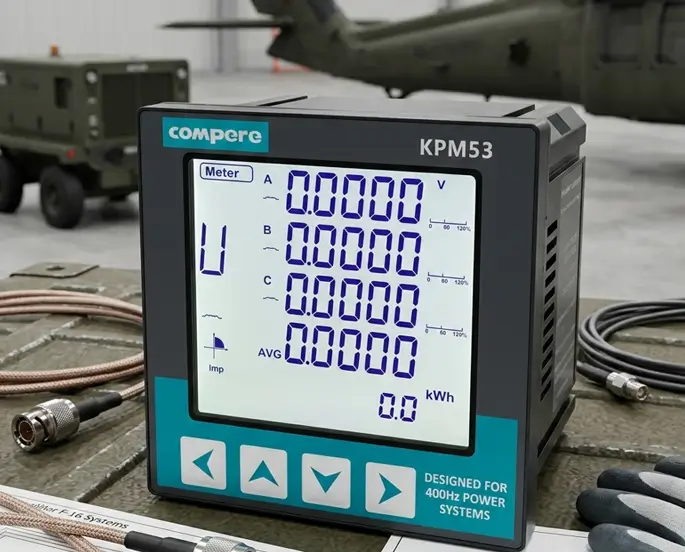
Most people are familiar with the standard frequency of power systems as 50Hz or 60Hz. However, in aerospace, military, marine, and high-performance computing fields, 400Hz power systems are the true “unsung heroes.” Dedicated 400Hz power meters are essential to ensure the stable operation of these sophisticated systems.
Why Do These Industries Prefer 400Hz?
Before delving into electricity meters, we need to understand why these specific fields don’t use ordinary frequencies.
Ultimate Lightweight Design: According to the law of electromagnetic induction, the higher the frequency, the smaller the core and windings required for transformers and motors. For aircraft, using 400Hz can significantly reduce fuselage weight, thereby significantly improving fuel efficiency.
Smoother Power Output: Higher frequencies mean shorter voltage fluctuation periods. After rectification, it provides smoother DC power with less ripple for precision electronic equipment.
The Fundamental Difference Between a 400Hz power meter and a Regular Electricity Meter
You cannot simply connect a household electricity meter to a 400Hz system. Because regular electricity meters are designed for low-frequency environments, using them in high-frequency environments will lead to the following serious problems:
Iron Loss and Overheating: Magnetic components generate huge eddy current losses at high frequencies, causing the meter to overheat rapidly and even burn out.
Measurement Distortion: The sampling frequency of regular meters is insufficient to accurately capture high-frequency waveforms, resulting in huge deviations in voltage and current readings.
The Core Advantages of a Dedicated 400Hz Power Meter:
Ultra-High Sampling Rate: Capable of accurately capturing 400 cycle changes per second, ensuring absolute accuracy in power factor and energy measurement.
Interference Resistance and Shielding: High-frequency environments are prone to electromagnetic interference (EMI), and dedicated meters feature enhanced shielding designs for the casing and circuitry.
Harmonic Analysis Function: Typically integrates Total Harmonic Distortion (THD) monitoring, which is crucial for assessing the health of avionics equipment.
Key Application Areas Detailed
1. Aerospace Ground Support
In airport runways or hangars, ground power vehicles (GPUs) must output a stable 400Hz power supply to aircraft. 400Hz meters are used to monitor the output quality of these power supplies in real time, preventing fluctuations from damaging onboard equipment.
2. Military and Defense Systems
Radar arrays, missile launchers, and modern warships typically operate high-frequency power grids. Dedicated meters ensure accurate power data feedback for these high-value weapon systems even in extreme environments.
Purchase Recommendations: How to Evaluate a 400Hz Meter?
When integrating meters into your project, pay close attention to the following technical details:
Frequency Response Range: Ideally, the meter should stably cover a fluctuation range of 360Hz to 440Hz.
Accuracy Class: Aerospace applications typically require an accuracy of 0.2 or 0.5 class.
Transient Recording: Does it have the ability to capture instantaneous voltage spikes?
Digital Communication: Does it support RS485 or Modbus RTU interfaces for data integration into automation control platforms?
Summary
A 400Hz power meter is more than just an instrument displaying numbers; it’s a “stethoscope” for the safe operation of high-frequency power systems. With the trends of more electric aircraft and increasingly sophisticated industrial processes, this highly specialized monitoring equipment will play an increasingly important role.