B2B BUYER NOTICE:
Compere is a professional, industrial-grade Smart Meter Manufacturer & OEM/ODM Supplier.
-
No Personal Utility/Retail Services: We DO NOT manage personal electricity bills, top-ups, or single retail sales for individual households.
-
Paid Samples Supported: If you are a utility company, project contractor, or distributor, we gladly support 1-unit paid sample orders for your technical evaluation, prototyping, and software integration testing.
-
To transition into bulk sourcing or request a test sample, please view our Smart Meter Product Catalog or Consult Our Engineers for Samples.
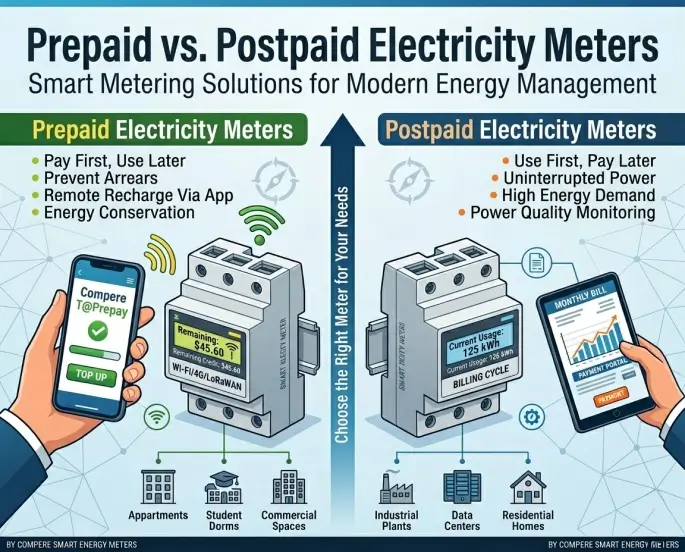
With the development of Internet of Things (IoT) technology, electricity meters are no longer just billing tools, but rather terminals for energy management. Whether you are a landlord, property manager, system integrator, or factory seeking to reduce costs and increase efficiency, understanding the fundamental differences between prepaid and postpaid electricity meters is crucial.
1.Technical Specifications & Features: Prepaid vs. Postpaid Meters for Commercial Deployment
| Type | Payment Method | Usage Characteristics |
|---|---|---|
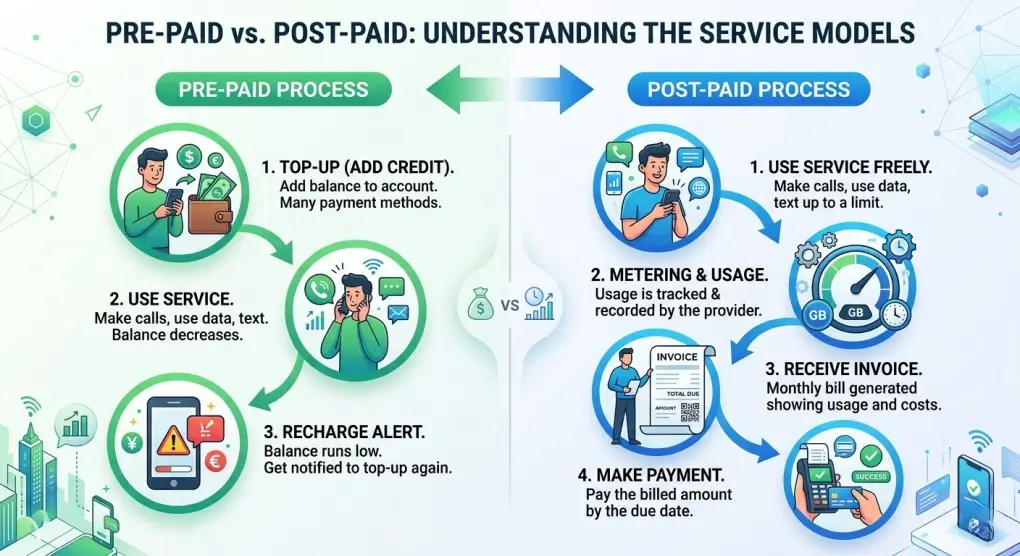
| Prepaid Electricity Meter | Pay first, use later (like mobile phone top-up) | User tops up the meter in advance. The meter shows remaining electricity. When electricity runs out, recharge is needed. |
| Postpaid Electricity Meter | Use first, pay later (traditional method) | User consumes electricity first. The meter records usage and bills are issued at the end of the month or billing cycle. |
Modern Prepaid Electricity Meters No Longer Rely On Physical IC Cards
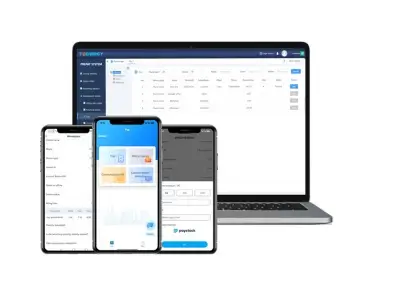
Modern prepaid electricity meters have been fully upgraded to 4G/Wi-Fi/LoRaWAN remote wireless recharge. Users can recharge simply through a mobile app or web browser, and the system automatically sends commands to connect or disconnect the power supply, completely eliminating the hassle of losing IC cards.
Our smart prepaid electricity meters use standard DIN rail mounting, are compact in size, and can be directly installed on the rail inside the distribution box without the need to drill holes in the distribution door, greatly reducing construction costs.
2.Detailed Comparison Charts Of Prepaid And Postpaid Electricity Meters
| Feature | Prepaid | Postpaid |
|---|---|---|
| Usage Control | Easy to control, prevents overspending | Hard to control, may lead to unpaid bills |
| Payment Timing | Pay first, use later | Use first, pay later |
| Risk of Nonpayment | No risk | Possible risk |
| Power Cut Risk | Automatic when credit runs out | May be cut off if bills are unpaid |
| User Convenience | Needs regular top-up | Automatic monthly billing |
| Applicable To | Tenants, public places, student dormitories, etc. | Residential, business, and industrial users |
| Installation costs | Higher | Lower |
3.ROI & Operational Efficiency: Advantages of Prepaid Smart Meters for Utilities
Advantages
Prevents the risk of overdue payments: No overdue payments occur, ensuring a guaranteed power supply.
Promotes energy conservation: Users monitor their balance and are more proactive in saving electricity.
Convenient management: Suitable for landlords and property management companies, reducing management costs.
Real-time inquiry: Balance and electricity consumption are transparent, allowing users to easily monitor their usage.
Disadvantages
Risk of power outages: Power outages due to insufficient balance may affect daily life or work.
Dependency on continuous balance monitoring: Users need to top up before the balance reaches zero to avoid sudden power cuts.
Higher equipment costs: Significant investment in hardware and management systems.
🏭 Looking For Smart Meters For Large-Scale Projects?
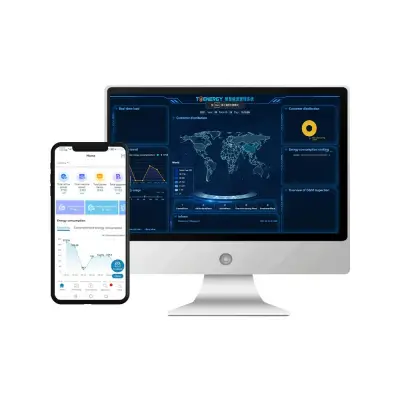
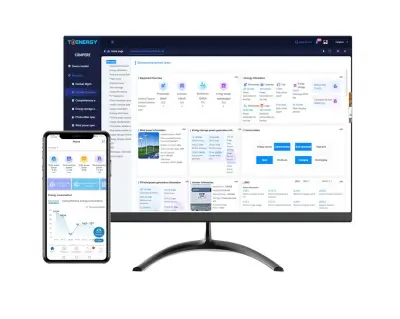
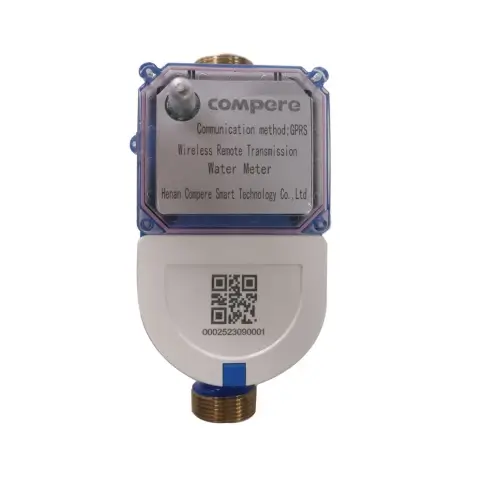
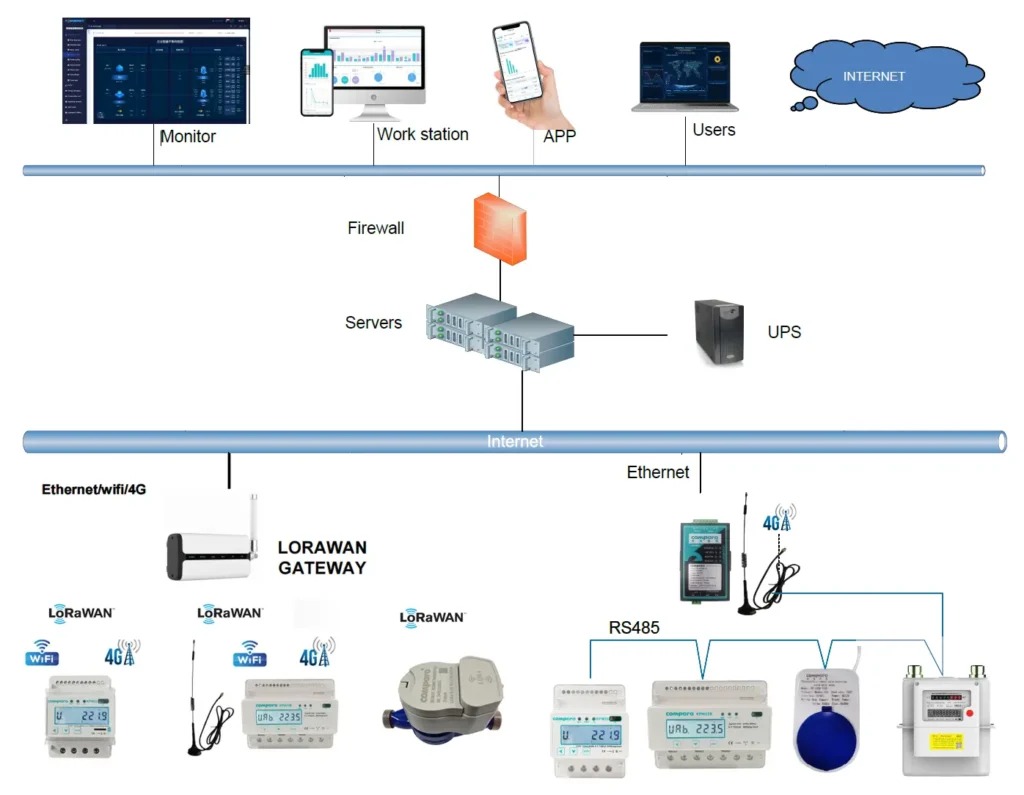
As shown in the image above, building robust power grids or property management infrastructure requires seamless integration of hardware with AMI/AMR systems. Compere Power offers IEC-compliant smart metering solutions tailored for global utility and commercial building deployments.
Supported communication methods: LoRaWAN, WiFi, 4G, RS485.
Applications: Sub-metering, smart grids, commercial complexes, and industrial parks.
👇 [Click Here To Download The Technical Datasheet And Get A Bulk Quote]
4.Advantages and Disadvantages of Postpaid Electricity Meters
Advantages
Strong power continuity: No need to worry about sudden power outages.
Flexible and convenient payment: Multiple payment methods, supporting online and offline payment.
Mature equipment and low cost: Simple installation and maintenance, widely adopted.
Suitable for stable users: Such as households, businesses, factories, etc.
Disadvantages
Risk of overdue payments: Users who fail to pay on time may have their power cut off.
Delayed billing: Electricity consumption cannot be monitored in real time, and there is a lack of immediate feedback.
Weak energy-saving awareness: Lack of real-time electricity consumption constraints easily leads to waste.
5.Examples Of Application Scenarios For Two Types Of Electricity Meters
| Application Scenarios | Prepaid Electric Meter | Postpaid Electric Meter |
|---|---|---|
| Student Dormitories, Rental Housing | Prevents arrears, easy to manage | Not suitable, risk of unpaid fees |
| Public Facilities | Convenient for unified collection and management | Suitable for stable power supply environments |
| Residential Homes | Suitable for tight budgets or short-term use | Mainstream choice for traditional household electricity use |
| Industrial Enterprises | Rarely adopted (requires continuous production) | Mainly used, ensures stable electricity usage |
| Commercial Buildings | Manages sub-metered electricity fees, reduces disputes | Suitable for overall settlement or long-term leasing |
6. Frequently Asked Questions(FAQ)
Q1: Will prepaid electricity meters cause sudden power outages?
A: Yes, the meter will automatically cut off power when the account balance is depleted. However, users can top up in advance to avoid the risk of power outages.
Q2: Are postpaid electricity meters safe and reliable? Could they be mistakenly disconnected?
A: Postpaid electricity meters are more mature and usually only disconnect power when a user has significant outstanding payments, and the power company will notify the user in advance.
Q3: Are there significant differences in installation and maintenance costs between the two types of meters?
A: Prepaid electricity meter equipment is more complex, with higher initial investment costs, but lower subsequent management costs; postpaid electricity meter equipment is simpler, with lower initial costs, but higher costs for managing outstanding payments.
Q4: How do I top up a prepaid electricity meter?
A: With modern smart prepaid systems (like Compere’s T@Prepay), users can seamlessly top up via mobile apps, web portals, or integrated SMS gateways, without needing any physical cards.
Q5: What communication methods does a prepaid electricity meter support?
A: Prepaid electricity meters typically support multiple communication methods, such as 4G/WiFi/LoRaWAN, to meet the needs of different users, especially LoRaWAN smart energy meters which are becoming increasingly widely used.
Conclusion
With technological advancements and the promotion of smart grids, the application of prepaid electricity meters is constantly expanding, especially suitable for scenarios requiring flexible electricity management and risk reduction. Postpaid electricity meters remain the primary choice for the vast majority of households and businesses, ensuring stable and convenient electricity supply.
| Selection Recommendations | Prepaid Electric Meter is Suitable For… | Postpaid Electric Meter is Suitable For… |
|---|---|---|
| Limited Electricity Budget | Need to strictly control electricity budget | Stable and continuous electricity demand |
| Arrears Risk Control | Need to eliminate arrears risk | Arrears risk is acceptable and willing to pay fees on time |
| Electricity Usage Environment | Short-term rentals, public places, student dormitories | Long-term electricity use in households, enterprises, and industries |
| Management Needs | Need real-time electricity monitoring and automatic power-off management | Traditional meter reading and payment, simple management |
Choices for Different Scenarios
Scenario A: Employee dormitories, rental apartments, commercial street shops.
Recommendation: 4G/WiFi prepaid electricity meter.
Reason: Zero risk of arrears; no need for manual meter reading by management personnel; the system automatically calculates tiered electricity pricing.
Scenario B: Industrial plants, data centers, public buildings.
Recommendation: RS485/LoRaWAN multi-functional power meter.
Reason: Ensures power supply continuity and supports high-precision energy efficiency analysis and power quality monitoring.