
In the global wave of digital transformation, intelligent energy management has become an irreversible trend. Traditional mechanical meters and early smart meters are being replaced by a new generation of IoT meters, and among them, din rail LoRaWAN energy meters, with their unique advantages, are becoming a revolutionary force in the field of industrial and commercial energy monitoring. This article provides comprehensive guidance for wholesalers, system integrators, and large end-users, covering technical principles, application scenarios, market trends, and procurement strategies.
1. Technical Analysis: What is a Din Rail LoRaWAN Energy Meter?
1.1 Core Components and Working Principle
The din rail LoRaWAN energy meter is a modular energy monitoring device specifically designed for installation in distribution boxes. It adopts a standard DIN rail mounting method (typically a 35mm standard rail) and integrates the following core components:
High-precision metering chip: Real-time monitoring of parameters such as voltage, current, power, power factor, and power quality.
LoRaWAN communication module: Employs spread spectrum modulation technology to achieve long-distance, low-power wireless transmission.
Rail-mounted housing design: Compact structure for dense installation within distribution cabinets.
Data processor: Built-in data analysis and storage functions.
Optional functional modules: Such as relay control, temperature monitoring, harmonic analysis, etc.
1.2 Unique Advantages of LoRaWAN Technology
Compared to traditional wired connections or other wireless technologies (such as NB-IoT, WiFi, Zigbee), LoRaWAN offers significant advantages in smart meter applications:
Ultra-long transmission distance: 3-5 kilometers in urban environments, and over 15 kilometers in suburban areas
Ultra-low power consumption: Battery-powered devices can last for several years, reducing maintenance costs
Strong penetration capability: Penetrates multiple walls and underground environments, adapting to complex installation scenarios
Flexible network deployment: Supports public and private network deployments, meeting different security needs
High cost-effectiveness: Low investment in network infrastructure and moderate cost of terminal equipment
1.3 Practical Value of the Din Rail Design
Easy installation: No professional tools required; installation can be completed in minutes
Efficient space utilization: Suitable for dense installation in space-constrained distribution boxes
Easy maintenance: Modular design supports hot-swappable replacement, reducing system downtime
Scalability: Easily increases or adjusts the number of meters according to monitoring needs
2. Market Application Scenarios Analysis
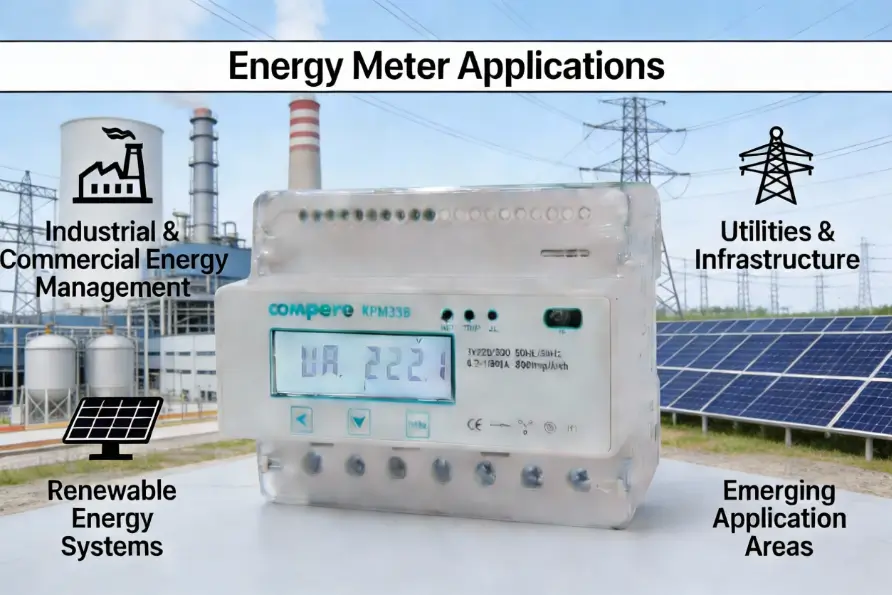
2.1 Industrial and Commercial Energy Management
Factory Workshops: Monitoring energy consumption distribution of production lines and large equipment
Commercial Buildings: Tenant-specific metering and public area energy consumption analysis
Chain Stores: Cross-regional energy consumption comparison and standardized management
Data Centers: Refined energy consumption monitoring at the rack and server levels
2.2 Public Utilities and Infrastructure
Municipal Facilities: Monitoring electricity consumption of streetlights, traffic signals, and public charging stations
Water Systems: Energy consumption monitoring of pumping stations and water treatment plants
Communication Base Stations: Remote energy consumption management and optimization of distributed base stations
2.3 Renewable Energy Systems
Distributed Photovoltaics: Monitoring power generation efficiency and self-consumption ratio
Microgrid Systems: Real-time monitoring and balancing of multi-source energy flows
Energy Storage Systems: Charge and discharge efficiency analysis and lifespan management
2.4 Emerging Application Areas
Electric Vehicle Charging Facilities: Charging Pile Utilization Efficiency and Load Management
Smart Agriculture: Energy Consumption Optimization of Irrigation Systems and Greenhouse Environments
Cold Chain Logistics: Energy Consumption Monitoring and Early Warning of Refrigerated Trucks and Cold Storage
3. Decision-Making Factors for Wholesale Procurement
When purchasing wholesale, the following technical parameters should be given priority:
Metrological Accuracy Class: Typically divided into 0.5S, 1.0, and 2.0 classes, varying depending on the application requirements.
Communication Performance: Receiver sensitivity (typically above -137dBm), transmit power, and anti-interference capability.
Environmental Adaptability: Operating temperature range (industrial grade is typically -40°C to 85°C), protection level.
Data Security: Encryption algorithms, authentication mechanisms, and data integrity protection.
Protocol Compatibility: LoRaWAN protocol version and compatibility with mainstream network servers.
4. Market Trends and Future Outlook
4.1 Technological Convergence Trends
AI Empowerment: Predictive performance consumption analysis, intelligent detection of abnormal power consumption
Edge Computing: Local data processing reduces transmission requirements and improves real-time performance
Blockchain Applications: Trust mechanism for distributed energy trading
5G Convergence: Complementary applications in high-bandwidth scenarios
4.2 Policy and Standards Promotion
Global Carbon Neutrality Goals: Driving enterprises to manage energy consumption more precisely
Energy Efficiency Standards Improvement: Countries are gradually increasing mandatory energy efficiency requirements
Data Privacy Regulations: Affecting data collection, transmission, and storage methods
Industry Standard Unification: The LoRaWAN protocol continues to evolve, improving device interoperability
4.3 Market Size Forecast
According to market research data:
The global din rail LoRaWAN energy meter market is projected to grow at a CAGR of 28% (2023-2030).
The share of industrial and commercial applications will increase from the current 35% to over 50% by 2030.
The Asia-Pacific region will become the largest market, particularly China, India, and Southeast Asian countries.
Conclusion: Seizing the Wholesale Opportunities in Smart Energy Monitoring
Din rail LoRaWAN energy meters are experiencing rapid market expansion, offering significant growth opportunities for wholesalers and system integrators. Key to success lies in:
Deep understanding of technology: Going beyond simple product sales, becoming a technical advisor to customers.
Scenario-based solutions: Providing customized product portfolios for different industries.
Full lifecycle services: Value creation across the entire chain from procurement to deployment and ongoing maintenance.
Ecosystem cooperation: Establishing partnerships with network operators, software developers, and installation service providers.
With the accelerated global energy transition, din rail LoRaWAN energy meters are not just a product category, but a crucial bridge connecting the physical energy world with digital management systems. Wholesalers who establish a presence in this sector early will be able to gain a favorable position in the multi-billion dollar smart energy market and become key drivers of the industry’s digital transformation.
Contact Us
Welcome to inquire about smart energy meter and IoT technology solutions! Our professional team will tailor a smart energy management solution for you!
📧 Email: [email protected]
📞 Phone: +86-15938727545
💬 WhatsApp: WhatsApp