In today’s increasingly intelligent world, efficient and accurate energy management has become a core requirement in fields such as industrial automation, building automation, data centers, and smart grids. Traditional wall-mounted meters, due to their large size, complex installation, and limited communication capabilities, are no longer suitable for modern system integration.
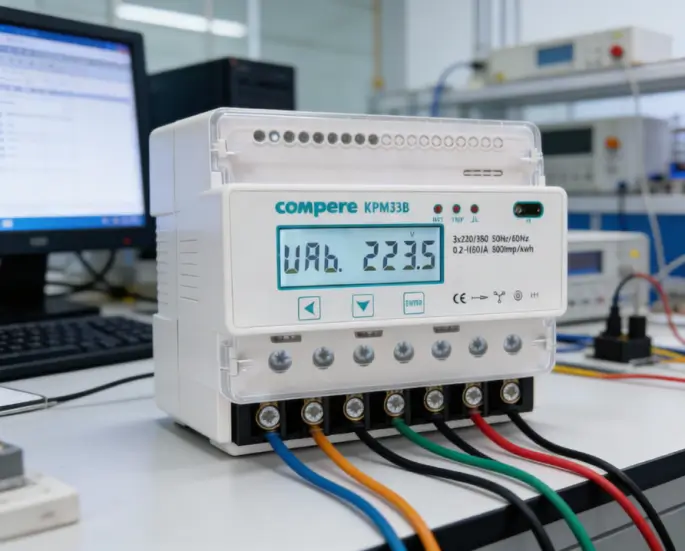
DIN rail energy meters, as compact measuring devices that can be directly installed on standard DIN rails, are becoming the backbone of intelligent energy management systems thanks to their modularity, intelligence, and high integration.
1. What Is a DIN Rail Energy Meter? — Definition by System Integrators
A DIN rail energy meter is a power metering device specifically designed for installation on standard 35mm DIN rails. Unlike traditional meters, its true value lies in system-level integration rather than standalone measurement.
Core Characteristics
- Modular Design: Easily integrates into distribution cabinets like electrical building blocks, saving over 90% installation space.
- Precise Measurement: Real-time monitoring of voltage, current, active/reactive power, power factor, frequency, and energy (kWh, kVarh).
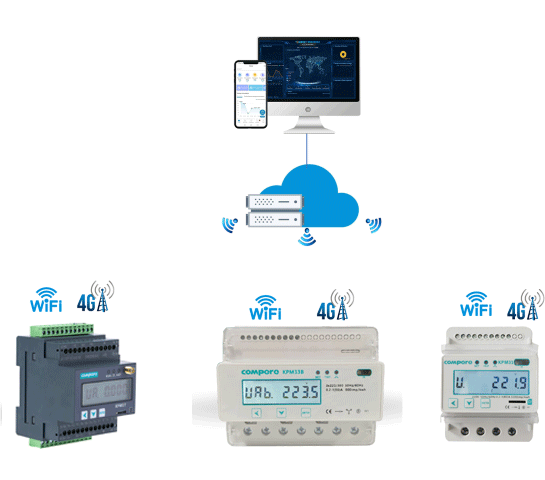
- Communication Core: Supports RS-485, Ethernet, and wireless options (LoRaWAN, NB-IoT) with protocols such as Modbus RTU/TCP, DL/T645, MQTT.
- Advanced Functions: Demand analysis, time-of-use billing, alarms, harmonic analysis, and remote control.
For system integrators, a DIN rail energy meter acts as a Data Acquisition and Communication Unit (DAQ), converting physical electrical signals into digital data streams for upper-level platforms.
2. Why Choose DIN Rail Energy Meters for System Integration?
✔ Space-Saving and Easy Installation
Snap-on DIN rail installation eliminates drilling and simplifies wiring. Compact design enables dense deployment in space-constrained control cabinets.
✔ Flexible Protocol Compatibility
DIN rail meters act as protocol bridges, enabling seamless integration with:
- Building Automation Systems (BAS)
- Energy Management Systems (EMS)
- Industrial SCADA & PLC systems
- Cloud & IoT platforms via MQTT
✔ High-Accuracy and Reliable Data
With Class 0.5S or higher accuracy across wide current ranges (direct or CT-connected), DIN rail meters provide reliable data for billing, efficiency analysis, and power quality monitoring.
✔ Strong Functional Scalability
Options range from basic metering to advanced power quality analysis, alarm outputs, event logging, and remote switching, enabling proactive energy control.
✔ Excellent Cost-Effectiveness
Reduced installation cost, simplified maintenance, and detailed energy insights allow quick ROI by identifying energy losses and optimizing load distribution.
3. Key Application Scenarios in System Integration
Industrial IoT & Smart Manufacturing
Monitor energy consumption of individual machines (CNCs, compressors, injection molding machines) in real time to improve OEE and detect abnormalities.
Smart & Green Buildings
Floor-level, tenant-level, and circuit-level metering integrates with BA systems to enable energy visualization, quota control, and automatic optimization — supporting LEED and BREEAM certifications.
Data Center Infrastructure Management
Monitor rack PDUs, UPS, and cooling systems to calculate PUE, issue overload warnings, and optimize cooling strategies.
Distributed Energy & Microgrids
Bidirectional metering for PV inverters, energy storage, and EV chargers supports energy scheduling, self-consumption calculation, and surplus power billing.
Commercial Complexes & Chain Stores
Standardized deployment enables centralized monitoring and comparative analysis across multiple sites.
4. Selection & Integration Guide for System Integrators
Requirement Clarification
- Single-phase or three-phase
- Direct connection or CT-based measurement
- Upper-system communication protocol compatibility
Key Parameters to Evaluate
- Accuracy: Class 0.5S for billing, Class 1.0 for internal monitoring
- Communication: RS485, Ethernet, or wireless
- Functions: Harmonic analysis, demand control, temperature input
- Certifications: CE, MID (for commercial settlement)
Integration Implementation Steps
- Meter point planning and quantity calculation
- Installation and wiring with proper CT ratio settings
- Communication parameter configuration
- SCADA/EMS data mapping and testing
- Dashboard, reporting, and alarm application development
5. Future Trends: Smarter and More Integrated DIN Rail Meters
- Edge Computing: Local data processing and anomaly detection
- AI Integration: Load identification and non-intrusive load analysis
- Integrated Protection: Combining meters with breakers and contactors to form intelligent power distribution modules
Conclusion
DIN rail energy meters are no longer simple metering devices. They are a critical bridge between physical power systems and digital information platforms.
With modular design, intelligent communication, and scalable functionality, they empower system integrators to deliver future-ready energy management solutions while helping enterprises achieve refined operations and carbon reduction goals.