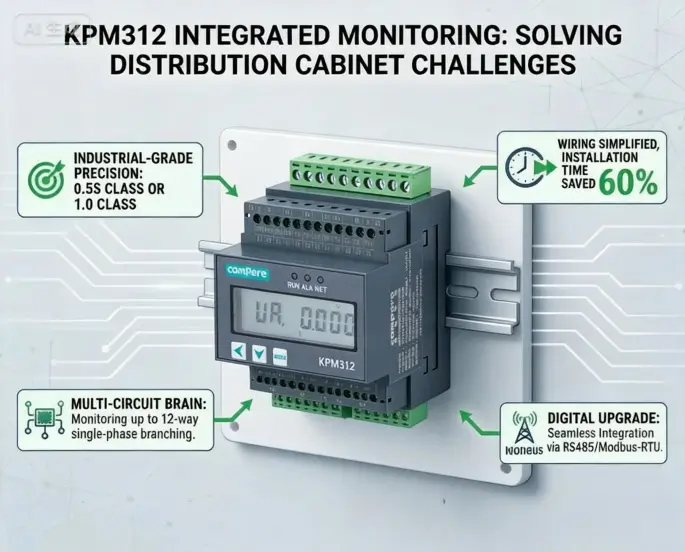
In industrial automation, large commercial complexes, and smart parks, traditional distribution cabinet designs commonly face challenges such as a large number of circuits, limited cabinet space, and difficulty in later installation of monitoring equipment.
The application of multi-circuit din rail energy meters can efficiently monitor a large number of branch circuits within limited cabinet space, effectively alleviating this pain point and thus becoming an ideal choice for system integrators to optimize power distribution solutions.
Solving Three Major Design Challenges of Distribution Cabinets
1. The Limits of Space Utilization
In standard distribution cabinets, circuit breakers, contactors, and busbars already occupy most of the space.
Traditional Model: If energy metering is required for 12 branch circuits, installing 12 single-circuit meters is almost an impossible task, which forces an increase in the size of the distribution cabinet and increases costs.
Multi-circuit solution: Utilizing an integrated design, the width of a single multi-circuit meter (e.g., 12 single-phase or 4 three-phase) is equivalent to that of several miniature circuit breakers. This approach increases space utilization by over 50% without altering the cabinet dimensions.
2. Complex wiring and maintenance:
The cable layout within the distribution cabinet directly impacts operational safety.
Simplified wiring logic: Multi-circuit meters employ a shared voltage bus design, requiring only one set of voltage sampling signals to complete calculations for all circuits. Compared to the traditional “one circuit, one sampling” model, wiring complexity is reduced by 60%.
Clear wiring: Modular terminal blocks make the cabinet layout more organized, significantly reducing labor costs for later inspections and troubleshooting.
3. Measurement accuracy and stability:
In industrial power distribution environments, high current and electromagnetic interference are common.
High-precision sensors: Combined with high-precision current transformers (CTs), multi-circuit meters can achieve metering accuracy of 0.5S or 1.0 class. Anti-interference capability: Designed specifically for industrial environments, rail-mounted meters offer excellent electromagnetic compatibility (EMC), ensuring accurate and reliable data even under complex loads such as frequency converters and high-power motors.
Core Technology Application Solutions
1. Flexible Current Connection Methods
To adapt to different copper busbar or cable sizes within distribution cabinets, multi-circuit solutions typically support various CT (current transformer) connections:
Solid CT: Suitable for new distribution cabinets, compact installation, and extremely high accuracy.
Open/Clamp-on CT: Suitable for retrofitting existing cabinets; installation can be completed without cutting cables or power outages.
2. Multi-protocol Networking and Integration
Multi-circuit meters serve as the “data touchpoints” of smart energy systems.
RS485/Modbus-RTU: Standard industrial communication protocols supporting seamless integration with PLCs, touchscreens (HMIs).
Digital Transformation: Real-time uploading of current, voltage, power factor, energy consumption, and total harmonic distortion (THD) data for each branch circuit provides a foundation for energy consumption analysis and load early warning.
Typical Application Scenarios Of Multi-Circuit Din Rail Meters
Industrial Plant Power Distribution: Monitoring the energy consumption distribution of different production lines and workshops enables accurate cost accounting.
Smart Office Buildings: Classifying and metering circuits with different attributes such as central air conditioning, lighting, and power supply.
Hospitals and Research Institutes: Real-time power quality monitoring for circuits of critical experimental or medical equipment to prevent power outage risks.
Business Value for System Integrators
For distribution cabinet manufacturers and system integrators, multi-circuit rail-mounted meters are not only a hardware upgrade but also an enhancement of competitiveness:
Reduced Overall Costs: Reduced cabinet size requirements, lower installation labor costs, and simplified internal components.
Enhanced Delivery Aesthetics: Neat and aesthetically pleasing internal wiring meets the high-end customer requirements for project quality.
Increased Solution Value
Transforming from a traditional “power distribution equipment supplier” to a “digital energy solutions provider.” In summary, during the intelligent upgrading of low-voltage distribution cabinets, multi-circuit rail-mounted meters, with their high integration, low installation cost, and industrial-grade reliability, have become the cornerstone for building a refined energy management system.