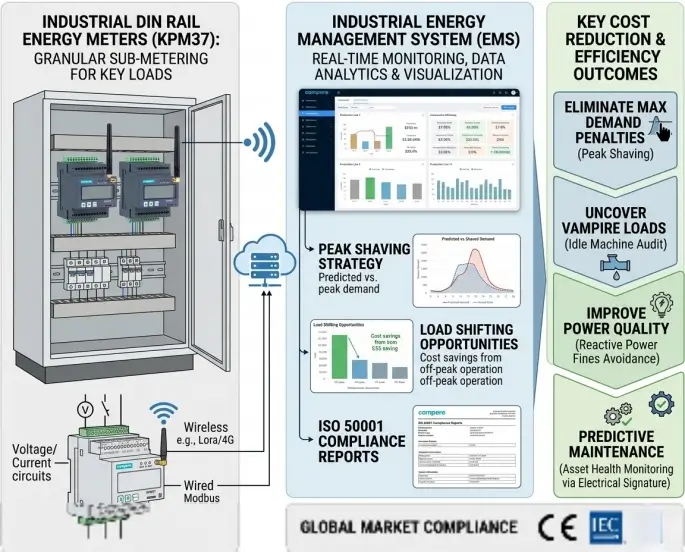
Under the dual pressures of pursuing carbon neutrality and extreme cost optimization in the global manufacturing industry, energy management is no longer a logistical option, but a core competitive advantage for enterprises. This article will provide an in-depth analysis of how to achieve genuine cost reduction and efficiency improvement through the deep integration of industrial din rail energy meters and energy management systems (EMS).
A Core Tool for Industrial Energy Transformation
Industrial rail-mounted smart meters are power monitoring terminals specifically designed for industrial environments, using standard DIN 35mm rail mounting, and integrating high-precision measurement and multi-protocol communication functions.
Key Attributes:
Ease of Installation: Compatible with standard distribution cabinet rails, allowing for rapid deployment without modifying existing cabinets.
Protocol Diversity: Supports mainstream industrial protocols such as Modbus-RTU and DL/T 645, easily connecting to the Industrial Internet.
Comprehensive Parameters: Simultaneously monitors voltage, current, power factor, and total harmonic distortion (THD).
Environmental Adaptability: Possesses strong electromagnetic compatibility (EMC), maintaining accurate metering even in environments with high interference from large motor start-ups and shutdowns.
Conclusion: DIN rail meters are the “nerve endings” of the Industrial Internet of Things (IIoT) for acquiring power data, representing the first step for enterprises to achieve digital energy management.
Hardware Layer – The Professional Choice for Industrial DIN Rail Meters
Split-core current transformers (CTs) are a technology that allows current sensing without cutting cables. Used in conjunction with DIN rail meters, they enable uninterrupted power supply retrofits in factories.
Key Attributes:
Non-invasive: The transformer has a detachable structure, directly attaching to existing busbars or cables.
High Safety: Construction does not involve contact with exposed busbars, significantly reducing electrical safety risks.
Construction Efficiency: Modification time for a single circuit is reduced from hours to minutes.
Conclusion: For global factories operating 24/7, split-core current transformers are the optimal path for low-cost upgrades to energy monitoring.
Software Layer – The Brain Role of the Energy Management System (EMS)
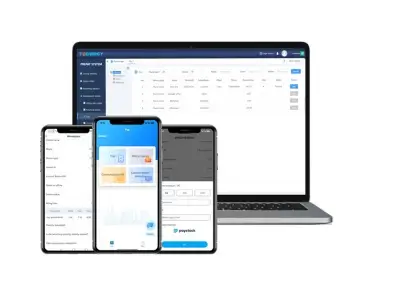
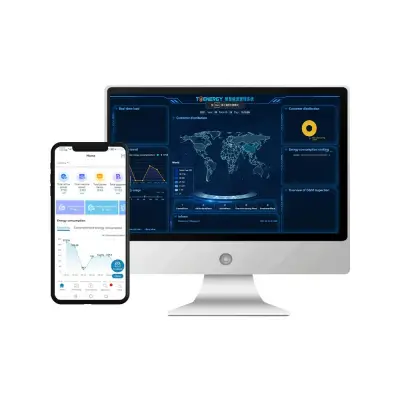
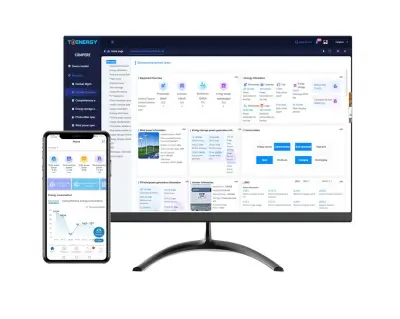
An Industrial Energy Management System (EMS) is a digital software platform that uses industrial electricity data as its core, leveraging cloud computing, big data analytics, and AI algorithms to monitor, analyze, and optimize enterprise energy consumption in real time.
Key Attributes:
Multi-level Dashboards: Provides transparent energy consumption display at four levels: group, plant, workshop, and equipment.
Energy Efficiency Benchmarking (EnPIs): Calculates unit product energy consumption based on production output, identifying inefficient processes.
Automated Reporting: Generates ISO 50001 compliant energy audit reports with a single click, replacing manual meter reading.
Conclusion: The energy management system acts as the “brain” that transforms fragmented electricity data into business decision-making intelligence, directly driving the implementation of cost reduction strategies.
Four Practical Strategies for Cost Reduction and Efficiency Improvement
1. How to Eliminate Peak Shaving (Demand Penalty)?
In most large industrial electricity markets globally, electricity bills consist of a “power consumption fee” and a “demand fee (or basic power fee).”
Method: The EMS system monitors total incoming power in real time. When the load approaches the contracted capacity limit, it automatically issues a warning and temporarily shuts down non-critical loads.
Conclusion: This strategy effectively avoids huge penalties caused by peak electricity consumption, typically reducing monthly electricity bills by 5% to 10% (Data source: IEEE Xplore Smart Grid Survey).
2. How to eliminate “vampire loads”?
“Vampire loads” refer to ineffective power consumption generated by factories during non-production periods (such as weekends or late at night), such as air compressors running unloaded or industrial refrigerated dryers left running.
Method: Using rail-mounted meters for sub-item metering, the EMS can generate energy consumption analysis for non-production periods, locating equipment that has not been shut down as required.
Conclusion: By finely controlling power consumption during non-production periods, companies can directly save more than 3% of total electricity consumption with almost zero cost.
3. How to Avoid Reactive Power Penalties Through Power Factor Compensation?
When the proportion of inductive loads (such as motors) is too high, the power factor will drop, leading to penalties from the power supply bureau and increased line losses.
Method: Smart meters monitor the power factor (PF) in real time, and EMS guides the precise activation of reactive power compensation devices.
Conclusion: Raising the power factor to above 0.95 not only eliminates penalties but also improves the effective load-carrying capacity of transformers.
4. How to Use Energy Consumption Data for Preventive Maintenance?
Changes in electrical parameters are often precursors to equipment failures; for example, bearing wear can cause abnormal increases or fluctuations in motor current.
Method: By monitoring harmonic fluctuations and current curves fed back by smart meters, the health status of equipment can be predicted.
Conclusion: This “data-driven” maintenance model can reduce unplanned downtime by more than 20%, significantly improving production efficiency.
💡 Practical Q&A on Problem Solving
1. How to solve the problem of excessively high wiring costs in old factory areas?
Utilize the wireless communication function of the KPM37. Through the matching 4G or LoRa mode, the meter can directly transmit data through walls to the gateway or cloud, saving the cumbersome conduit wiring costs of traditional RS485 and shortening the construction cycle by more than 70%.
2. What to do if you are frequently fined by the power company due to sudden load changes?
Enable the system’s “Maximum Demand Monitoring”. With the KPM37 and EMS system, once the workshop load approaches the contracted capacity limit, the system will automatically issue an alert via APP or email, reminding managers to adjust production or cut off non-core loads, directly avoiding high demand fees.
3. How to quickly locate which machine is consuming the most electricity?
Implement “Single-Unit Metering”. Install a separate KPM37 on the branch line of critical high-energy-consuming equipment (such as high-power motors and chillers). By comparing the unit energy consumption of different work groups and different products, we can accurately identify the “energy efficiency black hole” and thus optimize production scheduling in a targeted manner.