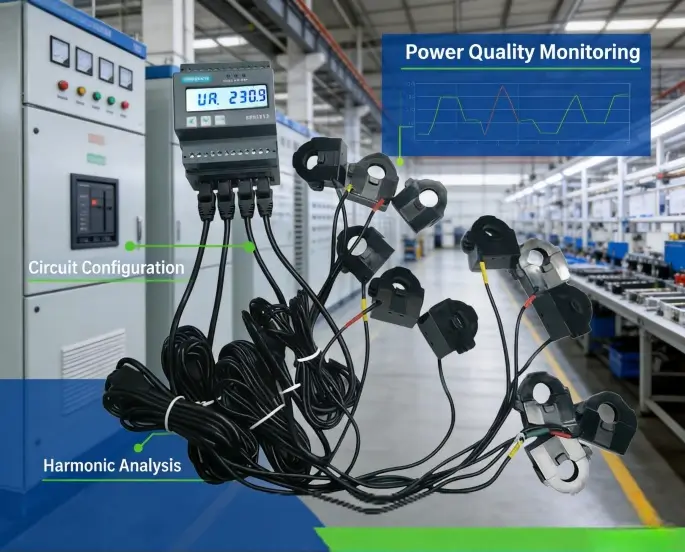
Under the backdrop of dual carbon targets and dual energy consumption control, the demand for refined energy management in industrial sectors such as large factories is increasingly urgent. The traditional “single main meter” model is no longer sufficient to meet the needs of modern industrial energy efficiency analysis. Multi-channel energy meters, due to their ability to monitor multiple circuits simultaneously, save installation space and overall costs, have become the preferred choice for upgrading industrial power distribution systems (such as power cabinets, lighting boxes, and production line power distribution).
However, industrial environments are complex, with numerous high-power devices, significant grid harmonic interference, and dense circuits. What core indicators should large factories focus on when selecting multi-channel energy meters? This article will provide a scientific selection methodology.
Identifying the Core Pain Points of Industrial Sites
Before selection, we need to understand the unique characteristics of the power distribution environment in large factories:
Limited Space: Limited remaining space within distribution boxes/cabinets cannot accommodate a large number of traditional single-circuit energy meters.
Complex Loads: Nonlinear loads such as frequency converters, electric arc furnaces, and large motors generate a large number of harmonics, affecting measurement accuracy.
Mixed Circuits: Three-phase power (e.g., high-power equipment) and single-phase power (e.g., lighting, office use) often coexist on-site, requiring compatible measurements.
High Reliability Requirements: Continuous factory production necessitates meters with extremely strong anti-interference capabilities and the ability to support uninterrupted power supply (UPS) maintenance.
Core Elements for Selecting Industrial Multi-Channel Meters
To select a suitable multi-channel meter for industrial applications, it is recommended to consider the following five dimensions in depth:
1. Circuit Configuration and Modular Expansion Capabilities
The number of power distribution circuits in a factory is often not fixed; production line modifications and expansions are common.
Selection Recommendation: Prioritize modular and expandable multi-channel meters. For example, the base control module should support dynamic splicing of measurement modules.
Compatibility: Must support mixed three-phase and single-phase measurements. For example, a single main control unit can simultaneously monitor 4 three-phase circuits and 12 single-phase circuits, enabling one meter to manage an entire distribution cabinet.
2. Measurement Accuracy and Power Quality Analysis
Industrial electricity consumption is enormous, and even slight deviations in accuracy can lead to huge discrepancies in electricity bills. Furthermore, harmonics are the “invisible killer” of industrial power grids.
Accuracy Level: Active power accuracy should reach at least 0.5S level (or 1.0 level), and reactive power accuracy should reach level 2.
Power Quality Monitoring: Excellent industrial meters not only measure voltage, current, and power, but must also have harmonic analysis capabilities (typically requiring support for 2nd to 31st or even higher total harmonic distortion (THD) measurements), three-phase imbalance monitoring, and voltage surge/dip recording. This is crucial for protecting the precision manufacturing equipment in factories.
3. Current Transformer (CT) Matching and Installation Methods
Large factories cannot afford to shut down production and cut off power just to install a meter; therefore, the choice of current transformer directly determines the construction cost. Selection Recommendations: It is strongly recommended to use split-core current transformers (CTs).
Foolproof Design: Prioritize meters that support pluggable connection or have built-in error-proof terminals. Due to the numerous leads in multi-channel meters, troubleshooting reversed secondary wiring or incorrect phase sequence is extremely difficult. Meters with on-site wiring diagnostics (such as phase sequence error alarms) can save significant debugging time.
4. Communication Protocols and System Integration Capabilities
Data collected by the meters must be uploaded to the factory’s EMS (Energy Management System).
Standard Protocols: Modbus-RTU (RS485 interface) is standard in industrial applications. However, for large factories, meters natively supporting Modbus-RTU (RS485 interface) or MQTT protocols (for direct integration with IoT cloud platforms) are recommended.
Multi-channel Communication: Some high-end meters support dual RS485 or Ethernet + RS485 dual-channel backup, which is very useful in manufacturing workshops with extremely high data continuity requirements. 5. Industrial-Grade Environmental Adaptability and Safety Certification
Factory environments may involve high temperatures, high humidity, and strong electromagnetic interference.
Hard Requirements: Operating temperature range should be -25℃ to +70℃; EMC (electromagnetic compatibility) immunity performance must meet industrial level 4 standards.
Safety Protection: The secondary side of the meter must have good isolation protection and basic overvoltage and overcurrent alarm functions.
Industrial Selection Decision-Making Workflow
To help your purchasing and technical teams make decisions more efficiently, the selection process can be simplified to the following three steps:
Count how many three-phase circuits and how many single-phase circuits are contained in the distribution cabinet, measure the wire diameter (to determine the transformer bore diameter), and measure the remaining installation space on the guide rails or panels inside the distribution box.
Determine if harmonic analysis is required. What is the data upload frequency? Is power outage permissible on-site (to decide whether to use a closed or open current transformer)? Determine the communication interface required by the system.
Compare the overall cost (including meter purchase, transformers, cabinet space, cabling, and system debugging manpower) of “one multi-channel meter” versus “multiple single-phase/three-phase meters stacked together”. Typically, the cost advantage of the multi-channel solution becomes more pronounced when there are four or more circuits.
💡 Expert Tip: Large factories often overlook local data storage when deploying multi-channel meters. Intermittent interruptions in industrial networks are common. Choosing multi-channel meters with data logging (such as built-in Flash storage that supports resume download after network outage) ensures the absolute integrity of workshop energy consumption data, preventing data gaps in financial accounting.