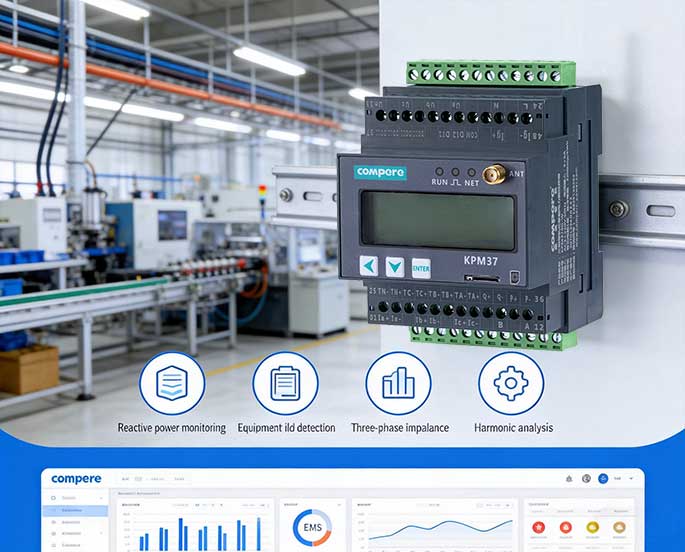
In modern manufacturing, electricity costs are often the largest expense in a company’s operating costs. Many factory managers often face a perplexing question: why are monthly electricity bills so high even though production output hasn’t increased significantly? In fact, there is a large amount of “hidden waste” in industrial electricity consumption.
This article will provide an in-depth analysis of how industrial three phase energy meters, through precise data collection and analysis, help factories uncover these unseen “electricity thieves.”
Catching the “Hidden Thieves”: Four Core Dimensions of Three-Phase Meters in Identifying Electricity Waste
1. Monitoring “Reactive Power” and Eliminating Power Factor Penalties
In industrial power grids, electrical energy is divided into active power (electricity that is actually converted into mechanical energy and heat) and reactive power (electricity used to establish magnetic fields and maintain equipment operation, such as motors and transformers).
Waste Occurs: If a large number of asynchronous motors in a factory operate under light loads, or if equipment is aging, it will lead to a decrease in the power factor. Power companies will impose hefty fines on factories with power factors below the standard.
1. Breakthrough with Electricity Meters: Three-phase smart meters can monitor active power, reactive power, and power factor in real time. Through meter data, businesses can clearly see which production line or equipment has a substandard power factor, allowing for precise installation of reactive power compensation devices (such as capacitor banks), directly avoiding fines from the power bureau.
2. Identifying “Equipment Idle” and Eliminating Energy Consumption During Non-Production Time: Many factories leave some large equipment, air compressors, lighting, or air conditioning systems in standby or idle states during shift changes, lunch breaks, and even weekend shutdowns.
Waste Arises: “Many drops of water make a mighty river.” These seemingly insignificant standby power consumptions accumulate into a staggering expense in a 24-hour factory.
Breakthrough with Electricity Meters: Three-phase meters, in conjunction with an energy management system, can generate a factory’s load profile. When managers see obvious “energy spikes” or abnormally high “baseline loads” on the charts during non-production periods, they can immediately identify equipment that is not shut down, optimizing shift scheduling and equipment downtime management.
3. Detect Three Phase Imbalance to Reduce Line and Equipment Losses
Industrial electricity is typically three-phase AC (A-phase, B-phase, C-phase). Ideally, the three-phase loads should be perfectly balanced.
Waste Arises: Uneven distribution of single-phase loads (such as lighting and single-phase equipment) during wiring in factories leads to three-phase imbalance. This not only causes excessive neutral current and overheating of the lines (electrical energy is directly converted into useless heat energy and wasted), but also shortens the lifespan of expensive motors and can even cause fires.
Meter Solution: One of the core functions of a three-phase meter is to monitor three-phase voltage and current in real time. Once the imbalance rate exceeds a safe threshold, the system will immediately issue a warning, prompting electrical engineers to adjust the distribution of single-phase loads, stopping losses at the source.
4. Diagnose Harmonic Pollution to Prevent Power Quality Deterioration
With the widespread use of frequency converters, LED lighting, and precision electronic equipment in factories, harmonic pollution in industrial power grids is becoming increasingly serious.
Waste Generation: Harmonics cause voltage distortion in the power grid, leading to transformer overheating, abnormal meter readings, and a significant decrease in energy efficiency.
Meter Solution: Advanced industrial three-phase meters possess power quality analysis capabilities, measuring harmonic distortion (THD) rates from the 2nd to the 63rd order and even higher. By locating the harmonic sources, factories can install active power filters (APFs) to purify the power grid and improve energy efficiency.
Real-World Scenario: How do three phase meters help production lines benchmark energy efficiency?
Beyond monitoring the aforementioned technical indicators, the greatest value of three-phase meters in management lies in introducing the concept of “energy consumption per unit product.”
Traditional Model: A factory produces 10,000 units this month, with total electricity costs of 100,000 yuan, averaging 10 yuan per unit.
Smart Meter Mode: By deploying three-phase miniature rail meters on key production lines and even individual high-energy-consuming equipment (such as injection molding machines and melting furnaces), management can obtain more detailed data:
Production Line A: 8 kWh per product
Production Line B (same type): 12 kWh per product
Identified Problem: Why does production line B consume 50% more energy than other production lines with the same process?
Investigation Results: By retrieving historical current data from the three-phase meters, it was discovered that a motor on production line B had increased operating resistance and abnormally high current due to poor lubrication and bearing wear.
Final Benefit: Timely equipment maintenance not only repaired the equipment and prevented unexpected downtime but also brought production line B’s energy consumption back to normal levels.
From “Seeing the Data” to “Saving Electricity Costs”: Three Steps to Factory Implementation
If you want to truly save money for your factory using three-phase meters, we recommend following these steps:
Main Incomer Monitoring
Grasp the overall power consumption baseline of the entire factory and perfectly align with utility grid bills.
Workshop & Production Line Sub-metering
Identify “energy guzzlers” among different workshops and implement internal cost accounting and accountability.
Critical Equipment Fine-Grained Monitoring
Track heavy-load machinery to eliminate technical power wastage (such as harmonics and idle running).
Multi-level Metering Deployment (Sub-metering): Don’t just install one meter at the factory gate. For high-energy-consuming workshops, air compressor rooms, refrigeration rooms, and core production lines, independent deployment of three-phase electricity meters is essential.
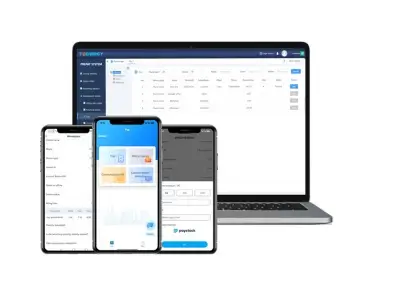
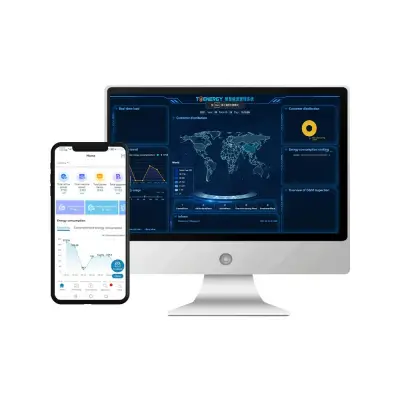
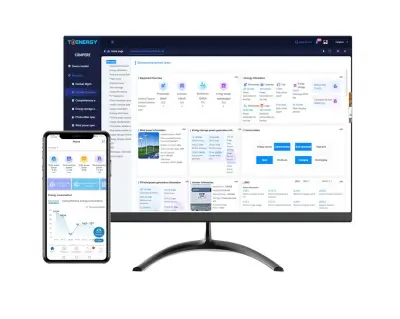
Data Cloud Interconnection (IoT Integration): Select three-phase electricity meters supporting Modbus-RTU, MQTT, or 5G/4G wireless communication to upload data to energy management software (EMS) in real time, transforming dry current and voltage figures into intuitive charts and alarms.
Establish a Regular Energy-Saving Mechanism: Link electricity meter data to production scheduling and equipment maintenance plans, using the data to verify the actual effectiveness of each energy-saving modification (such as motor frequency conversion modification).
Conclusion
In today’s manufacturing industry, which pursues “carbon neutrality” and “lean production,” the era of extensive electricity management is over. Industrial three-phase electricity meters are no longer just billing tools, but diagnostic instruments for factory power systems and a guide for energy conservation and cost reduction.
Understanding the destination of every kilowatt-hour of electricity is the first step for factories to move towards intelligent manufacturing and maximize profits.