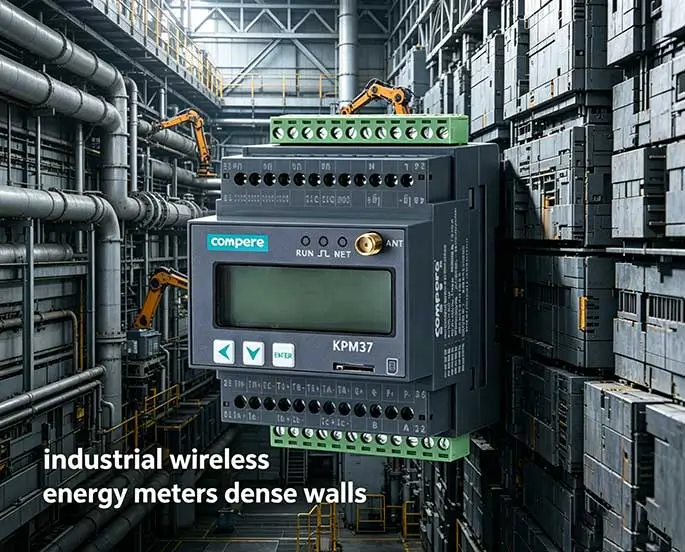
In the wave of digital transformation and the competition for “green factories” in the manufacturing industry, accurate monitoring of workshop energy consumption has become a necessity. However, many companies often encounter an invisible wall when deploying wireless multi-function energy meters—the factory’s reinforced concrete walls, thick explosion-proof and soundproof walls, and dense large metal equipment severely block wireless signals and cause frequent disconnections.
How can a stable, uninterrupted wireless energy meter network be built in such “hardcore” industrial environments? This article will focus on the three most common communication technologies—WiFi, 4G, and LoRaWAN—to provide you with a simple, easy-to-understand, and effective engineering solution.
Know Yourself and Your Enemy: A Breakdown of the “Wall-Penetrating” Power of the Three Wireless Communication Technologies
To solve signal blockage, the first step is to choose the right “communication unit.” The commonly heard terms Wi-Fi, 4G, and LoRaWAN, often used in industry, perform drastically differently in environments with multiple walls:
1. WiFi: High Speed, but Extremely Vulnerable to Walls
Wi-Fi boasts extremely high transmission speeds, making it suitable for transmitting massive amounts of real-time power waveform data. However, it has a fatal weakness: its short wavelength results in extremely poor penetration.
Industrial plant walls typically contain dense steel reinforcement. When Wi-Fi’s high-frequency radio waves (2.4GHz or 5GHz) encounter such walls, most of their energy is absorbed. Even closing a bedroom door at home can cause Wi-Fi signal loss; in the multi-layered, thick-walled environment of a factory, Wi-Fi connectivity is highly susceptible to widespread loss of connection. Therefore, large-scale Wi-Fi network usage is not recommended inside multi-walled factory buildings.
2. 4G Solution: Power-On and Ready, but Dead Zones and Costs are Headaches
The 4G solution is like a smartphone; the electricity meter simply needs a data SIM card to upload data directly to the cloud. Factories don’t need to set up their own base stations, making deployment very convenient.
However, the 4G signal source is outdoors (carrier base stations). When the electricity meter is installed in an underground distribution room, sealed in a metal distribution box, or deep within a large factory building, external signals have difficulty penetrating the walls, leaving the meter in a “no service” state. Furthermore, each meter requires a data SIM card, and with a large number of meters, the annual cost can be substantial.
3. LoRaWAN Solution: An Industrial Star Designed for “Wall Penetration and Long Distance”
LoRaWAN is currently the preferred technology for solving wall penetration problems in the Industrial Internet of Things (IIoT). You can think of it as a factory’s own dedicated low-frequency “walkie-talkie network.”
Physics tells us that the lower the frequency of radio waves, the longer the wavelength, and the stronger the diffraction capability. LoRaWAN operates in the low-frequency band around 470MHz. Like an agile pangolin, it’s not easily blocked by walls and large metal machinery, but rather can “hide” through cracks, doors, windows, and even dead corners. Although it sacrifices transmission speed for penetration (cannot stream video, only transmit numbers), it’s more than sufficient for electricity meters that report data every few minutes.
Core Tactical Approach: How to Completely Overcome Shielding “Dead Corners”?
In actual factories, simply choosing the right technology is not enough. Faced with extremely severe physical shielding, the following three engineering “combination punches” must be used:
First Move: Physical Barrier Breakthrough – External Antenna Placement and Feeder Extension
In factories, multi-function meters are usually installed inside metal distribution boxes or switch cabinets. The metal casing forms a physical “Faraday cage,” completely shielding most wireless signals inside.
Solution: Never leave the wireless antenna inside a metal cabinet. An extension antenna (feeder antenna) with a magnetic mount must be used, threaded through the wiring hole of the distribution box, and attached to the top of the distribution box or an external wall. Simply pulling the antenna out of the metal box usually results in a significant increase in signal strength.
Second Strategy: Leveraging Space – “High-Altitude Suspension” and Three-Dimensional Deployment
The factory floor is filled with machinery, raw materials, and moving personnel, all of which cause dynamic interference to the signal. However, the space above the factory is often open.
Solution: When deploying LoRaWAN base stations (gateways) or 4G signal amplifiers, make full use of the space above the factory. Install the gateway on the steel structure support frame on the factory roof, on the ceiling, or in an unobstructed high place. This “high-altitude” deployment method allows radio waves to travel through open air, reducing the number of times they need to pass through walls and creating good “line-of-sight transmission.”
Third Strategy: Combining Virtual and Physical Networking – Wired + Wireless Hybrid Networking
If the walls of certain electrical distribution rooms deep within the factory are too thick (such as explosion-proof walls or basements), no wireless signal can penetrate them. In this case, avoid blindly attempting wireless connectivity.
Solution: Adopt a strategy of “local wired connection and external wireless bridging.” Inside the enclosed electrical distribution room, use a traditional RS485 bus to connect multiple electricity meters in series. Then, run a wired signal cable through the thick wall to an open area outside the wall where there is a signal. Finally, connect a wireless data collector outside the wall to transmit the data. This avoids the shielding effect of the enclosed space and ensures 100% communication stability.
Project Implementation Selection Guide
For actual projects, companies can combine technologies based on the specific conditions of their factory:
If the factory is spacious, the electricity meters are concentrated, and the budget is limited: Consider using Wi-Fi in conjunction with high-power industrial APs (routers) for coverage, but ensure there are no thick walls obstructing the path between the electricity meters and the AP.
If the factory is large, with electricity meters scattered across different areas, all on the perimeter: Prioritize the 4G solution, saving the hassle of network construction, but the signal strength at the installation points must be tested with a mobile phone beforehand.
If it’s a typical manufacturing plant with multi-story buildings, dense walls, and complex structures: The LoRaWAN solution is strongly recommended. Deploy 1-2 gateways at higher elevations in the factory, using low-frequency modules for all electricity meters with extended antennas. This is currently recognized in the industry as the most reliable and cost-effective solution overall.
Summary
The key to solving the shielding problem of factory electricity meter networking lies in “adapting to local conditions.” Utilize the diffraction capability of low-frequency LoRaWAN to bypass large walls, use external antennas to escape the constraints of sheet metal distribution boxes, and utilize the RS485 bus to penetrate absolute blind spots. By combining these technologies appropriately, even factories with many walls can build a smooth energy consumption data highway.