In today’s surge of industrial automation, smart buildings, and distributed energy management (such as charging stations and solar energy storage), OEM manufacturers face increasing pressure to quickly integrate highly reliable energy metering modules into existing equipment or systems.
DIN rail energy meters, with their standardized installation and compact design, have become the preferred solution for OEM integrators. This article will explore why these meters are ideal for OEMs to enhance product competitiveness and shorten time-to-market.
Why are DIN Rail Energy Meters Best for OEM Integration?
For OEMs, internal space, development costs, and supply chain stability are key considerations. DIN rail energy meters perfectly meet these needs in the following three dimensions:
1. Extremely Compact Design
Space within control cabinets and equipment is money.
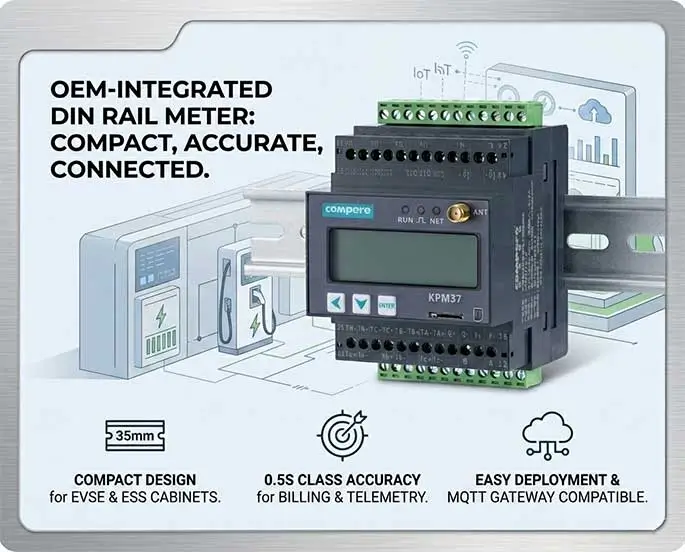
35mm Standard Rail Mounting: Seamlessly integrates into existing industrial and electrical control cabinets without requiring modifications to existing structural designs.
Modular Width: Many advanced rail meters (such as single-phase meters) have a width of only one module (approximately 18mm), allowing for easy installation even in space-constrained charging stations (EVSEs) or communication base stations.
2. Industrial-Grade High Accuracy
Whether used for internal energy consumption analysis, equipment health prediction, or third-party billing, data accuracy is fundamental.
Compliant with International Standards: Mainstream OEM rail meters comply with IEC 62053-21 (Level 1 Active Energy) or even more stringent 0.5S high-accuracy standards.
Wide Measuring Range: Maintains linearity and measurement stability under various dynamic loads in low- and medium-voltage systems, ensuring the reliability of data output from OEM systems.
3. Extremely Simple Deployment and Maintenance (Easy to Deploy)
Plug and Play: Standardized terminal block design significantly reduces wiring time in assembly plants and lowers the risk of human error.
Multiple Current Transformer Connection Options: Supports direct connection or connection via an external split-core current transformer (Split-core CT), the latter allowing for rapid installation without disrupting existing circuitry.
Core Functions: Empowering OEM Manufacturers to Achieve Digital Upgrades
An excellent OEM integrated energy meter is more than just a reader of electricity consumption; it functions as a smart “power sensor.”
| Key Features | Value for OEMs |
|---|---|
| Full Electrical Parameter Measurement | Beyond active energy (kWh), it provides real-time monitoring of voltage, current, power factor, frequency, and reactive power, delivering rich raw data for the OEM’s software system. |
| Multi-Tariff / Time-of-Use (TOU) Metering | Supports electricity calculation across different time periods, meeting the energy optimization and scheduling needs of smart microgrids and Energy Storage Systems (ESS). |
| Bi-directional Energy Metering | Perfectly adapted for B2B green energy scenarios, such as solar PV generation and energy storage, which require simultaneous measurement of both “import” and “export” energy. |
Rich Communication Interfaces: Seamless Integration into Your System
Interoperability is key to OEM integration. Rail-mounted energy meters typically feature open and standard communication protocols, ensuring seamless integration with OEM’s host computers, PLCs, or cloud platforms:
Modbus-RTU (RS485): The most classic protocol in the industrial field, with strong anti-interference capabilities, suitable for data acquisition by local controllers (such as PLCs and industrial PCs).
MQTT: Supports direct connection of meter data to the cloud platform via a gateway. Data packets are extremely lightweight, enabling low-latency, low-power asynchronous data transmission and monitoring even in scenarios with limited network bandwidth and hundreds or thousands of distributed devices on-site.
Wireless Communication (WiFi/4G/LoRaWAN): For distributed devices (such as outdoor charging stations and unattended base stations), energy consumption data can be directly uploaded to the OEM’s cloud-based Internet of Things (IoT) platform without on-site wiring.
Typical Application Scenarios for OEM Manufacturers
Smart Charging Stations (EV Charging Stations): Embedded in rail-mounted energy meters, enabling accurate metering of charging power and B2B billing management.
Intelligent power distribution cabinets and power environment monitoring (power environment monitoring system): Integrated into data center cabinets or communication base stations, monitoring the Power Usage Effectiveness (PUE) of IT equipment in real time.
Solar & ESS integrated photovoltaic energy storage units: Serving as the core sensing unit for backflow prevention detection and strategic scheduling.
Machinery & Automation equipment: Monitoring the energy consumption of individual large machines, helping end customers achieve carbon footprint tracking and predictive maintenance.
Conclusion
For OEM manufacturers seeking high efficiency, accuracy, and rapid delivery, choosing a high-quality DIN rail energy meter is not just choosing a metering component, but also injecting their equipment with the core capability of intelligent energy management. By streamlining space, simplifying deployment, and connecting data, OEM manufacturers can focus more on the R&D of their core businesses, gaining a competitive edge in the green and low-carbon B2B market.
Seeking customized OEM solutions?
We provide comprehensive OEM/ODM services, from white-labeling and firmware protocol customization to specific functional modules. Please contact our application engineers for free samples and technical support.
Get A Quote