In the field of electricity metering and energy management, meter accuracy class is the most crucial indicator for evaluating meter performance. Whether for large industrial users, commercial buildings, or ordinary residences, choosing a meter with the appropriate accuracy class not only affects the fairness of electricity billing but also directly impacts the precision of energy management.
This article will provide an in-depth analysis of what meter accuracy class is and focus on comparing the core differences between common classes such as 0.2S, 0.5S, 0.5, and 1.0.
What is Meter Accuracy Class?
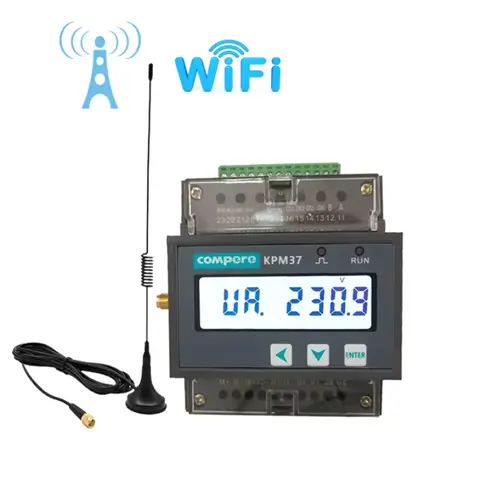
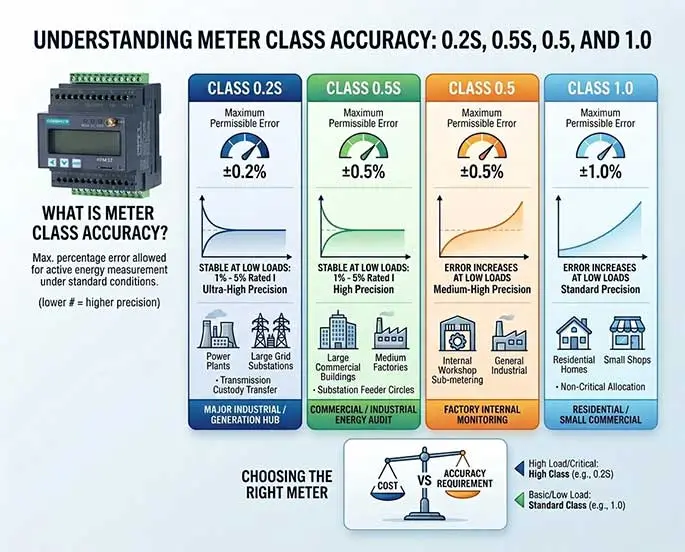
The accuracy class of an smart electricity meter refers to the maximum percentage error allowed when the meter measures electrical energy under standard operating conditions.
Simply put, if an electricity meter has an accuracy class of 1.0, it means that its maximum permissible error is within ±1.0%. If 100 kWh of electrical energy is actually consumed, a meter reading between 99 kWh and 101 kWh is within the acceptable range.
Core Concept: The smaller the rating number, the higher the meter’s measurement accuracy and the smaller its error range.
2. What’S The Difference Between Meters With And Without An “S”? (e.g., 0.5 vs. 0.5S)
When checking high-precision meters, you’ll often see the letter “S” after the numbers (e.g., 0.2S, 0.5S). This “S” stands for “Special” or a special standard for meters connected to current transformers (CTs).
The most crucial difference lies in their performance under light load (low current) conditions:
No “S” rating (e.g., 0.5, 1.0): Accuracy is guaranteed under relatively high loads (typically between 10% and 100% of the rated current). When the current is very low, the error increases significantly.
Meters with an “S” rating (e.g., 0.2S, 0.5S): These adhere to stricter international standards (e.g., IEC 62053-22). They maintain extremely high accuracy even under very low loads (even as low as 1% or 5% of the rated current).
3. Comparison of Common Accuracy Classes
The following is a comparison of different meter accuracy classes in practical applications:
| Accuracy Class | Maximum Permissible Error | Key Features | Primary Applications |
|---|---|---|---|
| Class 0.2S | ±0.2% | Ultra-high precision. Maintains exceptionally low error even under extremely low load conditions. Highest technical standards. | Power plants, grid substations, large regional transmission custody transfer, major industrial power hubs. |
| Class 0.5S | ±0.5% | High precision. Balances accuracy and cost-efficiency. Excellent low-load performance. | Large commercial buildings, medium-sized industrial users, substation feeder circuits, critical energy auditing projects. |
| Class 0.5 | ±0.5% | Medium-high precision. Accurate at rated loads, but underperforms compared to 0.5S under very low load conditions. | General industrial power consumption, internal sub-metering across factory workshops. |
| Class 1.0 | ±1.0% | Standard precision. Low cost, meets basic daily metering and billing requirements. | Residential households, small commercial shops, non-critical internal cost allocation. |
4. Differences in Error Curves: Why do industries prefer “S” class meters?
To understand this more intuitively, let’s look at their error performance under different current loads:
1.0 Class Meters: When the factory is shut down late at night and only a few devices are on standby (low current), the meter’s error may exceed ±1.0%, even reaching ±2.0% or more.
0.5S Class Meters: Even under light loads late at night, with current only 1% to 5% of the rated value, it can steadily control the error within ±0.5%.
For industrial users or power plants that consume massive amounts of electricity, even an error of ±0.1% can accumulate into significant economic losses over the long term. Therefore, power companies invariably mandate the use of 0.2S or 0.5S class meters at the point of sale (billing and settlement).
Summary: How to Choose the Right Electricity Meter?
When choosing a meter, more precision is not always better; a balance must be struck between cost and needs:
Residential and small commercial properties: A Class 1.0 meter (or what is commonly referred to as a Class 1 meter in China) is sufficient, offering the best cost-effectiveness.
Multi-level metering and energy consumption monitoring within factories: A Class 0.5 or 0.5S meter is recommended to accurately track energy consumption data for each production line and perform carbon emission accounting.
Large industrial users and grid trade settlement: High-precision Class 0.5S or 0.2S meters are essential to ensure accurate recording of every kilowatt-hour and prevent economic disputes.