Selecting the right communication architecture is critical for automating commercial billing, eliminating data transmission errors, and ensuring real-time energy visibility in large-scale property management. For system integrators and energy managers, deployment success depends entirely on communication stability, noise immunity, and seamless hardware networking in harsh electrical environments.
Get A Quote💡1. How is RS485 defined?
RS485 (now known as TIA/EIA-485) is an industrial-grade serial communication standard. It defines the electrical characteristics used for data transmission, primarily employing balanced transmission lines and differential signaling technology.
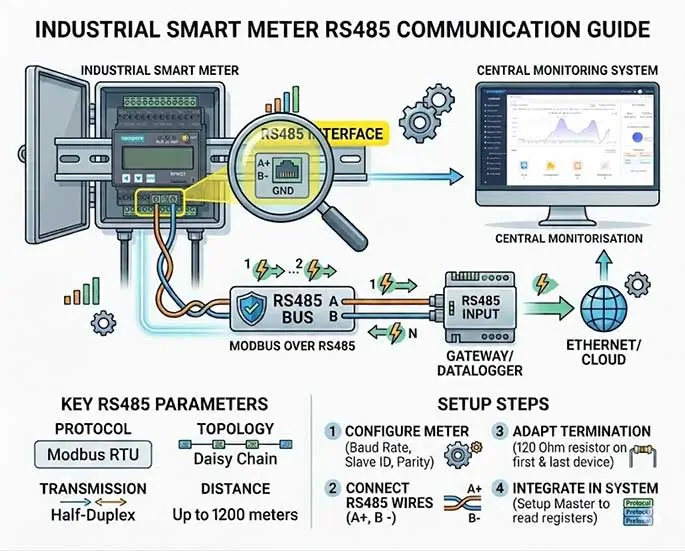
Half-Duplex Mode: Smart meter systems typically use a two-wire (A line and B line) half-duplex configuration. This means that data can be transmitted bidirectionally, but only one side can send while the other receives at any given time. In simple terms, it’s like a walkie-talkie mode: when you speak, I can only listen, and when I speak, you can only listen.
⚙️ 2. RS485 Working Principle & System Architecture
An industrial smart energy meter functions as a highly synchronized edge node within a master-slave network. While wireless technologies (such as 4G, LoRaWAN, and Wi-Fi) excel in open environments, RS485 remains the definitive wired backbone because of its localized stability inside shielded metal enclosures, basements, and high-density electrical rooms.
Core Working Mechanisms
- Differential Signaling: Represents logic states by evaluating the voltage difference between Line A and Line B, completely isolating the signal from ground loop fluctuations.
- Master-Slave Framework: Runs standard Modbus-RTU where a data concentrator polls individual meters sequentially by unique Slave IDs, effectively preventing bus data collisions.
Why Differential Signaling Eliminates Interference
When external electromagnetic noise (EMI) sweeps across the factory grid, it couples onto both Line A and Line B simultaneously and equally. Because the industrial receiver only calculates the voltage difference between the two lines, this identical common-mode noise perfectly cancels itself out upon subtraction, yielding uncorrupted data packages.
🌐 3. Network Topology: Standardized Daisy-Chain Layout
In actual smart meter deployments, hardware installer compliance regarding topology layout determines whether the system works or crashes. RS485 strictly demands a Daisy-Chain configuration.
The main backbone cable must travel continuously from the data gateway, connect directly to the first meter’s blocks, then proceed to the second meter, and so on. Branch stub lengths extending to individual meters must never exceed 30 centimeters.
Critical Pitfall: Star Topology Errors
Never split communication lines out from a single central point like a star. A star configuration induces severe impedance mismatches, causing communication wave pulses to reflect backwards down the cable. This creates signal collisions and intermittent packet losses that are incredibly difficult to debug.
🔋 4. Strategic Advantages of RS485 for System Integrators
- Extended Local Reach: At lower transmission rates, RS485 can achieve a maximum transmission distance of 1200 meters, more than enough to cover a high-rise building from the top floor to the ground floor electrical room, making it ideal for high-rise residential buildings, large factories, or commercial parks.
- Large Node Capacity: A single RS485 bus standard can connect 32 standard load nodes. By using modern chips with high input impedance, a single bus can even accommodate 128 or 256 smart meters.
- Zero Wireless Blind Spots: Electricity meters are often installed in basements, electrical rooms, or metal meter boxes, making it extremely difficult for wireless signals to penetrate. RS485 wiring is completely unaffected by building structures and shielding.
- Low Cost And Long Lifespan: Compared to configuring a wireless module for each meter and requiring annual SIM card renewals, RS485 only requires inexpensive twisted-pair cable—a few cents per meter. Once installed, it lasts for ten or twenty years without any worries, offering extremely stable performance.
Summary
In short, RS485 in a smart meter is an interference-resistant, multi-meter-connecting, long-range, and inexpensive “data bus.” It uses two twisted-pair wires, communicating via voltage difference. Like a group of interconnected wires, it ensures smooth data transmission. Remember these points during installation: always connect them in a single line, never use a star topology, and add a small resistor at the end—and your meter reading system will be basically stable.