In industrial, commercial, and large-scale infrastructure project planning, energy management is often a key factor determining operating costs. One of the most crucial decisions when selecting equipment is: should you choose a high-accuracy 0.5S class energy meter or a lower-cost 1.0 class meter?
Technicians often prefer “the higher the accuracy, the better,” but financial approvers are more concerned with “how long it will take to recoup the extra budget.” This article will explain the core differences between the two in the simplest terms, showing you whether high accuracy is truly a worthwhile investment.
Three Phase Energy Meter ListCore Difference: More Than Just a Change in Numbers
Many people mistakenly believe that the only difference between 0.5S and 1.0 class energy meters is the apparent error range. In reality, that crucial letter “S” represents a significant technological gap.
1. What is “S”? (Good Vision Under Low Load)
In the International Electrotechnical Commission (IEC) standard, “S” represents a special starting current. Simply put, it determines the meter’s measurement capability under “light load” conditions.
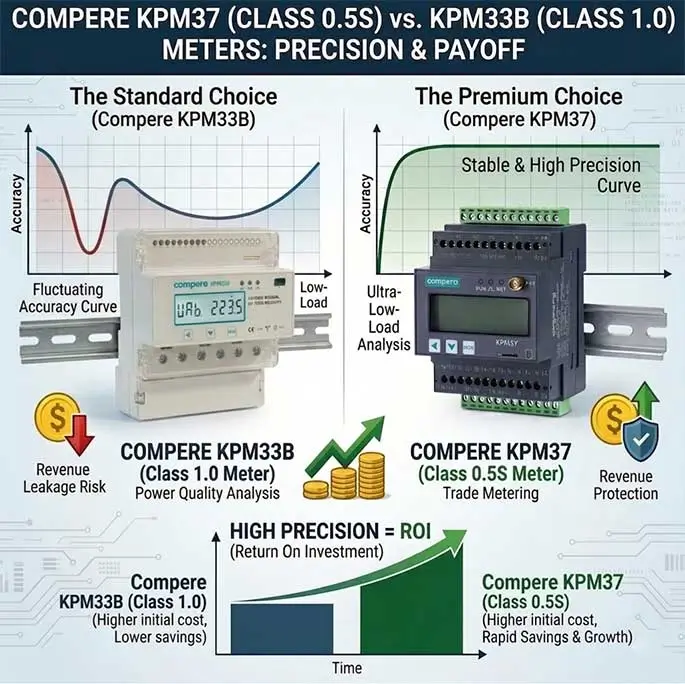
Class 1.0 energy meter: Like someone with slight nearsightedness. When a factory or building is in a low-power state (such as at night with only equipment on standby or safety lighting), the current becomes very weak. At this time, the measurement accuracy of a Class 1.0 energy meter will drop significantly, and it may even “miss” some electricity.
Class 0.5S energy meter: Possesses excellent “night vision.” Even under extremely low current loads, it can still maintain extremely high accuracy, recording even minute changes in electricity consumption.
2. Error Performance Comparison
A typical Class 1.0 energy meter performs normally when electricity consumption is high, but its error increases sharply when electricity consumption decreases. A Class 0.5S energy meter, however, maintains accuracy as stable as a straight line regardless of the amount of electricity consumed.
Financial Calculation: How Much Can High-Precision Meters Save You?
To understand this more intuitively, let’s look at a real-world business scenario.
Suppose a medium-sized factory or a large shopping mall has significant monthly electricity expenses. If they opt for a cheaper Class 1.0 electricity meter, they might face two hidden losses:
Underreporting of light loads: Tiny amounts of electricity consumed at night, on weekends, or when equipment is in standby mode are not accurately recorded.
Slower meter readings within acceptable limits: If the meter is slow within acceptable limits, it can accumulate into substantial, “invisible” accounting errors over time.
Conversely, upgrading to a Class 0.5S electricity meter can reduce the error range by half and accurately record every kilowatt-hour consumed under low load conditions.
While a high-quality Class 0.5S electricity meter is more expensive than a Class 1.0 meter initially, for businesses with a certain scale of electricity consumption, the losses saved by reducing metering errors by a high-precision meter can typically be fully offset within just two to three months. Over its long lifespan of several years, the savings it generates will far exceed the initial investment.
When Is It Recommended To Choose A 0.5S Class Energy Meter?
While its high precision is a significant advantage, not all places require a “high-end” meter. The following scenarios strongly recommend choosing a 0.5S-class meter:
1. Gateway metering and trade settlement (where the main account is calculated)
Used for main account meters for electricity bill reconciliation and settlement between power grid companies and businesses. At the main account, even a tiny error multiplied by a large base of electricity consumption can become a huge potential source of financial disputes.
2. Locations with significant “day-night temperature differences” or “tidal” electricity consumption
Office buildings and shopping malls: During the day, they are bustling with people and air conditioning is running at full capacity, resulting in huge electricity consumption; at night and on weekends, they are deserted, with only a few devices on standby. This huge difference in electricity consumption requires a 0.5S-class meter to accurately capture electricity consumption during off-peak periods.
Solar and wind power stations: Power generation is extremely low in the early morning, evening, or on cloudy days. A Class 1.0 meter is almost incapable of accurately recording these tiny inflows of green electricity.
3. High-Energy-Consuming Industrial Users
For energy-guzzling enterprises such as precision manufacturing, data centers, and steel mills, even a 0.1% improvement in accuracy translates into substantial economic benefits due to their extremely large electricity bills.
When Is A Class 1.0 Meter Sufficient?
Internal three-tiered assessment: For example, internal meters used within a building to roughly understand the energy consumption ratio of each department and workshop, not for external billing.
Used only for big data trend analysis: If the purpose of installing the meter is simply to monitor energy consumption trends and make energy-saving plans, not for precise billing.
Ordinary residential buildings: Individual household electricity consumption is small, and they rarely remain in a low-load standby state for extended periods.
Final Summary
Back to the initial question: Does high accuracy truly bring high returns?
The answer is yes, the key is “adapting to local conditions”:
Don’t skimp on the “gateway” and “high-energy-consuming nodes.” Choosing a 0.5S class energy meter is not a “luxury,” but a high-return financial defense strategy that ensures you don’t unnecessarily pay for invisible energy consumption due to “blind spots” in the metering.
Focus on cost-effectiveness in “internal assessments” and “auxiliary nodes.” A 1.0 class energy meter remains a classic and practical choice for controlling budgets and conducting large-scale energy consumption monitoring.