When building smart metering, energy management, or Industrial Internet of Things (IIoT) systems, the choice of data gateway is crucial. As the core hub connecting end-point meters (electricity meters, water meters, gas meters, etc.) to the cloud platform, the gateway’s communication interface directly determines the stability, construction cost, and maintenance difficulty of the entire system.
Faced with multiple communication technologies such as RS485, Ethernet, Wi-Fi, and 4G, how do you make the optimal choice based on the actual application scenario? This article will provide an in-depth analysis of the advantages and disadvantages of each interface and offer selection strategies for multi-meter systems.
In-depth Analysis of Core Communication Interfaces
In multi-meter systems, communication is typically divided into two layers:
Downlink Communication (Acquisition Layer): The connection between the gateway and the end-point meters.
Uplink Communication (Transmission Layer): The connection between the gateway and the local server or cloud platform.
1. RS485: The Classic Local Bus Expert
RS485 is a typical example of differential signal transmission, long used in industrial and instrumentation fields, typically for downlink communication.
Advantages:
Strong anti-interference capability: Utilizing differential transmission, it effectively suppresses electromagnetic noise in industrial environments.
Simple topology and large capacity: Employing a daisy-chain bus topology, a single bus can typically support 32 nodes (expandable to 128 or more with repeaters).
Long transmission distance: Stable transmission distance up to 1200 meters.
Extremely low cost: Hardware and cabling costs are significantly lower than network equipment.
Disadvantages:
Complicated installation: Requires cabling, unsuitable for already decorated areas or locations spanning multiple buildings.
Lower data rate: Limited bandwidth, unsuitable for transmitting large amounts of data (such as audio, video, or high-frequency waveform data).
2. Ethernet (RJ45): Unparalleled Stability
Ethernet is the foundation of modern wired networks, dominating uplink communication in gateways.
Advantages:
Extremely High Stability and Bandwidth: Zero data transmission delay and no packet loss; bandwidth can reach hundreds of megabits or even gigabits.
High Security: Closed-loop network environment, easier to defend against network attacks compared to wireless.
Plug and Play: Extremely convenient to connect in LAN environments.
Disadvantages:
Limited Cabling: Each gateway requires a network cable to the switch; installation costs increase dramatically with distance.
Poor Flexibility: High relocation costs once the device location is fixed.
3. Wi-Fi: Cost-Effective Wireless LAN
Wi-Fi is suitable for uplink communication, especially in indoor environments with existing wireless network coverage.
Advantages:
No Cabling Required: Eliminates the hassle of drilling holes in walls, significantly reducing installation labor costs.
High Bandwidth: Easily handles large volumes of concurrent data uploads from instruments.
Disadvantages:
Poor signal penetration: The 5GHz band has weak wall penetration capability, and the 2.4GHz band is easily interfered with by devices such as microwave ovens and Bluetooth.
Limited coverage: The coverage range of a single AP is usually within tens of meters, and the network configuration process (SSID and password input) is relatively cumbersome.
4. 4G/Cellular Network: Borderless Remote Transmission
4G (including Cat.1 and Cat.4) is currently the mainstream choice for IoT remote uplink communication.
Advantages:
Extremely fast deployment: No local network cooperation required (no need to ask the owner for Wi-Fi password or IP address), network access is available as soon as power is connected.
Wide coverage: Can be used wherever there is a base station signal (even in remote mountainous areas, rooftops, and power distribution rooms).
Easy maintenance: No need to reconfigure the network when the gateway location changes.
Disadvantages:
Continuous charges: Each gateway requires an IoT card (SIM card), which will incur continuous data charges.
Signal Dead Zones: Signal is poor in basement levels 2 and below, and inside metal-shielded cabinets, requiring external extension antennas.
Key Dimension Comparison
Data Gateway Interface Comparison
| Dimension | RS485 | Ethernet | Wi-Fi | 4G / Cat.1 |
|---|---|---|---|---|
| Primary Role | Downlink Collection (Meters to Gateway) | Uplink Transmission (Wired) | Uplink Transmission (Wireless Short-range) | Uplink Transmission (Wireless Long-range) |
| Transmission Distance | Medium to Long (≤ 1200m) | Short (Single Cable ≤ 100m) | Short (Indoor ≤ 50m) | Theoretically Unlimited (Depends on Base Station) |
| Deployment Difficulty | Difficult (Requires manual wiring) | Difficult (Requires engineering cabling) | Easy (Requires local network config) | Extremely Easy (Plug and play with SIM) |
| Anti-Interference | Extremely High | Extremely High | Medium (Prone to co-channel) | High (Dedicated frequency bands) |
| Post-maint. Effort | Maintain line aging/faults | Extremely low failure rate | Requires attention to router changes | Requires management of SIM card renewal |
| Hardware Cost | Extremely Low | Low | Low | Medium |
Practical Strategies for Multi-Meter System Selection
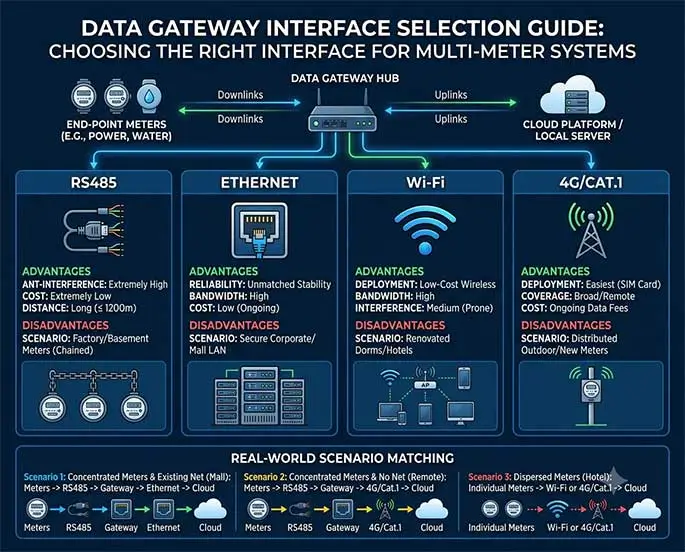
In multi-meter (centralized meter reading) systems, the most common architecture is: End-point meters (multiple units) → (Downlink) → Data Gateway → (Uplink) → Cloud Platform.
Based on the specific physical environment and project budget, the following combination is recommended:
Scenario 1: Highly concentrated meters, existing network environment (e.g., shopping malls, office buildings, modern factories)
Recommended Solution: RS485 (Downlink) + Ethernet (Uplink)
Selection Logic: Dozens of meters are typically installed in a distribution box or electrical shaft. All meters are connected daisy-chained to the gateway’s RS485 serial port using an RS485 bus. If there is a corporate LAN on-site, the gateway is directly connected to a switch via Ethernet.
Advantages: Most stable solution, zero risk of wireless signal interference, and no subsequent data traffic charges.
Scenario 2: Centralized Meters, No Existing Network or Strict Prohibition of Intranet Access (e.g., Power Distribution Room Renovation, Centralized Workshops in High-Energy-Consuming Enterprises)
Recommended Solution: RS485 (Downlink) + 4G (Uplink)
Selection Logic: Meters are still networked at low cost via RS485. Since there is no network on-site, or the client does not allow IoT devices to access their office/production intranet for network security reasons, the gateway directly transmits data to the cloud via 4G.
Advantages: Perfectly achieves physical isolation, shortens the construction period by more than 80%, and is currently the most popular commercial project implementation model.
Scenario 3: Dispersed Meters, Existing Indoor Wireless Coverage (e.g., Smart Parks, Park Dormitories, Budget Hotels)
Recommended Solution: Wi-Fi/4G Gateway (Direct Connection or Small-Scale Centralization)
Selection Logic: If there is only one meter per room, and running RS485 cables is extremely difficult, but overall Wi-Fi coverage is good, a Wi-Fi gateway (or a smart meter with built-in Wi-Fi functionality) can be selected. If thick walls obstruct the signal, a switch to a 4G solution should be made immediately.
Advantages: Completely eliminates on-site wiring, preserving existing fixtures to the greatest extent.
Selection Decision-Making Guide
Don’t blindly pursue full wireless: Many projects use wireless meters for convenience, but wireless signal attenuation is severe inside enclosed metal distribution boxes. The safest approach remains “RS485 wired connection inside the distribution box, with the gateway external and using 4G/Ethernet for data transmission.”
Pay attention to the 4G antenna location: If the gateway must be installed inside a metal cabinet, be sure to purchase a gateway with a suction cup antenna to extend the antenna outside the cabinet; otherwise, the device is prone to going offline.
Reserve expansion space: When selecting a gateway, confirm its RS485 polling capability and memory size. If there are currently 20 meters, it is recommended to choose a gateway that supports 32 or 64 meters to allow for future meter additions.
In summary, there is no single best interface, only the most suitable combination for the scenario. In multi-tablet systems, “RS485 (downlink collection) + 4G/Ethernet (uplink interconnection)” is a classic golden combination that balances cost, stability, and ease of installation. When planning a project, conducting a preliminary survey of the site’s network conditions, shielding, and cabling space is crucial to ensuring the efficiency and stability of the data acquisition system.