In the volatile global energy market, grid volatility and rising peak-hour demand charges represent a direct threat to industrial profitability. For energy procurement managers, EPC contractors, and sub-metering solution providers, managing electrical overhead is no longer just about tracking consumption—it is about strategic timing.
Implementing smart multi-tariff energy meters utilizing time-of-use billing commercial applications has emerged as the industry standard for stabilizing operational expenditures. By aligning power consumption with dynamic utility rates, commercial enterprises can transform electricity from an uncontrollable fixed cost into an optimized variable asset.
Navigating C&I Energy Challenges: Compliance, Cost, and Efficiency
Managing energy in commercial and industrial (C&I) sectors requires addressing three structural pain points that directly impact corporate bottom lines.
1. Regulatory Compliance
Navigating regional grid codes, anti-tampering directives, and fiscal metering legislations is a complex hurdle for international projects. Deploying sub-metering infrastructure must strictly adhere to international measurement standards. Without proven compliance, systems risk failing municipal utility audits or violating local grid-connection codes.
2. Strategic Cost Allocation
Flat-rate electricity billing penalizes high-load facilities operating during localized peak windows. Advanced tariff scheduling cost allocation allows energy managers to map consumption profiles against hourly grid pricing. By shifting heavy loads—such as centralized HVAC systems, heavy machinery, or fleet EV charging stations—to off-peak intervals, facilities mitigate steep peak demand surcharges.
3. Operational Efficiency
Manual data collection introduces human error, processing lag, and billing friction. Modern power management demands an automated, digital layer. Real-time telemetry, remote data logging, and multi-channel communication protocols eliminate manual entry, giving operators the transparent data required for instantaneous decision-making.
Engineering Core Advantages: Meeting Global Procurement Standards
International B2B buyers operate on a rigid decision-making framework centered on certification, data fidelity, and long-term service. The core architecture of industrial-grade multi-tariff meters reflects these strict requirements:
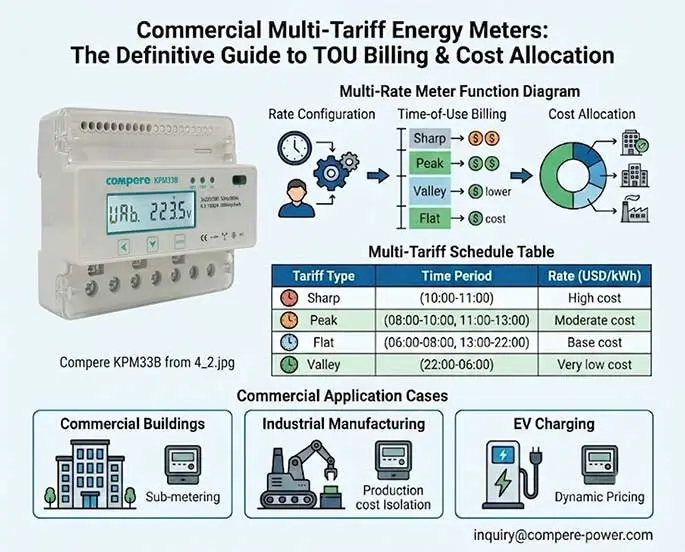
- Granular Tariff Scheduling: Supports up to 4 distinct tariffs (Sharp, Peak, Flat, Valley), multi-season configurations, and programmable holiday schedules to match any complex regional utility structure worldwide.
- Metrological Precision: Engineered with Class 0.5S active energy accuracy ratings, ensuring precision measurements even in environments with harmonic distortion.
- Anti-Tampering & Data Security: Features hardware-level seal monitoring, reverse-current detection, magnetic field interference logging, and a non-volatile internal storage module that retains critical billing data for more than 10 years without auxiliary power.
- Open Architecture Connectivity: Native integration with standard industrial automation networks via RS485 (Modbus-RTU) alongside scalable wireless options including 4G, NB-IoT, and WiFi for seamless Building Management System (BMS) ingestion.
Technical Specifications & Standard Matrix
To assist procurement teams during engineering verification, the table below outlines the structural and electrical parameters standard across modern commercial metering systems.
| Parameter Category | Technical Specification | International Standards |
|---|---|---|
| Accuracy Class | Active: Class 0.5S / Class 1.0 Reactive: Class 2.0 |
IEC 62053-22 / IEC 62053-21 |
| Nominal Voltage (Un) | 3 × 220/380V, 3 × 230/400V (± 20%) | IEC 62052-11 |
| Current Ratings (Imax) | Direct Connect: 5(60)A to 10(100)A CT Connect: 1.5(6)A |
Market-specific variations |
| Rated Frequency | 50Hz or 60Hz (± 5%) | Global Grid Compatibility |
| Tariff Capabilities | Max 4 rates, 8 daily time segments, 14 profiles | Programmable via software |
| Communication Layer | Modbus-RTU, DLMS/COSEM, IEC 62056-21 | Open-source interoperability |
| Environmental Protection | IP51 (Indoor Mount) / IP54 (with Enclosure) | IEC 60529 |
Primary Commercial Application Scenarios
Multi-Tenant Commercial Complexes
In large-scale shopping malls and mixed-use commercial office spaces, uniform energy billing leads to revenue leakage and tenant disputes. Sub-metering networks utilizing time-of-use billing commercial applications enable property managers to assign exact energy expenses to individual tenants based on the exact hour of consumption, driving accountability and transparent property management.
Industrial Manufacturing & Industrial Parks
Heavy industrial operations with high-consumption motor loads or thermal processing units utilize tariff scheduling cost allocation to isolate energy costs per production batch. By programming automation systems to run high-draw processes during valley hours, plant managers significantly drive down the levelized cost of manufacturing.
EV Charging Infrastructure & Microgrids
Commercial electric vehicle charging hubs rely heavily on multi-tariff capabilities. Operators can dynamically scale charging fees in real-time—charging premium rates during grid strain and offering discounts overnight—ensuring network profitability while protecting local substation hardware from thermal overloads.
B2B Sourcing Guide: De-Risking International Procurement
Sourcing industrial instrumentation requires checking structural criteria to prevent field failures and system incompatibility.
1. Verify Rigorous Certifications
Ensure all hardware carries accredited third-party validations certifications for protocol interoperability. These marks certify that the device meets statutory safety, calibration, and grid-tied accuracy mandates.
2. Confirm Data Interoperability
Avoid proprietary hardware lock-in. Sourced meters must transmit clean, unencrypted standard frames (like Modbus or DLMS) that seamlessly interface with your existing energy management software, or third-party cloud platforms.
3. Evaluate Engineering Support Frameworks
Hardware deployment is only as reliable as its technical backing. Partner with manufacturers that provide full SDK documentation, remote firmware updates (FOTA) capabilities, clear warranty parameters, and accessible field engineering support.
Frequently Asked Questions (FAQ)
Q1: How are tariff schedules modified when local utility rates change?
A: The firmware supports over-the-air (OTA) updates. Network administrators can reconfigure daily schedules, holiday exemptions, and seasonal tariff tiers remotely through centralized energy management software, completely removing the need for manual on-site reconfiguration.
Q2: When should an engineer specify a CT connection over a Direct connection meter?
A: Direct connection meters are engineered for standard commercial applications with currents up to 100A. For heavy industrial feeders, primary substations, or large service entrances exceeding 100A, a Current Transformer (CT) connection model must be specified to safely scale down massive primary currents for accurate metering.
Q3: What mechanisms prevent billing data loss during unexpected facility power failures?
A: The internal micro-control unit (MCU) automatically writes all accumulated energy registers, current tariff states, and tamper event logs to non-volatile EEPROM memory the moment a voltage drop is detected. This ensures absolute data permanence without relying on external battery maintenance.
Optimize Your Facility’s Energy Infrastructure
Selecting the right metering architecture requires matching precise technical requirements with local grid realties. Whether you are developing a new multi-tenant commercial property, upgrading an industrial park’s power management system, or scaling an EV charging network, our application engineers are here to streamline your integration process.
Email our technical engineering desk directly at [email protected] to request comprehensive product samples, receive a detailed project schematic review, or schedule a one-on-one consultation for a tailored onsite energy management solution.