Managing multi-tenant commercial facilities, high-density data centers, or complex industrial infrastructure involves dealing with high power distribution costs and complex compliance frameworks. Modern energy managers face massive hardware overhead, space constraints in panel boards, and integration silos when using single-channel meters. Upgrading these systems requires clear planning around space, hardware, and integration.
This 2026 Multi-Circuit Energy Meter Selection Guide outlines modern electrical engineering practices to help industrial procurement teams, electrical engineers, and panel builders address the three main structural challenges in power systems: regulatory compliance, hardware and labor cost reduction, and operational efficiency. It provides practical recommendations tailored for decision-makers who prioritize international engineering compliance, data reliability, and manufacturer technical services.
1. Solving the Three Pillars of Power Infrastructure Pain Points
Regulatory and Engineering Compliance
Modern commercial and industrial facilities must meet strict international energy management standards. Building frameworks such as ISO 50001 (Energy Management Systems), LEED (Leadership in Energy and Environmental Design), and BREEAM require detailed branch-level electrical monitoring rather than just main-breaker tracking. Multi-circuit energy meters capture data at the branch circuit level, allowing engineering teams to track power usage effectiveness (PUE), verify energy baselines, and maintain compliance during external green-building audits.
Structural Cost Reduction
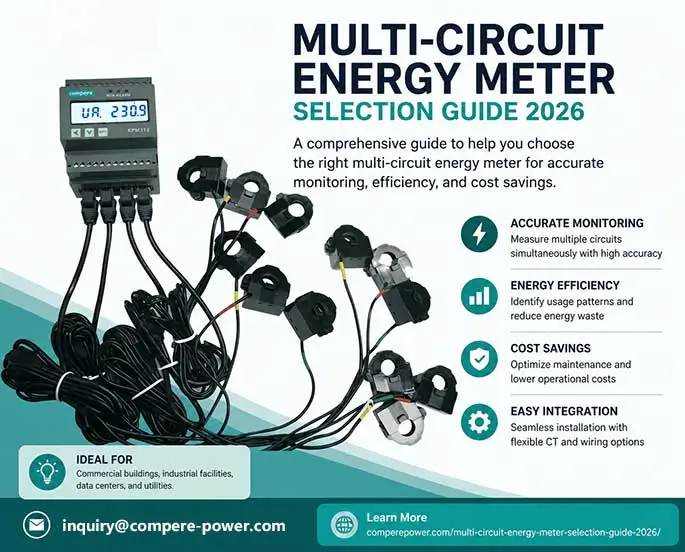
Traditional configurations that place individual DIN-rail or panel-mounted meters on every branch circuit are expensive and require a lot of space. Multi-circuit power meters solve this by monitoring dozens of single-phase or multiple three-phase circuits from a single hardware processor and display hub. This design reduces required panel space by up to 60%. Combined with external split-core current transformers (CTs) or flexible Rogowski coils, installation does not require cutting power busbars or main conductors, which reduces electrical contracting labor expenses by up to 55% during field retrofits.
Operational and Data Efficiency
Manual data collection and siloed electrical panels slow down operational response times. 2026-generation multi-circuit monitoring systems feature onboard industrial communication processors that convert field data into clear insights. By transmitting parameters directly to central building automation networks or facility management systems via native industrial protocols, these meters eliminate data bottlenecks. This gives engineering teams immediate visibility into phase unbalance, voltage sags, and peak demand spikes across the facility.
2. Core Application Scenarios in High-Density Electrical Environments
Multi-circuit sub-metering systems provide clear technical and financial advantages in environments with space limitations and multiple electrical loads:
- Data Centers & Critical Facilities: Monitoring individual server racks, power distribution units (PDUs), and remote power panels (RPPs) to calculate accurate rack-level PUE without interrupting power to active IT infrastructure.
- Commercial Complexes & Smart Buildings: Tracking energy use across multi-tenant commercial real estate, retail shopping malls, and mixed-use towers to ensure accurate billing based on actual consumption instead of estimated floor area.
- Industrial Plants & Manufacturing Lines: Isolating the energy consumption of high-power machinery, individual assembly lines, and large HVAC units to identify energy waste, schedule preventive maintenance, and manage peak loads.
- Telecom & Distributed Infrastructure: Monitoring multi-source power cabinets that integrate traditional utility grids, backup diesel generators, and DC solar arrays in a single compact housing.
3. 2026 Multi-Circuit Meter Structural Specifications Matrix
The table below outlines technical configurations for multi-circuit meters designed for high-density monitoring installations:
| Technical Parameters | High-Density Compact Variant | Industrial Multi-Channel Variant | High-Performance Analyzer Variant |
|---|---|---|---|
| Circuit Capacity | Up to 12 Single-Phase / 4 Three-Phase | Up to 36 Single-Phase / 12 Three-Phase | Up to 48 Single-Phase / Mixed Busbar |
| Accuracy Class | Active Energy: Class 1.0 (IEC 62053-21) | Active Energy: Class 0.5S (IEC 62053-22) | Active Energy: Class 0.2S (Revenue Grade) |
| Current Transformer Inputs | 333mV Low-Voltage Split-Core CTs | 100mA / 5A Split-Core or Solid-Core CTs | Flexible Rogowski Coils & Multi-Range CTs |
| Communication Protocols | Modbus-RTU via RS485, Wi-Fi | Modbus-RTU, LoRaWAN, NB-IoT | Modbus-TCP via Ethernet, MQTT, HTTPs |
| Power Quality Analysis | Voltage, Current, Frequency, kW, kVAR | Total Harmonic Distortion (THD), Unbalance | Individual Harmonics to 31st, Crest Factor |
| Data Logging Capacity | 2 MB Non-Volatile Flash Memory | 8 MB Industrial Onboard Logging | 32 MB+ Secure Event Data Logger |
| Mounting Configuration | Standard 35mm DIN Rail | Standard 35mm DIN Rail | Panel Flush Mount / Modular Array |
4. Technical Sourcing Framework for International Procurement
Verified Global Certifications: Electrical equipment must comply with regional safety and performance rules. Ensure devices carry recognized marks like CE (European Conformity) for low-voltage directives, UL (Underwriters Laboratories) or CSA listings for the North American market, and FCC compliance for electromagnetic compatibility. These marks show the equipment can operate safely in demanding industrial environments.
Data Integrity and Network Security: Because modern multi-circuit meters connect directly to local networks and cloud systems, they must be secure. Look for meters that support network security protocols like TLS 1.2 for MQTT cloud communication or password-controlled access for Modbus configuration. Additionally, local non-volatile data storage prevents loss of data during network drops by logging consumption locally and uploading it automatically when connection returns.
Technical Service and Integration Support: B2B electrical buyers require comprehensive documentation to keep projects on schedule. Reliable suppliers provide clear engineering resources, including detailed Modbus register maps, STEP files or CAD drawings for enclosure planning, and direct contact with application engineers to help resolve integration challenges during commissioning.
5. Engineering Frequently Asked Questions (FAQ)
Can a single multi-circuit meter monitor different voltage phases or a mix of single-phase and three-phase loads simultaneously?
Yes. Advanced multi-circuit meters allow flexible internal channel allocation. A single device can monitor a combination of single-phase commercial sub-distribution boards and three-phase industrial machinery loads at the same time. These channels can be configured through the meter’s configuration interface or software utility.
Is it necessary to isolate the main power distribution board during the installation or upgrade of a multi-circuit meter?
No, you do not need to shut down the system if you use split-core current transformers or flexible Rogowski coils. These sensors snap or loop directly around insulated live conductors without cutting conductors or interrupting downstream operations. Only the low-voltage voltage connection requires a standard circuit breaker connection, which can be safely managed under standard industrial work permits.
How do multi-circuit meters handle firmware updates and system reconfigurations after installation?
Industrial multi-circuit meters support remote configuration and updates via their primary communication ports, such as Modbus-TCP over Ethernet or RS485. This enables maintenance teams to adjust current transformer ratios, update security protocols, or verify diagnostic registers across several units from a central engineering station without accessing the physical electrical panel.
Optimize Your Power Distribution Efficiency
Designing a new electrical panel, managing a data center facility retrofit, or upgrading your plant’s compliance framework requires a precise technical approach. Contact our senior application engineering team to receive a free, comprehensive project review, tailored multi-circuit wiring diagrams, and one-on-one technical guidance customized for your facility’s requirements. Direct your engineering specifications and inquiries to our team at [email protected].