Choosing the right energy meter accuracy class is a critical decision for industrial facilities, commercial buildings, and energy management projects. Many engineers and purchasing managers face the challenge of selecting between a 0.2S and 0.5S energy meter because both provide high measurement accuracy but are designed for different application requirements.
A higher accuracy class does not always mean the best choice for every project. Selecting an unnecessarily precise meter can increase investment costs, while choosing a lower accuracy class may affect energy analysis, cost allocation, and power management decisions.
This article explains the key differences between 0.2S and 0.5S energy meters, their applications, cost considerations, and how to choose the right accuracy class for industrial energy monitoring systems.
Industry Pain Points: Why Choosing the Right Energy Meter Accuracy Matters
Industrial users often face several challenges when selecting energy measurement equipment. The wrong accuracy class may lead to inaccurate energy data, inefficient management decisions, or unnecessary equipment costs.
Common industry pain points include:
- Energy measurement errors affecting electricity cost allocation between departments or production lines.
- Low-accuracy meters providing insufficient data for detailed energy analysis.
- High-precision meters increasing project costs without providing additional value.
- Different applications requiring different measurement accuracy levels.
For factories, industrial plants, and energy management systems, selecting the correct energy meter accuracy class helps achieve a balance between measurement reliability and investment efficiency.
What Does Energy Meter Accuracy Class Mean?
Energy meter accuracy class defines the maximum allowable measurement error of an electricity meter under specified operating conditions. The smaller the error percentage, the higher the measurement accuracy.
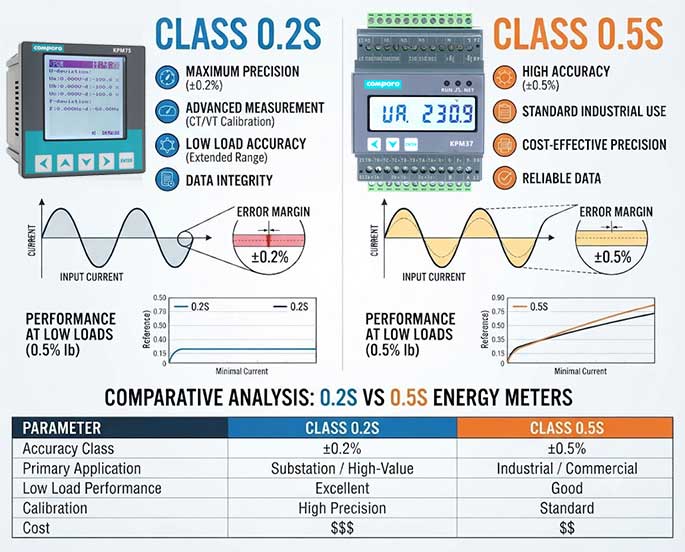
For example, a Class 0.5S energy meter has a maximum error of ±0.5%, while a Class 0.2S energy meter has a maximum error of only ±0.2%. This means the 0.2S meter provides more precise measurement performance.
According to IEC energy measurement standards, accuracy classes such as 0.2S and 0.5S are commonly used for high-performance active energy measurement applications.
| Accuracy Class | Maximum Error | Typical Applications |
|---|---|---|
| 0.2S | ±0.2% | High precision measurement, utility applications, critical energy monitoring |
| 0.5S | ±0.5% | Industrial energy monitoring, commercial buildings, sub-metering |
| 1.0 | ±1% | General energy measurement applications |
0.2S vs 0.5S Energy Meter: Key Differences Explained
The main difference between a 0.2S and 0.5S energy meter is measurement accuracy. Both are widely used in professional energy measurement applications, but their performance and recommended use cases are different.
1. Measurement Accuracy Comparison
A Class 0.2S energy meter provides higher accuracy than a Class 0.5S meter. With a maximum error of ±0.2%, it can capture smaller measurement deviations and provide more precise energy data.
A Class 0.5S energy meter allows a maximum error of ±0.5%, which is still highly accurate and suitable for most industrial energy monitoring applications.
2. Cost Difference
Higher accuracy usually requires more advanced components, improved calibration processes, and better internal measurement technology. Therefore, 0.2S energy meters generally have a higher cost compared with 0.5S meters.
For projects where measurement accuracy directly affects financial transactions or energy trading, the additional investment in a 0.2S meter may be justified. However, for most industrial energy monitoring projects, a 0.5S meter provides an excellent balance between performance and cost.
3. Application Difference
| Feature | 0.2S Energy Meter | 0.5S Energy Meter |
|---|---|---|
| Accuracy Level | Higher precision | High precision |
| Maximum Error | ±0.2% | ±0.5% |
| Cost | Higher | Moderate |
| Typical Application | Utility measurement, critical loads, energy trading | Industrial monitoring, factory energy management |
| Industrial Energy Monitoring | Excellent | Excellent |
0.2S Energy Meter Applications: When Do You Need Higher Accuracy?
A 0.2S energy meter is typically selected when measurement accuracy has a direct impact on financial performance, compliance, or operational decisions.
Common applications include:
- Utility-grade electricity measurement.
- Renewable energy generation monitoring.
- Energy trading and settlement applications.
- Critical industrial equipment monitoring.
- Large-scale power distribution systems.
When even small measurement errors can result in significant financial differences, a higher accuracy Class 0.2S meter is usually preferred.
0.5S Energy Meter Applications: The Best Choice for Industrial Energy Monitoring
For most industrial energy management projects, a 0.5S energy meter provides the ideal combination of accuracy, reliability, and cost efficiency.
Typical applications include:
- Factory electricity consumption monitoring.
- Production line energy analysis.
- Building energy management systems.
- Industrial IoT energy monitoring platforms.
- Machine-level power monitoring.
A Class 0.5S smart energy meter can provide reliable measurement data for identifying energy waste, improving efficiency, and supporting energy-saving strategies.
How to Choose Between a 0.2S and 0.5S Energy Meter?
The correct accuracy class depends on your project requirements rather than simply choosing the highest available accuracy.
1. Consider the Application Purpose
First determine whether the meter is used for billing measurement, internal energy monitoring, or energy optimization.
- Billing and settlement applications may require higher accuracy.
- Internal factory monitoring usually works well with Class 0.5S meters.
2. Evaluate Accuracy Requirements
Consider how much measurement error could impact your business. If a small difference in energy measurement creates significant financial impact, a 0.2S meter may be a better choice.
3. Balance Accuracy and Project Budget
For many industrial projects, investing in a 0.5S energy meter provides sufficient accuracy while controlling equipment costs.
4. Check System Compatibility
Modern industrial energy monitoring systems often require communication functions such as RS485 Modbus, Ethernet, or IoT connectivity. Accuracy should be considered together with communication capability and system integration requirements.
Why Accuracy Matters in Smart Energy Management Systems
Accurate energy measurement is the foundation of effective energy management. Whether using a 0.2S or 0.5S energy meter, reliable data helps businesses understand energy consumption patterns and optimize operations.
High accuracy smart energy meters support:
- Energy waste identification.
- Production efficiency improvement.
- Carbon management strategies.
- Power quality analysis.
- Data-driven energy optimization.
By integrating accurate meters with an industrial energy monitoring system, companies can achieve better visibility into electricity usage and reduce unnecessary energy costs.
FAQ: 0.2S vs 0.5S Energy Meter
What is the difference between a 0.2S and 0.5S energy meter?
The main difference is measurement accuracy. A 0.2S energy meter has a maximum error of ±0.2%, while a 0.5S energy meter has a maximum error of ±0.5%. The 0.2S model provides higher precision but usually comes with a higher cost.
Is a 0.5S energy meter accurate enough for industrial applications?
Yes. A 0.5S energy meter is widely used in industrial energy monitoring because it provides high accuracy with a reasonable cost. It is suitable for factories, production lines, and building energy management systems.
Which is better, Class 0.2S or Class 0.5S?
Neither is universally better. Class 0.2S is suitable for applications requiring extremely high accuracy, while Class 0.5S is usually the better choice for general industrial energy monitoring where accuracy and cost must be balanced.
Does a higher accuracy class mean better energy monitoring?
A higher accuracy class provides more precise measurement, but overall monitoring performance also depends on communication capability, data management systems, and application requirements.
What accuracy class do I need for a factory energy monitoring system?
Most factory energy monitoring systems can use Class 0.5S energy meters because they provide reliable measurement accuracy for production analysis, energy optimization, and cost management.
Are 0.2S energy meters worth the extra cost?
A 0.2S energy meter is worth the additional investment when measurement accuracy affects billing, energy trading, or high-value equipment management. For standard industrial monitoring, a 0.5S meter is often more cost-effective.