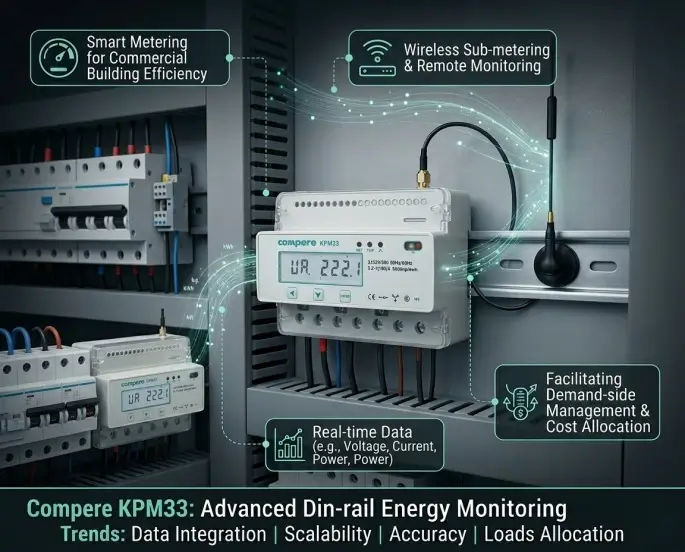
With the deepening of the “carbon neutrality” goal and the acceleration of smart city construction, energy management in commercial buildings is undergoing reform towards “refined governance.” However, smart din rail energy meters, with their unique size advantage and powerful communication capabilities, have become an indispensable core component of modern commercial complexes, office buildings, and data centers.
The following are the four main application trends of smart din rail energy meters in commercial buildings:
1. Compact Installation, Space Saving
The space in distribution boxes in commercial buildings is usually extremely limited. Traditional wall-mounted meters, due to their large size and complex wiring, are difficult to meet the needs of multi-circuit monitoring.
Trend: din rail meters use standard 35mm rails for installation. This design not only saves more than 70% of installation space but also greatly simplifies the on-site construction process and installation costs, making it possible to achieve “one meter per household” or “one meter per circuit” in dense distribution cabinets.
2. Power Quality Analysis
Early commercial buildings focused solely on total power consumption, while modern high-end office and medical buildings have extremely high requirements for power quality (such as harmonics and voltage fluctuations).
Trend: New smart rail meters are no longer limited to measuring kWh, but integrate comprehensive electrical parameter measurement (voltage, current, active/reactive power, frequency, power factor) and 2nd-31st harmonic analysis. This allows managers to promptly identify sources of interference in the power grid, protecting sensitive equipment from damage.
3. Multi-Protocol Convergence and Wireless IoT
In commercial building renovation projects, cabling costs often exceed the cost of the equipment itself.
Trend: Traditional RS485 (Modbus-RTU) is evolving towards wireless. Therefore, rail meters integrating LoRaWAN, WiFi, or 4G communication capabilities are becoming mainstream.
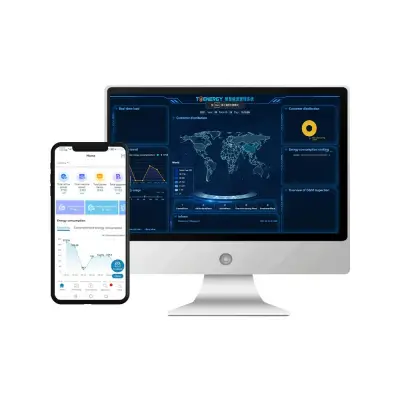
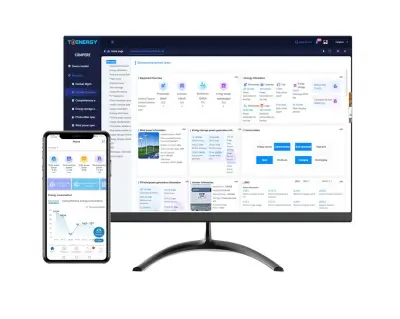
Value: They enable plug-and-play data transmission, directly uploading energy consumption data to a cloud management platform without requiring extensive cabling that disrupts existing decor.
4. Intelligent Upgrade of Prepaid Systems
For commercial real estate such as shopping malls and apartments that combine rental and sales, electricity bill payment and management have always been challenging aspects of operation and maintenance.
Trend: Deep integration of smart din rail prepaid meters with IoT prepaid systems. Supports remote on/off switching, automatic power cut-off for overdue payments, and real-time top-up via mobile devices (WeChat/Alipay).
Security: Also features malicious load identification (e.g., identifying unauthorized high-power appliances), significantly improving the fire safety of commercial buildings.
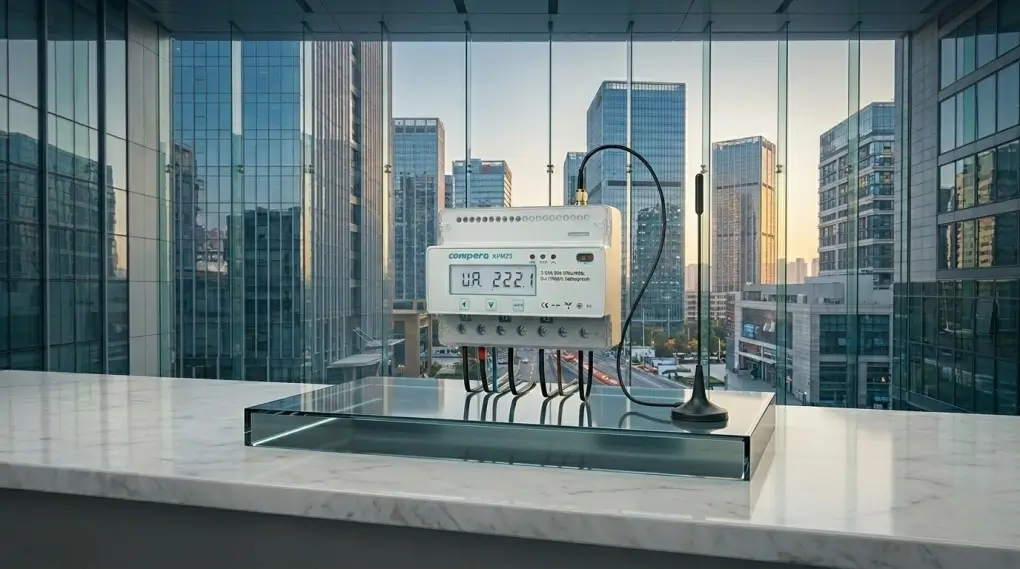
Typical Application Case: Energy Management Upgrade of a Large Smart Commercial Complex
Project Background:
This project is a smart commercial complex located in the city center, comprising a shopping mall, Grade A office buildings, and underground parking. The main challenges faced by the owner were: a large number of tenants with complex electricity usage habits, inefficient traditional manual meter reading, and the inability to monitor potential electrical safety hazards in various areas in real time.
Solution:
The project ultimately selected the KPM33 smart din rail prepaid electricity meter and deployed it in the power distribution rooms on each floor as follows:
Itemized Metering: Prepaid din rail meters were installed for the mall’s air conditioning, lighting, elevators, and each retail tenant, enabling accurate allocation of electricity costs.
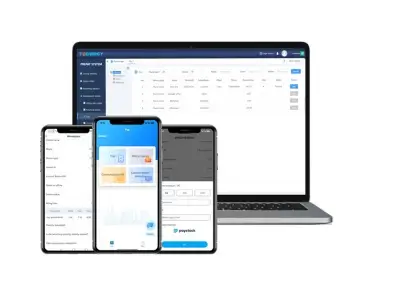
Remote Billing Control: Combined with a cloud-based management system, a “prepaid, then used” model was implemented for tenants. When the balance is insufficient, the system automatically sends SMS reminders and supports remote power outage/restoration.
Quality Monitoring: For the data center in the office building, the harmonic analysis function of the meters was used to effectively monitor the impact of nonlinear loads on the power grid, preventing the risk of tripping.
Implementation Results:
Improved Operational Efficiency: 100% automated remote meter reading was achieved. What previously required three electricians and two days can now be completed by one person in the background in just five minutes.
Reduced Energy Consumption: Through energy consumption big data analysis, the property management optimized the operation strategy of air conditioning in public areas, resulting in a 12% reduction in overall shared energy consumption in the first quarter. Cash Flow: The prepaid model completely solves the previous problem of difficulty in collecting overdue payments from tenants.
Conclusion
Smart din rail energy meters are no longer just simple billing tools; they are the foundation for energy digitalization in commercial buildings. Through precise data collection and real-time monitoring, businesses can not only achieve energy savings of over 10%, but also effectively improve the operational efficiency and safety of the power distribution system.
For detailed information about prepaid electricity meters, please refer to the article: