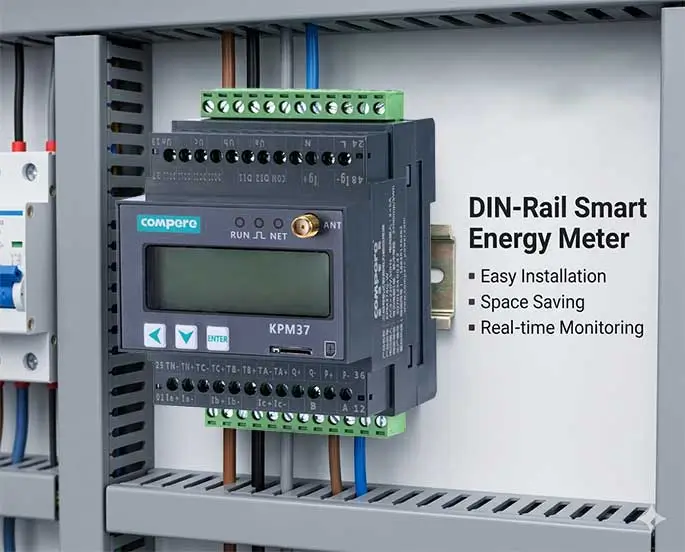
In the fields of modern industrial automation and energy management, “modularity” and “efficiency” have long been core requirements. If you’ve ever opened a factory distribution cabinet or seen the power control box in a modern commercial building, you’ve undoubtedly noticed the various electrical components neatly arranged on metal rails.
This core mounting method is DIN rail mounting. For industrial energy meters, adopting a DIN rail design is not merely an aesthetic choice, but a key technical factor ensuring the stable, safe, and efficient operation of the power monitoring system.
What Is a DIN Rail?
A DIN rail is a standard metal rail used for mounting industrial control, switching, and protection devices.
The origin of “DIN”: DIN stands for the German Institute for Standardization (Deutsches Institut für Normung). This organization developed this standard as early as the 1970s, and due to its excellent practicality, it was later adopted as an international standard (IEC) and a European standard (EN).
The most common DIN rail is the Top Hat (Ω-shaped) rail, with a standard width of 35 mm. Its cross-section resembles a top hat, with protruding edges on both sides, allowing compatible equipment to “click” into it directly without the need for separate screw mounting to a backplate.
Why Are Din Rail Mountings So Prevalent In Industrial Energy Meters?
In industrial energy management, energy meters monitor high-current, high-voltage power circuits. Compared to traditional wall-mounted or panel-mounted installations, DIN rail energy meters offer the following irreplaceable advantages:
1. Extremely high space utilization (modular design)
Space within industrial distribution boxes is often extremely limited. DIN rail energy meters typically use modular widths (e.g., multiples of the standard 18 mm, such as 2-module, 4-module, or 7-module).
Compact layout: Multiple energy meters can be arranged closely and seamlessly side-by-side.
High-Density Monitoring: Within a single distribution cabinet, enterprises can simultaneously monitor dozens of different branch circuits, significantly saving cabinet space.
2. Lightning-Fast Installation and Maintenance
Traditional meter installation requires drilling and screwing, which is time-consuming and labor-intensive. DIN rails, however, utilize a “click-lock” mechanical structure.
Manual Installation: During installation, simply hang the meter on the rail from above and press gently from below; a “click” will secure it.
Quick Replacement: If a meter needs upgrading or maintenance, simply pull open the bottom spring clip with a screwdriver; the meter can be removed in seconds, minimizing downtime for maintenance.
3. Strict International Standardization, Unrestricted Compatibility
Because DIN rail standards are completely unified globally, this means:
Equipment from different brands and with different functions (such as circuit breakers, contactors, PLCs, and meters) can be seamlessly installed on the same rail.
This greatly simplifies the selection and layout work for electrical engineers when designing distribution cabinets.
4. Superior Vibration Resistance and Industrial-Grade Stability
Industrial environments are often accompanied by mechanical vibrations (such as heavy machinery operation, resonance from fans and pumps).
The spring-clamping mechanism of the DIN rails provides continuous and uniform clamping force.
Even in environments with prolonged vibration, the electricity meter will not loosen or fall off, thus preventing electrical fires or data acquisition interruptions caused by poor contact.
5. Easy Centralized Cabling and System Expansion
In industrial energy consumption monitoring, electricity meters often need to upload data to a local PLC or cloud system via RS485 (Modbus-RTU) or MQTT protocols.
When all electricity meters are neatly arranged on DIN rails, communication cables and power lines can be routed in a standardized and neat manner using cable trays within the distribution box.
If a new production line is added to the factory in the future, new electricity meters can simply be inserted into the existing space on the rails, and communication lines can be connected in parallel, resulting in extremely low expansion costs.
Summary
Industrial energy meters, acting as the “eyes” of energy data, are directly affected by their installation method, impacting system deployment efficiency and operational reliability.
DIN rail mounting, with its international standards, compact size, convenient installation, and robust durability, has become the undisputed standard configuration for modern industrial energy meters. Choosing energy meters based on DIN rail design not only ensures efficient on-site installation but also builds an easily upgradable, safe, and reliable future energy management platform for enterprises.