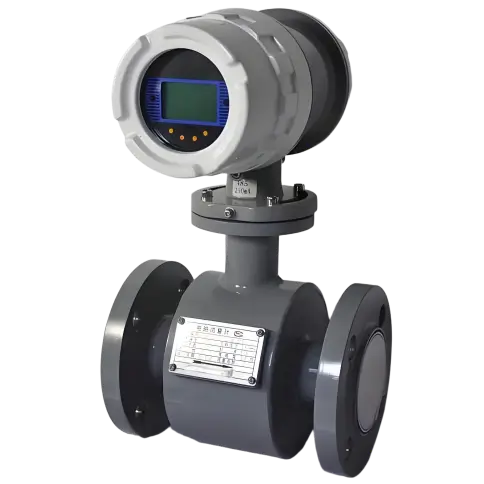
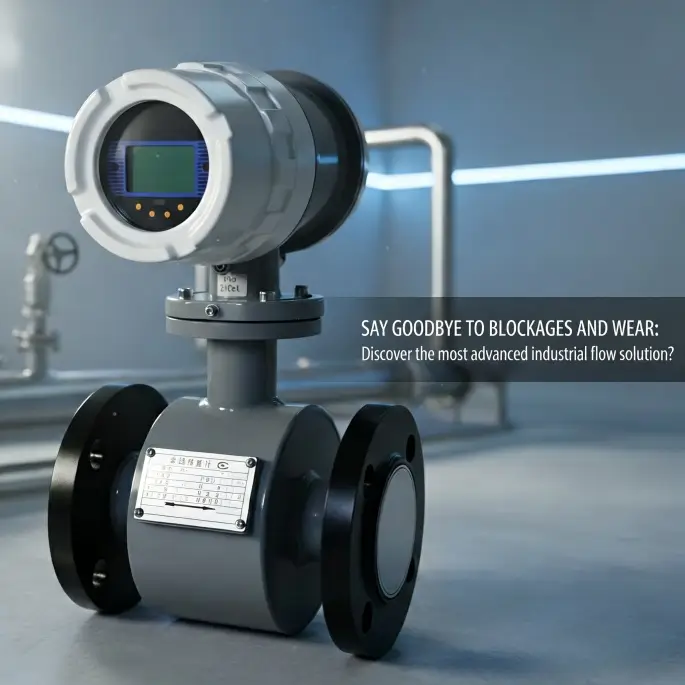
Electromagnetic flow meters have become a staple in industry because they solve the three most troublesome problems in flow measurement: clogging, wear, and corrosion.
Because its internal structure is a completely unobstructed circular tube without any mechanical parts, it’s like creating an “unobstructed highway” for the fluid. As long as the liquid is conductive, it can accurately capture it.
Practical Applications: In which scenarios does it solve problems?
1. Wastewater Treatment and Environmental Protection – “Unfazed by Dirt”
When treating wastewater containing fibers, silt, or domestic waste, traditional mechanical flow meters (such as turbine flow meters) are easily entangled or jammed.
Solution: The straight-through structure of the electromagnetic flow meter allows solid impurities to pass directly, never clogging.
Typical Applications: Inlet and outlet flow monitoring, sludge return measurement.
2. Chemical Industry and Strong Corrosive Media – “Indestructible”
Ordinary metal instruments will be completely corroded within weeks when exposed to sulfuric acid, hydrochloric acid, or strong alkalis.
Solution: By lining the inner wall of the pipe with PTFE (polytetrafluoroethylene) and using tantalum or Hastelloy electrodes, the instrument can achieve complete corrosion resistance.
Typical Applications: Acid and alkali addition, chemical feeding.
3. Mining and Paper Pulp – “Wear-Resistant Expert”
Fluids containing large amounts of mineral sand or pulp cause significant wear to the pipe walls.
Solution: Using highly wear-resistant polyurethane rubber lining greatly extends the instrument’s service life.
Typical Applications: Slurry conveying, pulp forming control.
User Pain Points: What problems can it solve for you?
1. Reduced Maintenance Costs and Downtime
Many flow meters require periodic disassembly for cleaning or replacement of worn parts. Electromagnetic flow meters, because they have no moving parts, can be virtually maintenance-free for life once installed, provided the medium does not scale.
2. Reduced Energy Consumption (Saving Pump Costs)
Any flow meter that introduces obstructions in the pipeline (such as orifice plates or vortex flow meters) will generate pressure loss. To maintain flow, the pump must consume more electricity. Electromagnetic flow meters have zero pressure loss, resulting in significant electricity savings over the long term.
3. Handling Complex Flow Conditions
Many factories have limited piping space. Electromagnetic flow meters have relatively low requirements for the straight pipe sections before and after the flow (typically 5D upstream and 3D downstream) and are unaffected by fluctuations in fluid density, viscosity, and temperature, resulting in very stable readings.
Avoiding Pitfalls During Use
While it is powerful, to use it effectively, these pitfalls must be avoided:
“Empty Pipe” Hazard: The measuring tube must be completely filled with fluid. If the tube is not full, the readings will fluctuate wildly.
“Conductivity” Threshold: It cannot measure oils (such as gasoline and diesel) and pure water. The medium must have basic conductivity.
“Grounding” Criterion: This is the cause of interference for 90% of users. The sensor must be at the same potential as the fluid (through a grounding ring or grounding electrode); otherwise, the signal will be overwhelmed by electromagnetic noise.
Conclusion
The electromagnetic flow meter is not only a measuring tool, but also a “burden reducer” for industrial production. Through zero pressure loss, high resistance to fouling, and extremely strong chemical stability, it helps users solve the most troublesome problems of equipment maintenance and inaccurate measurement.