In today’s rapidly developing energy management and industrial IoT landscape, smart meters are no longer just tools for metering electricity; they are core terminals for transmitting energy efficiency data. However, in actual project deployments, many engineers and project managers are often troubled by the choice of communication protocols: how to choose between 4G, Wi-Fi, LoRaWAN smart meters? Should they prioritize the plug-and-play functionality of 4G, the cost advantage of Wi-Fi, or the powerful penetration of LoRaWAN?
4G Smart Energy Meters: The All-Round Champion of Long-Distance and High Reliability
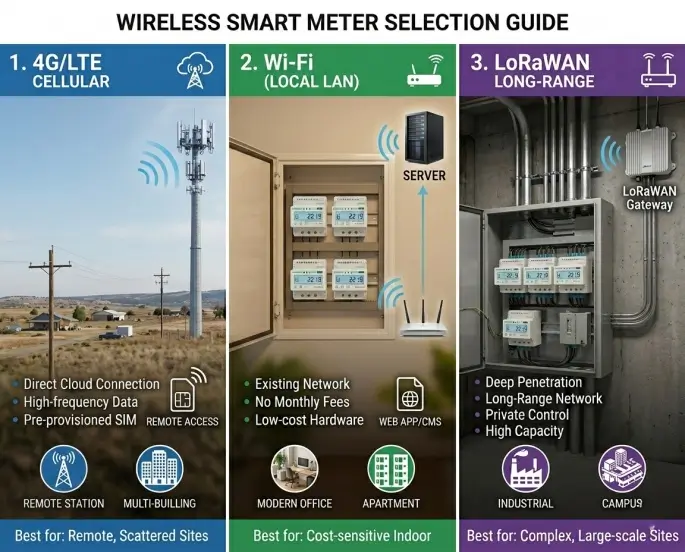
4G meters connect directly to the cloud server via the cellular network, and their biggest feature is independence. They do not require an additional gateway relay; as long as there is mobile signal coverage, the meter can upload data in real time.
Core Advantages
- Plug-and-Play: No on-site wiring or complex LAN configuration is required; simply install and power on to connect to the network.
- High Transmission Speed: Sufficient 4G network bandwidth supports high-frequency data acquisition, such as second-level load curve monitoring.
- Stability Guarantee: Relying on carrier base stations, its anti-interference capability is far superior to ordinary self-built Wi-Fi.
Optimal Application Scenarios
- Distributed Rental Properties: Such as long-term rental apartments or street-front shops scattered throughout the city, where electricity meters are extremely dispersed, making unified network construction impossible.
- Outdoor and Remote Base Stations: Where existing network infrastructure is lacking, but high-reliability power monitoring is required.
- Municipal Lighting and Engineering: Requires the highest level of data transmission security and remote control response.
Wi-Fi Smart Energy Meters: The “Cost-Effective Choice” for Indoor Environments
Wi-Fi meters primarily rely on existing wireless routers for data transmission. They are widely used in the consumer market and small office environments.
Core Advantages
- Low Hardware and Communication Costs: Wi-Fi module costs are relatively low, and there are no additional data charges, resulting in a significant cost-performance advantage.
- Convenient Interaction: Quick pairing with a mobile app provides a smooth user experience for viewing real-time power consumption.
Limitations and Risks
- Weak Signal Penetration: Wi-Fi signals attenuate significantly when encountering heavy metal distribution boxes or reinforced concrete walls.
- Limited Number of Connected Devices: Ordinary routers are prone to disconnection or latency after connecting more than 20 devices, making them unsuitable for large-scale meter access.
Optimal Application Scenarios
- Individual Metering in Small Offices: Spaces are relatively compact, and Wi-Fi signal coverage is comprehensive.
- Smart Home Systems: Used in conjunction with a home gateway for basic energy efficiency management.
LoRaWAN Smart Energy Meters: The “Signal Expert” for Large-Scale Campuses
LoRaWAN is a low-power, long-range wide-area network technology. It uses a “meter + gateway” architecture, suitable for building private networks.
Core Advantages
- Extremely Strong Penetration: The signal can penetrate multiple layers of walls and even reach deep basements, with a coverage range of several kilometers.
- Massive Access and Low Power Consumption: A single gateway can support hundreds or thousands of meters online simultaneously, and the long-term system maintenance cost is extremely low.
- Private Network Management: No need to pay data charges for each meter; data is in the user’s own hands, resulting in higher security.
Optimal Application Scenarios
- Large Industrial Parks and Factories: Vast factory areas require unified data collection from thousands of monitoring points.
- Underground Power Distribution Rooms and Shopping Mall Ground Floors: Deep building spaces where 4G signals often struggle to reach.
- Smart Campuses and Hospitals: Complex building structures requiring complete signal coverage even in dead zones.
Summary and Recommendations
In actual selection, you can follow these guidelines:
- Consider Distribution: If devices are highly dispersed, prioritize 4G.
- Consider Environment: For basements or complex industrial structures where signals are difficult to penetrate, definitely choose LoRaWAN.
- Consider Budget: For small-scale, low-budget indoor projects, WiFi is the most economical transitional solution.
For industrial applications, 4G or LoRaWAN is generally recommended. 4G excels in simple deployment, while LoRaWAN excels in lower long-term operating costs and better signal coverage during large-scale access.