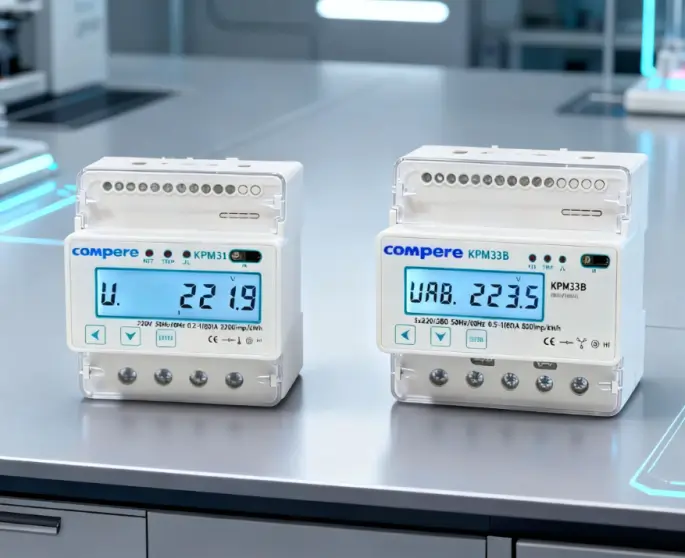
In the field of energy metering, electricity meters are the most basic and crucial devices. With the increasing popularity of smart electricity management, the most common question users encounter when choosing an electricity meter is: what are the differences between single-phase and three-phase meters?
This article will provide a clear comparison from aspects such as working principle, applicable scenarios, functional differences, cost, and installation, helping you quickly find the most suitable type of meter.
1. What is a Single-Phase Meter?
Single-phase meters are mainly used in general households and small commercial establishments, and are currently the most common metering devices.
Features:
Only connected to the live wire + neutral wire (some use live wire × 2 + neutral wire)
Rated voltage is generally 220V
Lower power capacity
Simple structure, easy installation
Applicable to:
Residential homes
Small offices
Small shops, snack bars
Small electrical equipment (lighting, home appliances, etc.)
2. What is a Three-Phase Meter?
Three-phase meters are used in industrial and large commercial establishments, and can handle higher power and more stable power supply needs.
Features:
Connects to three-phase live wire + neutral wire (some are three-phase three-wire)
Rated voltage is generally 380V
Capable of handling high loads and high-power equipment
Suitable for enterprises, factories, and other similar scenarios
Applicable to:
Factory and industrial equipment
Large electromechanical equipment
Large commercial buildings
High-load production lines
3. Comparison Of The Core Differences Between Single-Phase And Three-Phase Meters
| Project | Single-phase Electricity Meter | Three-phase Electricity Meter |
| Power Supply Type: | Single-phase (220V) | Three-phase (380V) |
| Applicable Load: | Low-power Equipment | Medium-to-large-power equipment |
| Stability: | Sensitive to load fluctuations | More stable power supply |
| Application Scope: | Homes, small shops, general commercial use | Factories, industrial equipment, large buildings |
| Metering Accuracy: | Standard accuracy | Higher accuracy (especially industrial grade) |
| Installation Cost: | Low | High, requires professional installation |
| Power Capacity: | Low | High, supports high starting current equipment |
4. How to determine which type of meter you should choose?
(1). Select based on electrical load
Total power of electrical equipment < 10kW → Single-phase meter recommended Total power of electrical equipment > 10–15kW, or with motors or pumps → Three-phase meter required
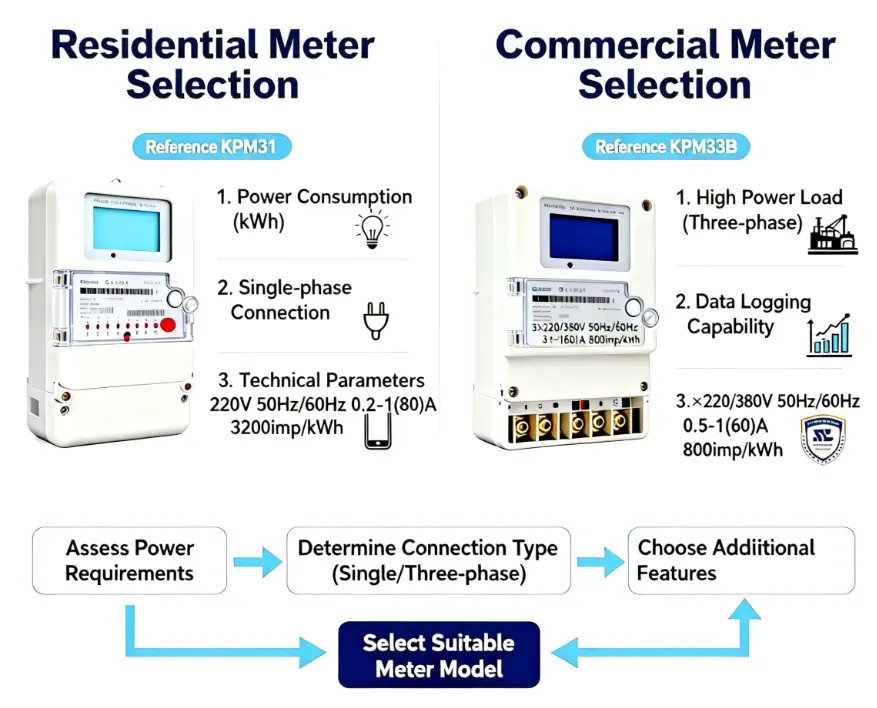
(2). Determine based on site purpose
Residential or ordinary shop: Single-phase
Manufacturing factory: Three-phase
Large office building, restaurant kitchen: Usually three-phase
Equipped with motors, air compressors, refrigeration units, etc.: Three-phase
(3). Based on power company distribution method
If the power company provides three-phase power, even if the site’s current power consumption is not large, it is recommended to install a three-phase meter for future capacity expansion.
5. Functional Differences Between Smart Single-Phase And Three-Phase Meters
With the development of smart energy management, both single-phase and three-phase meters have become intelligent, but three-phase smart meters typically have richer data and communication capabilities.
Single-phase smart meter functions:
Remote meter reading
Rate metering (peak and off-peak)
Prepaid function
Anti-theft monitoring
Three-phase smart meter functions:
All of the above functions
Three-phase voltage and current imbalance monitoring
Demand (maximum demand) analysis
Harmonic analysis (some models)
Accurate data acquisition for energy management systems (EMS)
If your company is building an energy management system, three-phase smart meters offer greater data depth advantages.
6. Summary: How To Make A Quick Decision?
General households and small businesses → Choose single-phase meters
Factories, large commercial enterprises, and businesses with many devices and high power consumption → Must use three-phase meters
If you plan to expand your equipment in the future → We recommend prioritizing three-phase meters
If paired with an energy management system → Three-phase smart meters provide more complete and valuable data.