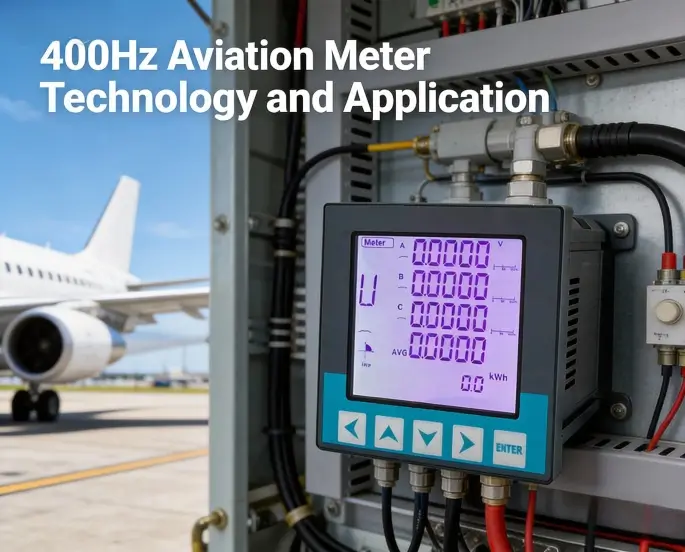
In our daily understanding of power systems, we are accustomed to civilian frequencies of 50Hz or 60Hz. However, in the cabins of aircraft at tens of thousands of meters altitude or in precision radar stations, a completely different set of electrical laws operates. 400Hz power meters, as core measuring instruments in this special frequency environment, play a crucial role.
1. Why Use 400Hz?
Before delving into the details of electricity meters, we must first answer: Why does the aerospace field choose 400Hz instead of 50Hz?
The core reason is weight reduction. According to the principle of electromagnetic induction, the higher the frequency of transformers and motors, the greater the power converted per unit weight. Using 400Hz allows for a significant reduction in the size and weight of generators and transformers, which translates to greater payload and lower fuel consumption for aircraft. Furthermore, the current waveform after high-frequency rectification is smoother, which is more conducive to the stable operation of precision electronic equipment.
2. Core Monitoring Dimensions of a 400Hz Power Meter
A 400Hz electricity meter is not simply a modified civilian electricity meter; it is a precision instrument tailored for high-frequency environments. It primarily monitors the following key indicators in real time:
Voltage and Current Stability: Monitors fluctuations in aviation intermediate frequency power supplies (commonly 115V/200V systems) to ensure that onboard equipment loads remain within safe ranges.
Frequency Accuracy: Aviation power supplies are extremely sensitive to frequency. The meter must ensure frequency stability around 400Hz, as even small frequency deviations can cause inductive loads (such as motors) to overheat significantly.
Energy Consumption and Efficiency: Measures active power, reactive power, and power factor. This data allows engineers to assess power transmission efficiency and optimize onboard power distribution.
3. Technical Challenges
Designing and manufacturing a 400Hz electricity meter faces higher technical barriers than ordinary meters:
Extremely High Sampling Rate: To accurately reproduce the fast waveform of 400Hz, the meter’s internal sampling circuit must have an extremely high sampling frequency, typically tens of thousands of times per second, to avoid signal distortion.
Special Magnetic Materials: At 400Hz, the silicon steel sheets used in ordinary meters generate significant hysteresis and eddy current losses. Therefore, the current transformer in a 400Hz meter must use high-performance magnetically conductive materials such as permalloy or nanocrystalline materials.
Stringent Electromagnetic Compatibility (EMC): The electromagnetic interference in the aviation environment is extremely complex. The meter must pass avionics standard tests such as RTCA/DO-160 to ensure that its operation does not interfere with the aircraft’s navigation and communication systems.
4. Main Application Scenarios
Aerospace Ground Support (GPU): When the aircraft is parked on the ground and the engines are off, ground support power vehicles monitor the quality of the power supplied to the aircraft using 400Hz meters.
Airborne Power Distribution System: Directly installed on the aircraft’s power distribution panel, serving as the “eyes” for pilots or ground maintenance personnel to monitor the status of the airborne electrical network.
Military and Special Equipment: Many military radars and weapon systems, in pursuit of miniaturization, utilize medium-frequency power supplies, requiring high-precision 400Hz monitoring instruments.
Advanced Ships: The sophisticated electronic compartments within certain modern ships and submarines also rely on independent 400Hz power systems.
5. Selection and Future Outlook
When selecting a 400Hz power meter, in addition to considering accuracy (0.5 or 0.2 class), its stability in wide temperature environments (e.g., -40°C to +70°C) and its vibration resistance must also be considered.
With the increasing prevalence of the “Mechanical Engineering, Automation, and Architecture (MEA)” concept, future 400Hz meters will not merely be data display instruments; they will integrate more bus communication functions (such as Modbus or CAN) and evolve towards more miniaturized and intelligent diagnostic terminals.