In the current energy management field, simple “prepaid” models are no longer sufficient to meet the complex needs of industrial and commercial applications. Electrical engineers and system integrators require a highly integrated energy metering terminal that supports remote dispatch and is easy to secondary develop. DIN rail prepaid energy meters are designed to resolve the contradiction between limited space in distribution cabinets and complex communication requirements.
Hardware Architecture and Design Standards: Industrial-Grade Reliability
As a core component of power distribution systems, the physical reliability of DIN rail-mounted meters is paramount.
1. 35mm Standard DIN Rail Structure:
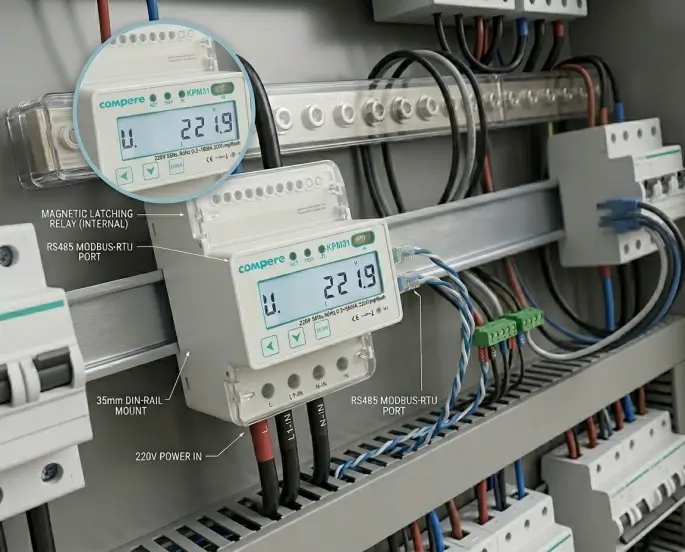
Unlike traditional wall-mounted round meters, the DIN rail design allows for high-density installation within standard distribution drawers or lighting boxes. For shopping malls or industrial parks requiring centralized monitoring of hundreds of circuits, this compact design effectively reduces cabinet size and lowers construction and wiring costs.
2. High-Performance Magnetic Latching Relay:
The core of the prepaid function lies in “controlled power-off.” We utilize high-capacity, low-power magnetic latching relays. Compared to ordinary electromagnetic relays, it consumes power only during the moment of activation and does not overheat during long-term operation, avoiding malfunctions caused by coil burnout. Its contact capacity is rigorously redundantly designed to withstand the instantaneous surge current during the startup of highly inductive loads.
3. Four-Quadrant Metering and Accuracy Class:
Supports full-parameter power measurement, including active/reactive energy, voltage, current, frequency, and power factor. Metering accuracy strictly complies with Class 1.0 standards, ensuring accurate readings over a wide load range and reducing trade settlement disputes caused by metering errors.
Communication Protocol and System Integration: Breaking Down Data Silos
For system engineers, the electricity meter is not just a billing tool, but also an edge sensor.
1. Standard RS485 (Modbus-RTU) Interface
As the most stable industrial bus, the RS485 interface allows up to 32 meters to be connected in series on each bus (more can be added via repeaters). The open Modbus register address mapping table allows third-party PLCs or data gateways to easily read real-time electrical parameters.
2. Multi-level Communication Options
We offer flexible modular communication solutions for different site environments:
4G: Suitable for urban renewal projects with dispersed locations and no need for cabling.
LoRaWAN: Suitable for long-distance, low-power wireless coverage in large industrial parks.
WiFi: Suitable for indoor commercial environments, enabling rapid cloud access using existing network infrastructure.
3. Proactive Data Reporting and Alarm Logic
Built-in logic supports real-time reporting of abnormal events, such as overvoltage, undervoltage, overload, malicious load access (for dormitory scenarios), and overdue payment warnings, ensuring that maintenance personnel obtain on-site status information immediately.
Prepaid Logic and Software Control Strategy
Compere’s solution achieves “deep integration of hardware and software” for prepaid management:
1. Time-of-Use (TOU) Pricing Strategy
Supports multiple rate settings (peak, flat, and off-peak). Engineers can remotely update rate tables according to local power grid policies. The system automatically calculates multi-rate electricity charges, assisting property management in profiting from peak-valley price differences or adjusting load.
2. Local and Remote Recharge Closed Loop
The system supports remote issuance of recharge amount/electricity commands. When the balance falls below a preset threshold, the meter will automatically trigger an LED alarm or send a notification to the user. If the balance reaches zero, the built-in relay will perform a protective trip.
3. Anti-Theft and Electricity Safety Monitoring
It features cover opening detection, reverse current detection, and magnetic field interference alarm functions. For commercial rental scenarios, the system can identify illegally used high-power resistive loads (such as electric kettles) and perform automatic trip protection to eliminate fire hazards.
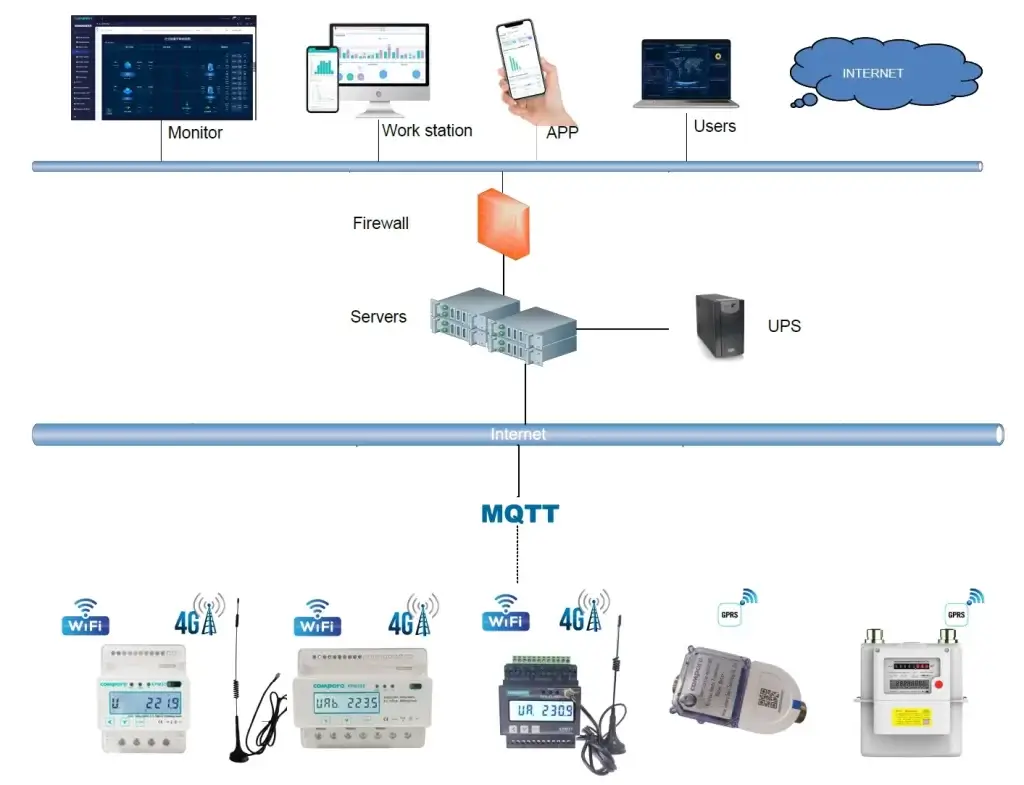
Typical Application Scenario Topology Architecture of Prepaid Systems
In typical projects, engineers usually adopt the following architecture:
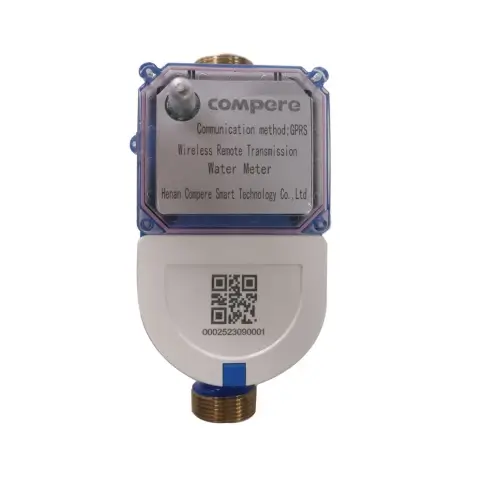
Bottom Layer: Data acquisition terminals, including smart meters, water meters, gas meters, and other hardware devices.
Middle Layer: Smart data acquisition gateway (data acquisition via RS485 downlink and Ethernet/4G uplink).
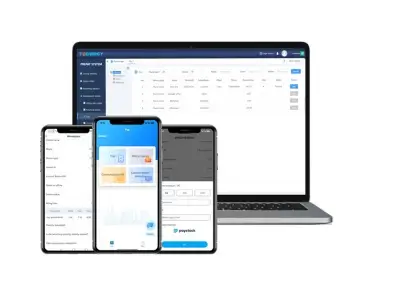
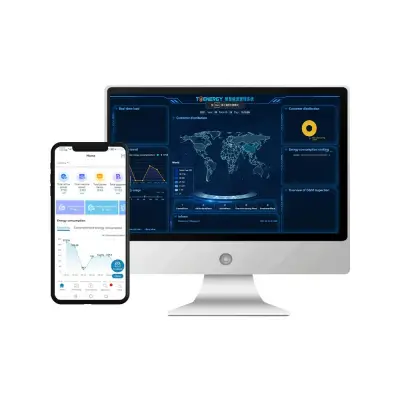
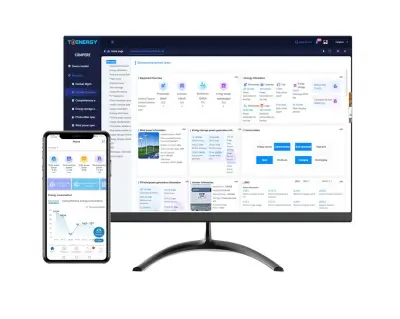
Application Layer: Smart energy management platform or electricity sales mini-program, completing the closed loop from metering, billing to payment.
Conclusion
The evolution of DIN rail prepaid energy meters marks a leap from “passive billing” to “active management” of electricity metering. Compere is committed to providing global partners with stable, accurate, and cost-effective hardware.