Did you know? In today’s Industrial Internet of Things (IIoT) wave, industrial communication gateways play a crucial role. They act like “translators” and “couriers” in the industrial field, responsible for collecting data from underlying devices, PLCs, and sensors, converting protocols, and securely transmitting it to the cloud or local monitoring systems.
However, faced with a dazzling array of gateway models on the market, how do you choose the one best suited to your monitoring needs? This article will provide a scientific selection guide based on typical product application cases.
Define Your Monitoring Needs (Core Prerequisites)
Before looking at hardware parameters, you must first accurately profile your application scenario:
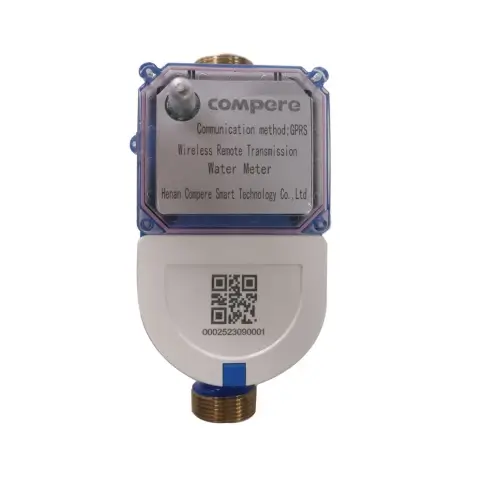
Data Volume and Acquisition Frequency: Are you on a precision manufacturing production line that needs to collect tens of thousands of data points per second, or a remote water meter that only needs to report data once per hour?
Network Environment: Is there a stable wired Ethernet connection on-site? Or are you located in a remote area and can only rely on 4G/5G or cellular networks?
Physical Environment: Is the equipment installed in a temperature-controlled cabinet, or exposed to harsh outdoor conditions with high temperature, high humidity, and strong electromagnetic interference?
Five Core Dimensions for Industrial Communication Gateway Selection
1. Interface and Physical Connectivity (Downlink Interconnection)
The gateway must be able to connect to your field devices.
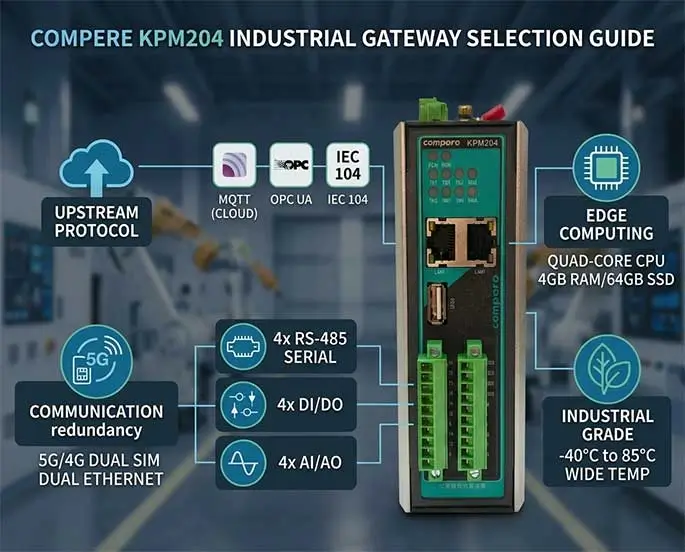
Serial Ports vs. Ethernet Ports: Traditional devices mostly use RS485 serial ports, while modern devices mostly use Ethernet ports. It’s necessary to confirm whether the number of interfaces meets the requirements for mounting multiple buses in the field.
I/O Interfaces: In some scenarios, the gateway needs to directly acquire digital or analog signals.
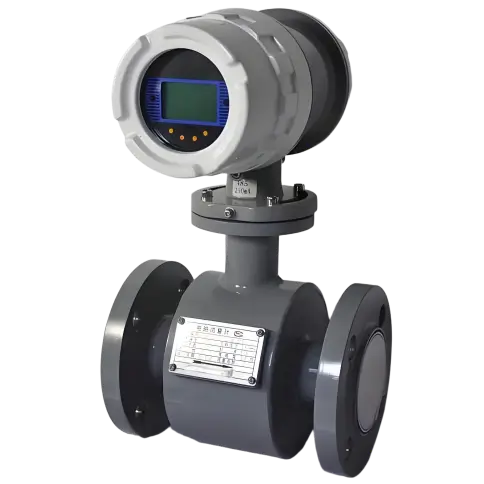
💡 Case Study: In remote pump station monitoring for smart water systems, since the field devices are mostly traditional flow meters and pressure transmitters, low-power gateways with built-in multiple RS485 serial ports and analog input (AI) interfaces are usually preferred during selection. No additional acquisition modules are needed; they can directly connect to the sensors.
2. Protocol Conversion Capability (Software Core)
Industrial field protocols are diverse, and the gateway’s “translation” capability determines the success or failure of a project.
Downlink Protocol (Equipment Side): Must natively support Modbus RTU/TCP and the proprietary protocols of mainstream PLCs.
Uplink Protocol (Cloud/Platform Side): Supports MQTT (for interfacing with mainstream cloud platforms), Modbus, and specific industry-specific national standard protocols.
3. Edge Computing Capability (Computing Power Matching)
A “dumb gateway” only handles data transmission, while a “smart gateway” possesses edge computing capabilities.
Lightweight: Only needs to filter outliers, perform simple data packaging, and local caching (to prevent data loss during network outages).
Advanced Edge Intelligence: Needs to run complex control logic, interlocking alarms, and even lightweight AI algorithms locally.
💡 Case Study: In precision discrete manufacturing digital production lines, to calculate OEE (Overall Equipment Effectiveness) and perform predictive maintenance on machine tools, companies typically choose edge computing gateways with powerful chips and Docker container support. The gateway can directly clean and analyze high-frequency vibration data locally, preventing massive data from overwhelming factory bandwidth.
4. Network and Communication Assurance (Uplink Transmission)
Multi-Network Backup: Gateways supporting automatic switching between wired + 5G/4G + WiFi are preferred.
💡 Case Study: In unattended photovoltaic power plants or wind farm monitoring, due to their remote locations and extremely high data continuity requirements, fully industrial-grade 5G dual-SIM dual-standby wireless gateways are typically chosen. When a network signal from one operator is interrupted, the gateway can seamlessly switch to a backup link within milliseconds, ensuring uninterrupted monitoring.
5. Industrial-Grade Reliability (Environmental Adaptability)
Industrial environments differ from commercial environments; hardware must be sufficiently robust.
Wide Temperature Range and Protection: Operating temperature typically requires a range of -40°C to 85°C. Features a metal casing and supports DIN rail mounting.
Interference Resistance: Must possess strong electromagnetic compatibility (EMC), lightning protection, and surge protection capabilities.
Typical Application Scenarios and Selection Quick Reference Table
To make the selection process more intuitive, we have summarized configuration recommendations for three typical scenarios:
| Scenario Type | Typical Case | Core Monitoring Needs | Recommended Configuration |
|---|---|---|---|
| Lightweight Data Acquisition | Urban underground pipe networks, energy consumption monitoring | Small data volume, low frequency, cost-sensitive, partial lack of utility power | Low-power Wireless Gateway: Single/dual serial ports, Modbus to MQTT, 4G/Cat-1 support, features an ultra-low power consumption sleep mode. |
| Industrial Automation Line | Automotive parts manufacturing, smart factories | Coexistence of multi-brand PLCs, high-frequency concurrency, local edge computing | High-Performance Edge Gateway: Multi-Ethernet + multi-serial ports, strong protocol conversion (OPC UA, etc.), powerful CPU/large RAM, supports Docker/Python development. |
| Harsh Remote Environment | Solar power plants, wind power O&M | Unattended sites, no wired network, extreme environments, high security requirements | Full Industrial 5G Wireless Gateway: 5G dual-SIM backup, -40°C to 85°C wide temperature range, strong EMC electromagnetic isolation protection, supports VPN encrypted transmission. |
Conclusion
Selecting an industrial communication gateway is not about “the higher the configuration, the better,” but rather about “a precise match between needs and cost-effectiveness.” In actual selection, it is recommended to first identify the non-negotiable hard indicators (such as the number of interfaces, specific protocols, and operating temperature), and then adjust edge computing capabilities and network redundancy according to the budget. Choosing the right gateway not only ensures the stability of the monitoring system but also lays a solid foundation for subsequent digital upgrades.