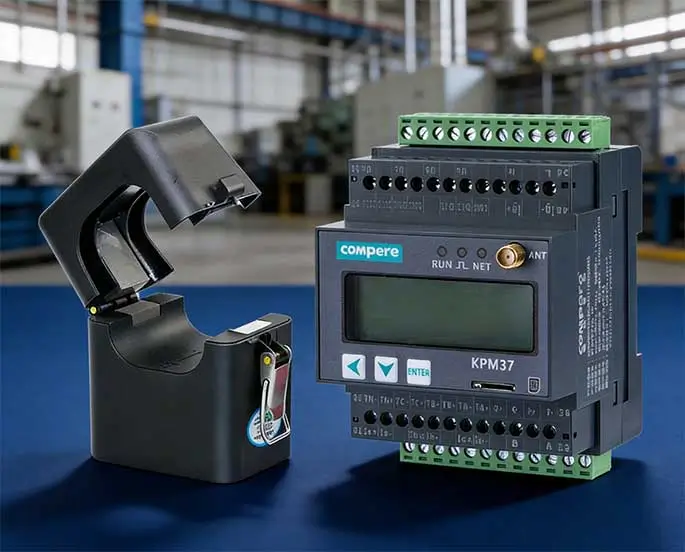
In the construction of modern industrial plants, B2B enterprise energy management systems, and smart factories, how do industrial smart meters (such as multi-circuit energy meters, Wi-Fi energy meters, etc.) play the role of energy “scoring officers”? Did you know?
However, the meter itself cannot directly connect to industrial currents of hundreds or even thousands of amperes. This is where current transformers (CTs) come in, acting as “translators” to proportionally convert the large current into a smaller current that the meter can safely recognize. If the CT is not selected correctly, even the smartest meter will become “blind,” leading to inaccurate metering, electricity bill disputes, and even equipment damage.
This article will start from industrial application scenarios and teach you how to accurately select and match CTs for industrial meters.
Get A QuoteThe First Step in Industrial Selection: Understanding the Meter’s “Appetite”
Before choosing a transformer, you need to see what inputs your industrial meter supports. This determines the secondary side (output) specifications of the current transformer (CT) you choose.
1. 5A Output (Most Traditional): Standard configuration for most industrial meters and low-voltage distribution cabinets. If your meter and current transformer are in the same distribution cabinet and very close together, choose a 5A output CT without hesitation.
2. 1A Output (Long Distance): If your meter is installed in the central control room, and the CT is installed in the workshop distribution box, with a distance exceeding 10 meters, it is recommended to choose a 1A output CT. Because longer cables result in greater losses, 1A effectively reduces signal attenuation on the line.
3. Milliampere (mA) or Miniature CT: Commonly found in DIN rail miniature meters or multi-circuit monitoring in workshops; small in size and easy to wire.
Practical Explanation: How to Determine the Current Ratio of a CT?
A transformer’s transformation ratio (e.g., 200/5A) means that when 200A of current flows through the industrial busbar, only 5A is output to the meter.
To ensure the meter’s reading is most accurate, it’s crucial to avoid both overloading the transformer (saturation) with excessive current and underloading it with insufficient current (loss of accuracy).
The “golden rule” for industrial applications:
Forget complex formulas; remember this industry convention: ensure the maximum actual operating current in the workshop falls between 60% and 80% of the transformer’s rated current.
A simple calculation is: Actual maximum current × 1.3 ≈ Transformer primary current.
Approximate industrial application scenarios:
Scenario 1: Main incoming line circuit in the workshop (e.g., commercial complex, factory general contracting unit)
Characteristics: Load includes lighting, air conditioning, and production lines; significant difference in power consumption between day and night (full load during the day, only a few devices may be on standby during the night shift).
Selection Tips: In this scenario, a transformer ratio with an “S” class (e.g., 0.5S class) must be selected. Ordinary current transformers (CTs) have very large errors when the current is very low (e.g., during nighttime standby), while high-precision current transformers with an “S” class can accurately calculate every unit of electricity, even under extremely low loads (1%).
Example: A production line has a maximum daytime current of approximately 300A and only 20A at night. Selection: 300 × 1.3 = 390A. Based on specifications, select 400/5A (0.5S class).
Scenario 2: High-power motor/pump circuits
Characteristics: At the moment of equipment startup, the current spikes to 5-7 times the normal level. Although this only lasts for a few seconds, ordinary current transformers are prone to “magnetic saturation” at this moment, leading to distorted meter readings.
Selection Tips: Appropriately increase the margin. The ratio can be increased from 1.3 to 1.5-2 times. Example: An industrial water pump has a rated operating current of 100A. Selection: 100 × 1.5 = 150A, directly select a 150/5A current transformer.
Structural Selection: Closed-type or Open-type?
In industrial renovation projects, the physical structure of the current transformer (CT) directly determines the construction period and labor costs.
1. Closed-type (Integral) CT – First Choice for New Projects
Appearance: A complete circular ring or square hole; the cable must pass through the middle.
Advantages: Complete magnetic circuit, most accurate electrical energy measurement, and the cheapest price.
Disadvantages: Power must be disconnected, the cable end removed, passed through, and then re-crimped.
Applicable to: New factory construction, new distribution cabinet assembly.
2. Open-type (Opening/Closing) CT – A Must-Have for Technical Upgrade Projects
Appearance: Like a clamp; it can be broken open in the middle, clipped onto the cable, and then locked.
Advantages: Installation can be completed without power outages or interruptions to wiring. For B2B companies whose workshops cannot be shut down, this is the only option.
Disadvantages: Slightly lower accuracy than closed-type transformers, and higher cost.
Applications: Factory energy-saving renovations, installation of energy-saving meters, and upgrades to factory energy management systems (EMS).
Three Key Points for Avoiding Pitfalls in Industrial B2B Applications
1. Never choose a transformer that is too powerful for your needs: If the production line current is only 50A, don’t install a 500/5A transformer for convenience. The result will be that the current is too low for the meter to recognize, leading to under-billing.
2. Pay attention to the “rated capacity (VA)”: Transformer nameplates are usually marked with 5VA or 10VA. If the cable from your transformer to the meter is more than ten meters long, or if one transformer is connected in series with multiple meters, choose a 10VA or even larger capacity transformer; otherwise, the meter reading will be lower than advertised. 3. The secondary side must never be open-circuited: When the current transformer is operating, the secondary side (the two wires connected to the meter) must never be disconnected! An open circuit will generate several thousand volts of high voltage, which will not only damage the meter but also endanger personal safety.
So how do you choose the right current transformer (CT)?
When equipping industrial meters with CTs, remember this: For new installations, prioritize accuracy; for retrofits, prioritize convenience; leave a current margin; and avoid blind spots in the meter. Proper selection not only protects the instrument but also provides the most accurate and reliable data support for the factory’s refined energy management.