Project Background and Construction Objectives
With the growing global call for sustainable development and green, low-carbon transformation, Saudi Arabia, as a core practitioner of “Vision 2030,” is actively promoting a series of landmark mega-projects. Among them, Red Sea Airport, as the core gateway to the Red Sea global tourism destination, has been committed from its inception to becoming a modern, smart airport fully powered by renewable energy and meeting top industry ecological standards.
As a large-scale public transportation infrastructure, airport buildings are characterized by vast spaces, complex functional zoning, and all-weather operation. Their heating and cooling loads fluctuate dramatically, making energy supply and demand matching extremely challenging. To truly integrate green and low-carbon concepts into the airport’s daily operations, Red Sea Airport has introduced an advanced digital integrated energy management system (EMS). By constructing a highly intelligent energy sensing network and control brain, it comprehensively achieves refined and low-carbon operation of airport energy.
Core Technical Solutions: Comprehensive Sensing and “Brain” Construction
The Red Sea Airport integrated energy management project relies on the Internet of Things (IoT), big data analytics, and automated control technologies to deeply integrate digitalization into the traditional airport energy infrastructure. The project constructed a closed-loop management architecture encompassing “comprehensive monitoring, precise quantification, in-depth analysis, and intelligent supervision.” Its core technology deployment is primarily reflected in the following two dimensions:
1. Deploying the bottom-line network: 3000+ IoT smart meters
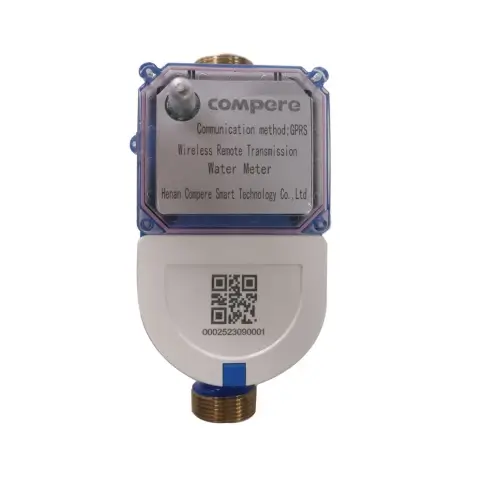
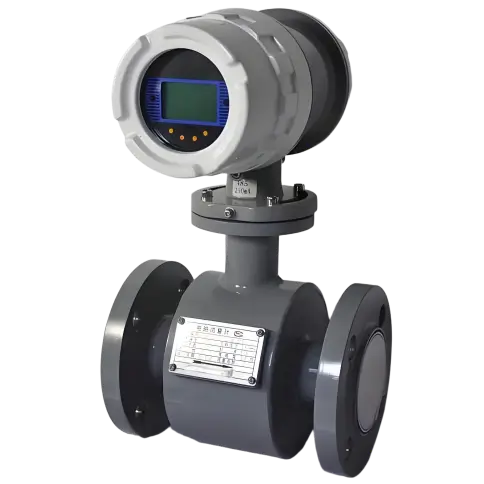
To eliminate blind spots in energy supervision, the project densely deployed over 3000 high-precision smart IoT meters across key nodes throughout the airport, including terminals, cargo terminals, runway lighting systems, and the central refrigeration station.
2. Comprehensive energy category coverage: Meter types not only include conventional electricity, water, and gas meters, but also, with a focus on the airport’s energy-intensive cooling and heating systems, a large number of precision cold and heat meters were deployed.
3. High-frequency real-time data acquisition: All meters possess wireless/wired networking capabilities, enabling high-frequency data acquisition at the second/minute level, converting physical parameters such as electricity consumption, water flow, cooling and heating loads, and pipeline pressure into digital streams in real time.
2. Building a Smart Energy Brain: EMS Software and Data Dashboard
Massive amounts of underlying data ultimately converge in the airport’s Integrated Energy Management System (EMS) software platform, enabling efficient data processing and value extraction.
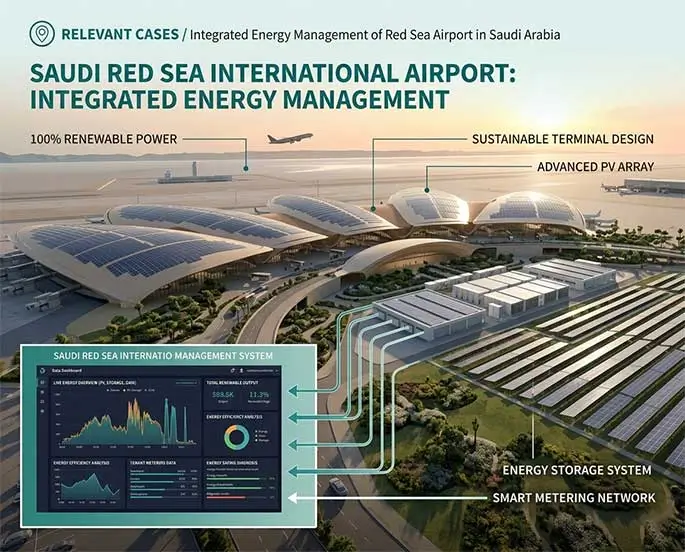
Integrated Energy Dashboard: The EMS system incorporates an intuitive, multi-dimensional graphical data dashboard, establishing a real-time “energy flow map” and “carbon emission monitoring network” for the airport.
Global Visibility: Management and operations teams can clearly grasp the dynamics of energy supply and demand, carbon emission footprints, and equipment operating status in all areas of the terminal, breaking down information silos and transforming complex underlying data into visualized, actionable operational decision-making data.
Core Values And Green Low-Carbon Achievements
Through the in-depth application of the Integrated Energy Management System (EMS), Saudi Red Sea Airport has achieved remarkable results in smart operations and green airport construction. Its core value is perfectly reflected in the following three core dimensions:
1. Scientific Energy Efficiency Analysis and Real-Time Optimization of Air Conditioning Operation Efficiency
As large public buildings, airports typically have HVAC systems that are major consumers of energy and emitters of carbon. The system focuses on providing refined energy efficiency diagnostics for the airport’s integrated air conditioning and cooling systems.
Dynamic Optimization of Air Conditioning Efficiency (COP/EER): Combining real-time load data from the underlying heat and cold water meters, the EMS system can calculate the actual operating efficiency of the air conditioning units in real time.
Equal Emphasis on Passenger Comfort and Energy Saving: Through AI algorithms, the system dynamically adjusts the refrigeration station’s operating strategy based on flight schedules, indoor and outdoor temperature and humidity changes, and passenger flow. While fully ensuring passenger comfort in the terminal, it significantly improves the energy efficiency of the air conditioning system, achieving substantial energy savings.
2. Precise Carbon Emission Tracking, Facilitating Comprehensive Green Energy Asset Management
The Red Sea Airport is powered entirely by renewable energy sources (such as solar photovoltaic and energy storage systems). The EMS system, through the classification, statistics, and analysis of data from over 3,000 meters, achieves precise tracking of every kilowatt-hour of clean energy from production and storage to consumption.
The system accurately measures the proportion of green energy used in each department and region, generating automated carbon reports. This provides authoritative and tamper-proof data support for the airport’s green and low-carbon operations, perfectly aligning with the Saudi Red Sea project’s stringent ecological commitment to “net-zero emissions.”
3. Proactive Operation and Maintenance, Ensuring Airport Operational Safety and Business Continuity
Beyond energy conservation and carbon reduction, the system’s introduction has fundamentally changed the Red Sea Airport’s energy operation and maintenance model, transforming it from the traditional “experience-driven, post-fault response” approach to a “data-driven, proactive defense” model.
Based on abnormal data monitoring from smart meters (such as sudden current changes, minor water leaks, and abnormal heat and cold losses), the EMS software can provide millisecond-level fault warnings.
Predictive maintenance by operations and maintenance personnel can intervene before equipment fails completely, significantly reducing system downtime risks and ensuring business continuity and public safety at this critical hub.
Conclusion and Industry Implications
The successful implementation of the Saudi Red Sea Airport Integrated Energy Management Project demonstrates that deeply integrating digital and intelligent technologies into infrastructure construction is the core path for large public buildings to become green, low-carbon, and intelligent. Through the integrated deployment of hardware and software—comprehensive sensing by over 3,000 multi-functional meters, intelligent decision-making via EMS software and dashboards, and scientific diagnosis of key energy consumption such as air conditioning efficiency—Red Sea Airport has not only improved its own operational efficiency but has also set a new technological benchmark and industry model for the construction of modern “green airports” globally.