🔍 Problem: Discovering a Sudden Electricity Bill Increase 30 Days Later – Too Late
“Why did my electricity bill suddenly increase this month? Is the meter broken?” This is a question many people have had, and it’s a common concern for managers.
Imagine managing a large industrial park with meters distributed throughout workshops, warehouses, and office buildings. Can you monitor the entire park’s electricity usage solely through manual meter reading? The answer is almost impossible. The problem of “blindly using electricity” is widespread. Discovering a sudden surge in electricity consumption only when checking the bill is too late. How can this be prevented?
✅ Solution: Install LoRaWAN Smart Meters
Regular WiFi is simply insufficient in factories. Signal drops quickly against thick concrete walls, metal partitions, and large equipment. Achieving full coverage would require hundreds of routers, which is too costly. LoRaWAN is specifically designed for this scenario.
What is the difference between WiFi and LoRaWAN?
- WiFi – High power, but short range and easily blocked by walls.
- LoRaWAN – Strong signal penetration, easily passing through concrete and metal structures.
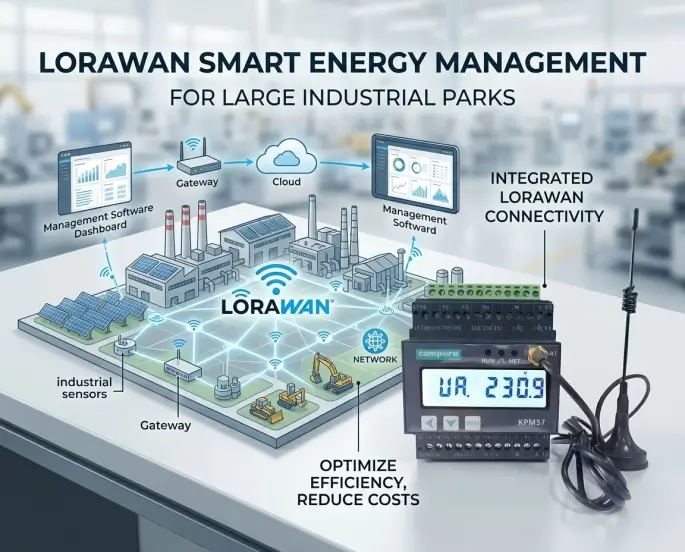
By installing LoRaWAN smart energy meters, managers can monitor abnormal electricity usage data in the park in real time, gaining a clear understanding of the overall electricity consumption situation and saving a significant amount of manual meter reading costs.
💰 Three Major Benefits of Using LoRaWAN Smart Energy Meters
1️⃣ Eliminates Manual Meter Reading Errors
The error rate for manual meter reading is approximately 5%. A single mistake can cost a business thousands or even tens of thousands of yuan more in electricity bills. LoRaWAN smart meters automatically upload data, eliminating manual labor and errors.
2️⃣ Reduces Peak-Hour Surcharges
Many people don’t know that electricity bills depend not only on total usage but also on how heavily you consume electricity within a short period. With real-time data, you can stagger device startup times, avoiding peak electricity consumption and easily reducing these surcharges.
3️⃣ Early Detection of Faulty Equipment
A malfunctioning machine might be wasting electricity, but you might not realize it until a month later. With real-time monitoring, abnormal power consumption can be detected immediately, allowing the maintenance team to address the issue promptly and prevent greater losses.
📡 Features of LoRaWAN Smart Energy Meters: Unaffected by Walls, Distance, or Interference
You may have experienced this: when using your phone in the basement or elevator of a large industrial park, the signal suddenly drops. This is because high-density materials, such as metal plates, concrete, thick glass, or instruments that generate electromagnetic interference, can block or reflect WiFi signals, preventing the meter from connecting to the network.
LoRaWAN’s advantage lies here: it doesn’t “shout,” but rather sounds like a deep, powerful whistle, easily penetrating thick walls and maintaining a stable connection in steel and concrete environments. This means you can build a wireless monitoring network covering the entire park, completely eliminating signal blind spots.
📊 How to Choose Among the Three Communication Technologies?
If you’re struggling to choose between WiFi, 4G, and LoRaWAN, here’s a comparison:
First, let’s look at transmission distance. WiFi only covers a few dozen meters, and the signal is practically nonexistent outside the room; 4G works as long as there’s a base station, distance isn’t an issue; while LoRaWAN can transmit for several kilometers, making it ideal for large campuses.
Next, consider penetration ability. WiFi is most vulnerable to walls, with very weak signals against concrete or metal; 4G performs moderately, often losing signal in basements or shipping containers; LoRaWAN is much stronger, easily penetrating thick walls.
Finally, consider operating costs. Achieving large-scale WiFi coverage requires numerous routers, making maintenance cumbersome; 4G requires a SIM card for each device, leading to significant accumulated data charges; LoRaWAN has relatively lower equipment and operating costs.
The conclusion is clear: WiFi is suitable for offices and homes, 4G is suitable for mobile phones and video surveillance, and for monitoring power consumption in large campuses, LoRaWAN is the most suitable choice.
🏭 Real-world application scenarios: Who uses it? How does it use it?
- Large manufacturing plants: Real-time monitoring of power consumption on every production line, with immediate alarms for any anomalies.
- Logistics parks: Unified management of warehouses, office buildings, and charging stations, avoiding peak-hour surcharges.
- Industrial parks/sectoral parks: Property management can view the power consumption, peak values, and anomalies of each company in real time.
- Petrochemical parks: Real-time monitoring of any abnormal power fluctuations triggers immediate alarms; security personnel can remotely view all data from the control room.
- Infrastructure projects (airports, high-speed rail stations, subway stations, etc.): LoRaWAN signals can penetrate multiple basement levels, eliminating the need for complex wiring. A single screen in the operations center displays the overall power consumption situation.
✅ Summary: Stop paying for “invisible waste”
Compare the differences between traditional methods and LoRaWAN smart meters:
- Traditional methods involve manual meter reading, with an error rate of around 5%, and problems are only discovered after 30 days. There are many signal blind spots and coverage difficulties, and peak-hour surcharges are often unpaid.
- LoRaWAN smart energy meters feature automatic data upload with zero errors, enabling real-time problem detection and immediate resolution. They boast strong signal penetration, full park coverage, and proactive cost savings through peak shaving and valley filling.
📞 Want to learn more?
Contact us for a customized electricity diagnostic report for your park.