When building an Energy Management System (EMS), choosing the right communication protocol is like building a complex “neural network” for the system. A good protocol ensures stable data acquisition and fast response; a poor one leads to endless optimization and maintenance problems later on.
Among the many protocols, Modbus and MQTT are the two most frequently used, yet diametrically opposed, mainstays. To understand how to choose, we need to first look at their core strengths and applicable scenarios.
In-depth Analysis of the Two Core Protocols
1. Modbus: The “Old Hand” in Industrial Sites
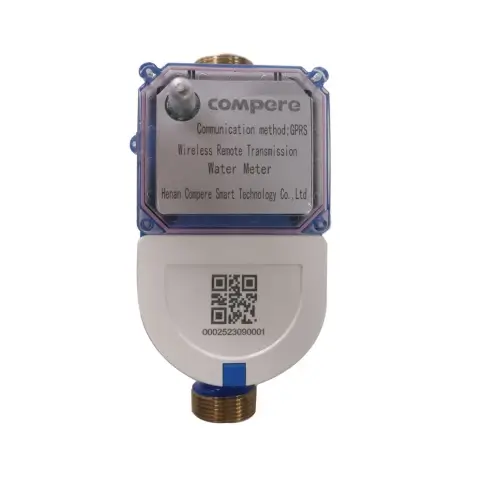
Modbus, born in 1979, is the absolute ruler in the field of industrial automation. In energy management systems, almost all hardware devices (such as smart electricity meters, water meters, inverters, PLCs, and circuit breakers) natively support Modbus.
Communication Mode: Typical master-slave architecture or query-response mode. Only when the master station (such as a gateway or host computer) sends a message can the slave stations (meters, sensors) respond.
Transmission Media: Commonly used are Modbus RTU (using RS485 serial port, extremely stable, strong anti-interference) and Modbus TCP (using Ethernet, fast).
Advantages:
Extremely high compatibility: Standard configuration by hardware manufacturers, almost “plug and play”.
Simple and reliable: Lightweight protocol, no redundant handshakes, extremely stable within a local area network.
Disadvantages:
Lack of security: Natively lacks encryption and authentication.
Efficiency bottleneck: Uses a polling mechanism. If the system has 500 meters, the master station must query them one by one, and data real-time performance will decrease as the number of devices increases.
2. MQTT: The “Lightweight Courier” of the IoT Era
MQTT is a lightweight IoT protocol based on a publish/subscribe model, designed specifically for remote communication in low-bandwidth, unstable network environments.
Communication Mode: Devices (clients) do not need to know of each other’s existence; they only send (publish) data to or receive (subscribe) data from a single core—the MQTT Broker.
Advantages:
On-demand Reporting (Report by Exception): Data is only sent when changes occur (e.g., increased power consumption, abnormal voltage), significantly saving network bandwidth.
Easily Penetrates Intranets: Based on TCP/IP, as long as there is an internet connection, it can easily bypass enterprise firewalls and send data to the cloud.
Naturally Supports High Concurrency: A single Broker can process data from tens of thousands of devices simultaneously.
Disadvantages:
Limited Underlying Hardware Support: Most basic electricity and water meters cannot directly send MQTT messages and require the installation of a smart gateway for conversion.
“Tailored Approach” In Energy Management Systems
In actual energy management systems, it is never a simple “either/or” choice, but rather a combination of strategies where each component fulfills its specific function. We can choose based on the system architecture layer:
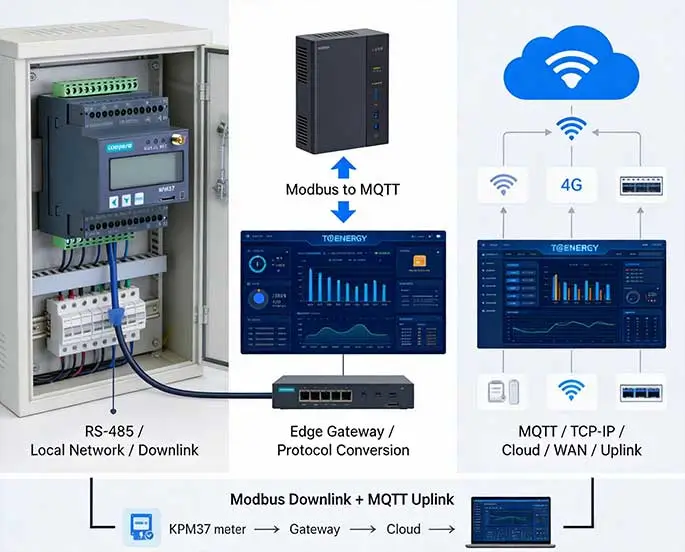
1. Device Layer to Gateway Layer (Local Area Network): Modbus is the preferred choice.
In factories, industrial parks, and buildings, from terminal devices (meters, sensors, inverters) to the edge gateway, Modbus is undoubtedly the best option.
Reason: The meters are located in the distribution box, close to each other. Connecting them via a single RS-485 bus using Modbus RTU is both economical and stable. There’s no need for each meter to have a complex network stack running MQTT.
2. Gateway Layer to Cloud/Central Server (Wide Area Network): MQTT is the preferred choice.
From the edge gateway in the field to the group’s cloud platform or a central server across regions, MQTT is the perfect solution.
Reason: Branch offices or factories are distributed across the country, with complex network environments (potentially using 4G/5G or the public internet). The gateway packages locally collected Modbus data, compresses it into JSON format, and publishes it to the cloud via MQTT on a scheduled or triggered basis, saving bandwidth and ensuring security (TLS encryption can be easily added).
Selection Decision Matrix: Multi-Dimensional Considerations
To give you more confidence in your selection, we can benchmark against the following core dimensions:
| Dimension | Modbus (RTU/TCP) | MQTT |
|---|---|---|
| Network Environment | Local Area Network (LAN), Fieldbus (RS-485) | Wide Area Network (WAN), Internet, Cellular Network (4G/5G) |
| Device Scale | Within hundreds (Limited by polling efficiency) | Tens of thousands or more (High concurrency, strong scalability) |
| Network Bandwidth | Dedicated bandwidth, requires high stability | Bandwidth-constrained, intermittent connection environments (Extremely low data overhead) |
| Security Requirements | Low (Requires physical isolation or VPN) | High (Native support for TLS encryption, username/password authentication) |
| Data Mechanism | Periodic Polling (Request-Response) | Event-driven (Report by Exception, Last Will and Testament, automatic reconnection) |
Summary: The Golden Architecture Formula
When designing an energy management system, the most mature and recommended deployment architecture is typically:
“Modbus downlink acquisition + MQTT uplink pass-through”
Downlink (Field End): The gateway uses Modbus RTU to intensively and stably collect physical parameters such as power consumption and power factor from each distribution branch.
At the Edge (Gateway End): The gateway cleans, down-converts, and converts the protocol (Modbus to MQTT).
Uplink (Cloud): The gateway acts as an MQTT client, securely and efficiently pushing structured data to the energy management cloud platform for big data analysis and visualization.
One final piece of advice: If your system is purely a local monolithic project (for example, a small factory with servers located in the factory’s server room) and you have no plans to expand to the cloud in the future, sticking with Modbus RTU all the way through is also a simple and cost-effective option.