In modern commercial real estate operations, with rising energy costs and increasing tenant demands for service quality, shopping malls, complexes, and specialized markets are facing unprecedented challenges: large fluctuations in tenant electricity load, slow electricity bill revenue recovery, and complex calculation of shared expenses.
Compere conducted in-depth research on hundreds of commercial real estate clients and launched a smart prepaid electricity meter management solution. This article will analyze in depth how this electricity meter, through automation technology, helps property owners transform from “passive payment collection” to “proactive management.”
I. Industry Status Quo
Most traditional shopping malls still use a “manual meter reading + paper receipts + pay-after-use” model. This model has three fatal flaws:
Accumulated Financial Risk: Property management companies typically need to pay huge electricity bills to the power grid before collecting payments from tenants. If tenants experience operational difficulties or maliciously default on payments, the property will face enormous cash flow pressure.
Low Management Efficiency: In a shopping mall with hundreds of stalls, meter reading and data verification alone require several electricians and days, leading to numerous complaints due to human error.
Lack of Load Monitoring: Traditional mechanical or simple electronic meters cannot monitor overload, harmonics, and other parameters in real time, making it difficult to prevent electrical fire hazards caused by merchants’ violations.
Core Technology: How Can Prepaid Systems Reshape Management Processes?
1. Rigid Power Control: The Power of Built-in Magnetic Latching Relays
The biggest difference between prepaid meters and ordinary meters lies in their built-in high-lifespan magnetic latching relays.
Logic Control: The system can preset a “bankruptcy threshold.” When the remaining amount falls below 50 yuan, the meter issues a preliminary warning through a flashing display and a background push notification; when the balance reaches zero, the relay activates instantly, achieving precise circuit breaker tripping.
Remote Reset: Within 3-5 seconds of a tenant completing a top-up, the system sends a command via RS485 or 4G/LoRa network, automatically resetting the meter. This “unattended” closed-loop process significantly reduces the cost of manual intervention.
2. Diversified Payment Options: Building a Convenient “Self-Service Top-up” Ecosystem
We understand the importance of payment flexibility in B2B scenarios. The system supports:
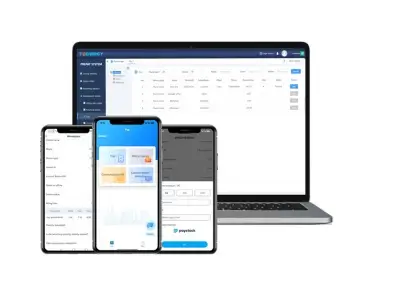
Mobile Self-Service: Tenants can check their balance, view real-time power consumption, and complete payments by entering the meter number through WeChat official accounts or mini-programs.
Back-end Batch Top-up: Property management staff can uniformly increase credit limits or adjust strategies for specific areas (such as anchor stores and food courts) from the management back-end.
Tiered and Time-of-Use Electricity Pricing: Addressing the characteristics of shopping malls’ daytime peak hours and nighttime off-peak hours, the system supports setting multiple electricity rates to guide tenants to use electricity during off-peak hours.
3. Data Transparency: Making Common Area Costs and Energy Consumption Transparent
The cost allocation of common areas in shopping malls (elevators, air conditioning, lighting) is often a point of contention.
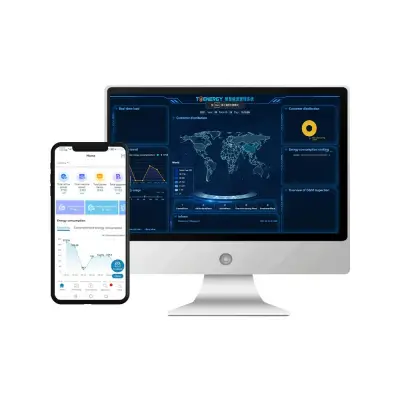
Multi-Circuit Monitoring: Through multi-circuit meters, property management can clearly understand the precise energy consumption of each escalator and each central air conditioning unit.
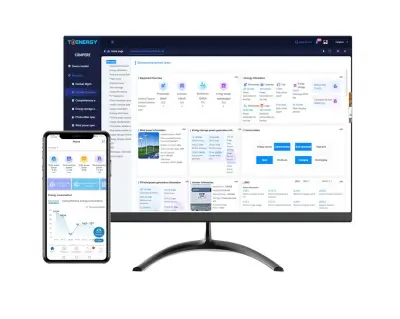
Automatic Cost Allocation Model: The system automatically calculates shared electricity costs into tenant bills based on factors such as shop area and rated capacity, generating detailed electronic statements to ensure every penny is accounted for, thus improving tenant satisfaction.
Implementation Recommendations: Three Key Steps from Planning to Implementation
If you plan to implement this system in your project, we recommend following these steps:
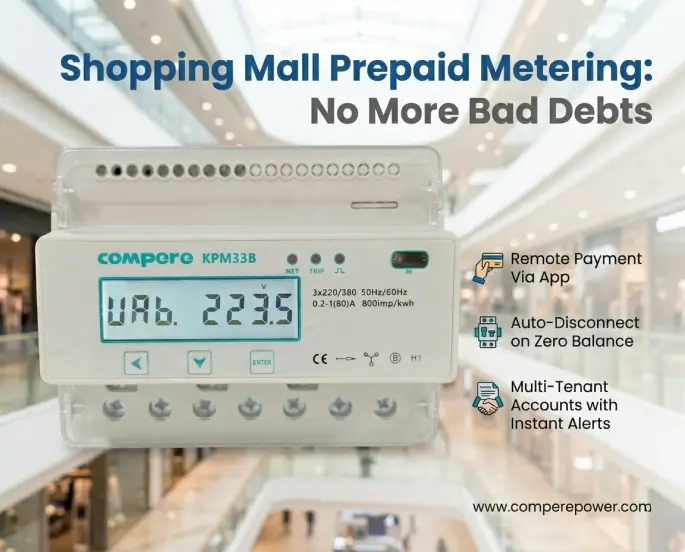
Site Selection and Equipment Selection: For anchor tenants, we recommend using KPM33 DIN rail prepaid meters (supporting high-precision metering); for food and beverage areas, models with harmonic monitoring functions should be selected to prevent high-power kitchen appliances from interfering with grid stability.
Communication Network Setup: Considering the numerous obstructions in the shopping mall, we recommend using an RS485 bus to gateway approach to ensure 100% data transmission success rate.
Policy Settings: In the initial stage of system launch, we recommend setting a high alarm threshold (e.g., alarm when 100 yuan remains) and giving tenants a 2-4 week adaptation period, informing them of the power outage rules for overdue payments through the system announcement function.
Return on Investment (ROI) Analysis
While upgrading to a smart prepaid system requires initial investment, in the long run:
Labor Savings: Approximately 70% reduction in meter reading and collection labor costs annually.
Zero Bad Debts: Completely eliminates electricity bill arrears due to tenant withdrawals, saving potential losses of tens of thousands of yuan annually.
Energy Savings: Real-time monitoring helps detect abnormal leakage, typically reducing unnecessary energy consumption by 5%-10%.
Conclusion
In the competitive business environment of 2026, digital operational capabilities are synonymous with brand power. Compere is committed to providing transparent and efficient energy management solutions to global customers through leading sensing layer hardware.
Related Articles:
Application of Prepaid Systems In Shopping Malls
How Multi-Tenant Smart Metering Reduces Operating Costs in Shopping Malls in Malaysia And Singapore?