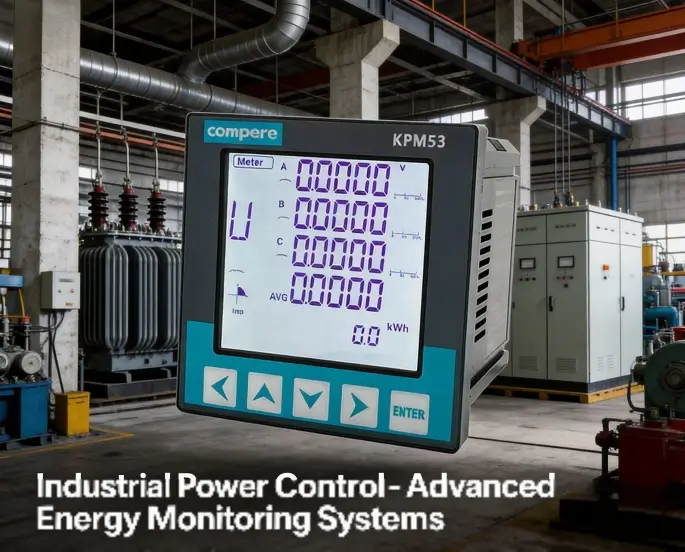
In traditional factory management models, electricity costs are often considered an uncontrollable “fixed cost.” However, with the widespread application of smart meters, they are no longer just billing tools, but have become powerful tools for solving production management challenges. The following are the core problems that smart power meters solve for factories:
Solving the Problem of “Unclear Accounting” in Cost Allocation
Pain Point: In the past, factories only had a master meter, making electricity expenditures a “muddled mess.” Finance departments struggled to calculate the actual unit consumption of different products and workshops, leading to a lack of basis for cost control.
Solution: Smart power meters, through itemized and segmented metering, accurately link energy consumption to specific production lines, work groups, and even orders.
Results: Managers can clearly see “which product consumes more electricity” or “which work group is wasting energy.” This not only solves the problem of inaccurate cost accounting but also provides objective evidence for internal assessments, stimulating the enthusiasm of grassroots workers for energy conservation.
Solving the Problem of “Hidden Waste” in Blind Spot Monitoring
Pain Point: Factories experience significant “invisible” power loss, such as ineffective standby of equipment, leaks from air compressors, and lighting systems left on after get off work hours.
Solution: Smart power meters can generate real-time power load curves.
Result: It solves the “management vacuum” problem. By analyzing baseline loads during non-production periods, managers can easily identify which equipment is “idling.” For example, if high power consumption is detected during lunch breaks, equipment that is not turned off can be precisely located, eliminating ineffective energy consumption.
Solving the Problem of “Electricity Penalties” and Energy Efficiency Loss
Pain Point: Industrial electricity consumption requires attention to both power output and power factor. Many factories incur hefty monthly penalties from power companies due to insufficient reactive power compensation; simultaneously, harmonic interference can cause malfunctions in precision equipment.
Solution: Smart power meters have power quality monitoring capabilities.
Result: It solves the problem of “lack of specialized data.” Real-time monitoring of power factor, harmonics, and voltage fluctuations alerts engineers to adjust compensation devices promptly, directly canceling penalties on electricity bills and protecting the operational lifespan of high-value equipment.
Solving Downtime Losses Caused by “Reactive Maintenance”
Pain Point: In the traditional model, equipment is repaired only after it breaks down. However, large equipment (such as fans and pumps) often exhibits abnormally high current or three-phase imbalance before failure.
Solution: Smart power meters act as a “stethoscope” for equipment health.
Result: Solves the problem of “lack of early warning.” By monitoring subtle anomalies in current fluctuations, the meter can issue alarms at the initial stages of motor overload or bearing wear. This “early warning instead of emergency repair” model avoids the scrapping of entire production lines and significant production losses caused by sudden shutdowns.
Solving the Problem of Risk Prediction for “Electrical Safety”
Pain Point: Complex factory wiring means that overloads, leakage, or poor contact leading to arcing can easily cause fires, which are difficult to detect in real time with the naked eye and regular inspections.
Solution: Smart power meters (especially those with temperature measurement and leakage current monitoring functions) enable electrical fire monitoring.
Results: They solve the problem of discontinuous safety monitoring. They can monitor cable temperature and leakage current 24/7, cutting off power or issuing alarms before sparks ignite, eliminating potential safety hazards in their infancy.
Summary
The core logic of smart power meters is to transform the “invisible” energy flow into “visible” data, and then transform that “visible” data into “manageable” decisions. It makes energy conservation no longer a mere slogan, but a well-documented and precise management practice.