In today’s rapidly developing technological world, smart meters are becoming increasingly common. Has your neighborhood already switched to smart meters? What are the differences between smart meters and traditional meters? Can using smart meters really save money?
The answer is: Yes. For factory managers and system integrators, choosing the right metering solution is the first step in reducing operating costs and achieving carbon neutrality goals. This article will provide an in-depth analysis of the core differences between the two and why smart meters are an inevitable choice for modern enterprises.
1. What is a Traditional Meter?
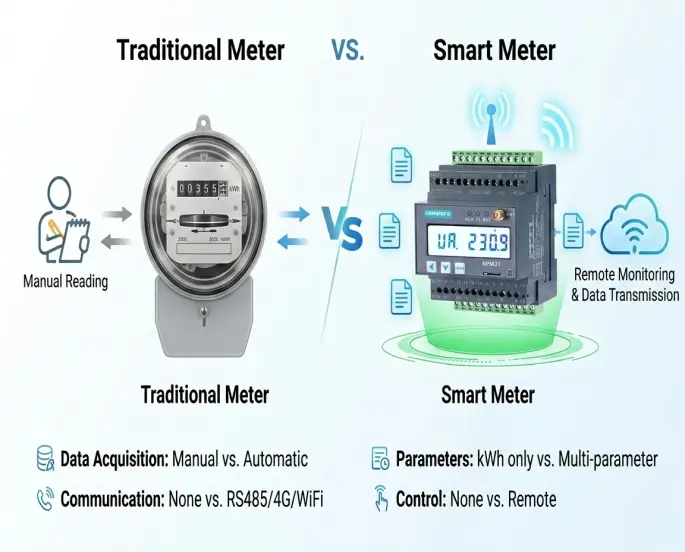
Traditional meters (usually referring to induction-type mechanical meters) have been in use for decades. They record electricity consumption by using a magnetic field generated by an electric current to drive an aluminum disc to rotate.
Manual Data Collection: Data must be recorded on-site by technicians, which is time-consuming, labor-intensive, and prone to errors.
Limited Information: Only displays cumulative electricity consumption (kWh), and cannot indicate peak electricity usage times or power quality conditions.
One-Way Device: Used only as a recording tool, it cannot communicate with other systems or be remotely controlled.
2. What is a Smart Meter?
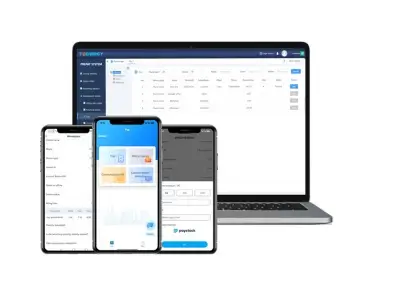
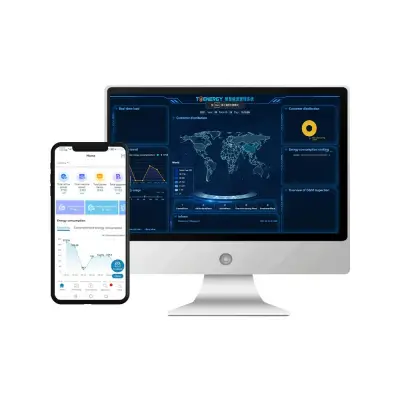
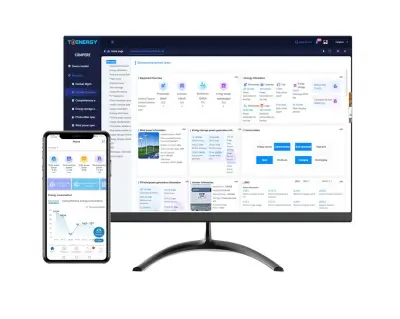
A smart meter is a new type of digital energy meter that accurately measures electricity consumption and transmits electricity data in real time. It eliminates the need for manual meter reading, supports real-time monitoring, fault diagnosis, time-of-use pricing, and remote control, effectively supporting energy management.
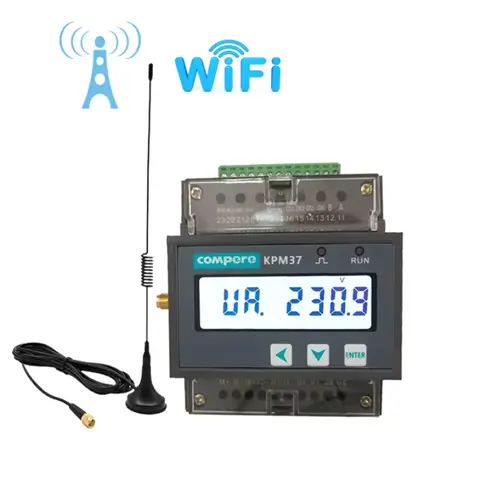
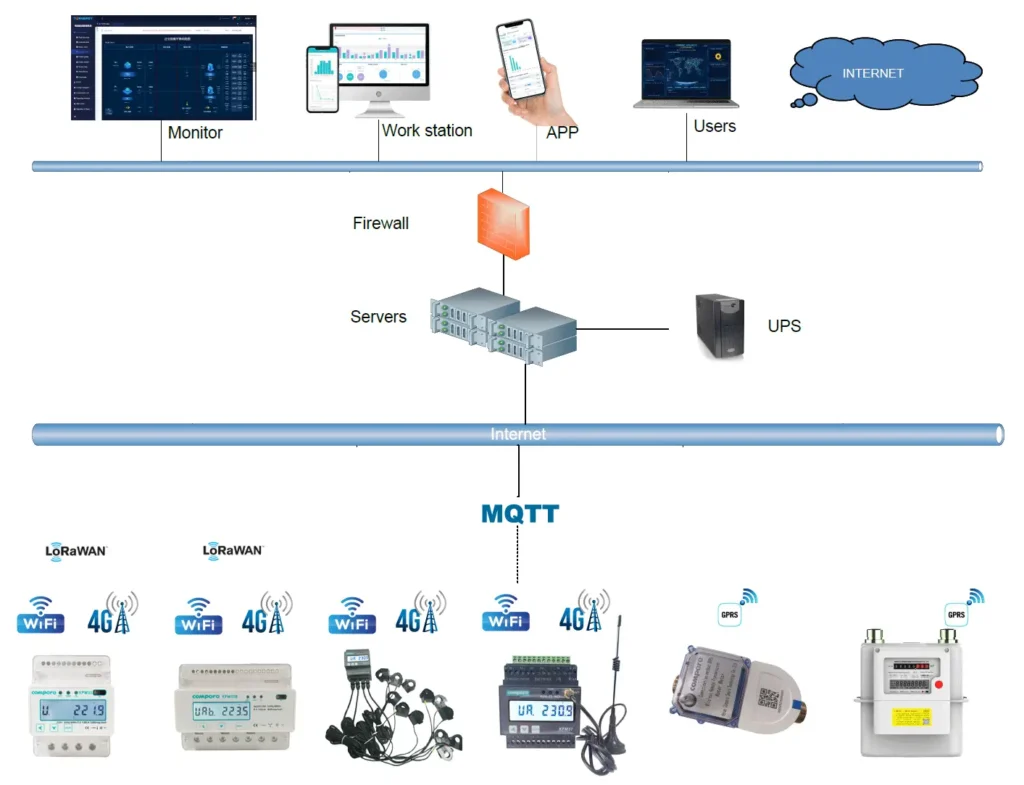
Communication: Equipped with RS485 (Modbus RTU), 4G, or WiFi interfaces, it can directly upload data to the cloud or EMS energy management platform.
Multi-dimensional Monitoring: In addition to electricity consumption, it can monitor voltage, current, power factor, harmonics (THD), and frequency.
Real-time Data Transmission and Remote Meter Reading: Automatically uploads electricity consumption information, enabling remote data collection without meter readers.
3. Core Comparison: Smart Meters vs. Traditional Meters
To facilitate your technology selection, the following is a summary of comparisons from professional perspectives:
| Features | Traditional Meters | Smart Meters |
|---|---|---|
| Data Acquisition | Manual reading; time-consuming and prone to human error. | Automatic real-time collection with high precision. |
| Connectivity | No communication or simple pulse output only. | Supports RS485 (Modbus RTU), 4G, WiFi, LoRaWAN. |
| Monitoring Scope | Cumulative energy consumption (kWh) only. | Voltage, Current, Power Factor, Harmonics (THD), Frequency. |
| Remote Control | Not supported. | Supports remote relay control, configuration, and OTA firmware updates. |
| Alarm System | None. | Real-time alerts for overvoltage, undervoltage, overload, and power outages. |
| Applications | Basic residential billing. | Industrial automation, Energy Management Systems (EMS), Data Centers. |
4. How do smart meters create value for your business?
A. Enhancing the “Resilience” of the Power System
Traditional meters cannot detect sudden voltage drops or frequency anomalies. Smart meters monitor power quality, helping engineers identify potential power hazards before sensitive equipment (such as semiconductor production lines or pharmaceutical workshops) is damaged, reducing unplanned downtime.
B. Simplified System Integration
For system integrators, compatibility is key. Our smart meters support the standard Modbus protocol, easily connecting to existing PLCs or third-party energy management systems (EMS), shortening project delivery cycles.
C. Optimized Cost Structure
By installing smart sub-meters in critical processes, companies can accurately calculate the energy cost of each product, thereby identifying energy-saving opportunities. Typically, energy waste detected through smart monitoring can help companies reduce operating costs by 10%-20%.
D. Remote Operation and Automation
For remote sites such as telecom base stations or distributed photovoltaic stations, using smart meters with 4G capability eliminates the need for on-site meter reading; configuration and troubleshooting can be completed through the backend.
5. Frequently Asked Questions (FAQ)
Q1: Does upgrading to smart meters require modifying the existing distribution cabinet?
A: No large-scale modification is required. Compere KPM series meters (such as KPM37 energy meter) are mostly mounted on a standard 35mm DIN rail, are compact, and can be directly installed in existing distribution boxes.
Q2: Are smart meters less lifespanable than traditional meters?
A: Although smart meters contain electronic components, our KPM series has undergone rigorous industrial-grade environmental testing. The stable lifespan of its high-precision metering chip fully meets industrial standards and eliminates the increased error caused by mechanical wear.
Q3: Are smart meters more accurate?
A: Yes. Mechanical meters lose accuracy with wear, while digital smart meters (such as those with 0.5S or 0.2S accuracy) maintain extremely high measurement accuracy throughout their entire lifespan, reducing trade settlement disputes.
Q4: How do I choose the right communication protocol for me?
A: If there is wiring available within a factory, RS485 is the most stable and economical choice; for distributed or decentralized buildings, 4G or WiFi offers greater flexibility.
Summary: What Does A Smart Meter Bring To Your Life?
In short, upgrading from a traditional meter to a smart meter is far more than just replacing a device. It brings you:
Right to know: You can clearly know where your electricity is being used.
Right to control: You can proactively adjust your electricity usage habits based on detailed data to achieve energy conservation.
Convenience: Say goodbye to manual meter reading and enjoy more accurate billing and more flexible services.
It’s like a considerate home energy manager, making previously ambiguous electricity usage behavior clearly visible. At first, you might feel a little uncomfortable with the complete transparency of the data, but this is just the first step towards smart electricity use and energy conservation. Hopefully, this article will help you fully understand this “new member” of your home!