Contents
In the wave of Industry 4.0 and digital transformation, refined management of energy consumption has become crucial for enterprises to reduce costs and enhance competitiveness. Traditional power monitoring faces pain points such as difficult wiring and data silos. LoRaWAN smart energy meter solutions provide a highly reliable and easily deployed wireless monitoring method for large industrial parks and factories.
What Is A LoRaWAN Smart Energy Meter?
Simply put, a LoRaWAN smart energy meter is an advanced metering device that integrates a LoRaWAN (Long Range Wide Area Network) long-range wireless communication module into a traditional digital meter.
1. Core Definition
It not only measures current, voltage, and energy consumption like a regular meter, but more importantly, it has the ability to “network and communicate.” Through the LoRaWAN low-power wide area network standard, the LoRaWAN smart energy meter can wirelessly transmit data to a gateway several kilometers away, without the concerns about short signal coverage or poor wall penetration that exist with WiFi or Bluetooth.
2. Why Choose LoRaWAN? (Technical Features)
Long-Range Coverage: In complex industrial parks, a single LoRaWAN gateway can typically cover a radius of 2-5 kilometers, easily penetrating multiple layers of reinforced concrete walls.
Deep Penetration: Industrial distribution boxes are usually made of metal, severely shielding wireless signals. LoRaWAN, with its superior spread spectrum technology, can stably transmit signals from inside enclosed metal cabinets.
Low Power Consumption Design: Compared to 4G energy meters, LoRaWAN modules consume extremely low power. Although the meters themselves are usually powered by mains electricity, the low power consumption means lower heat generation and longer electronic component lifespan.
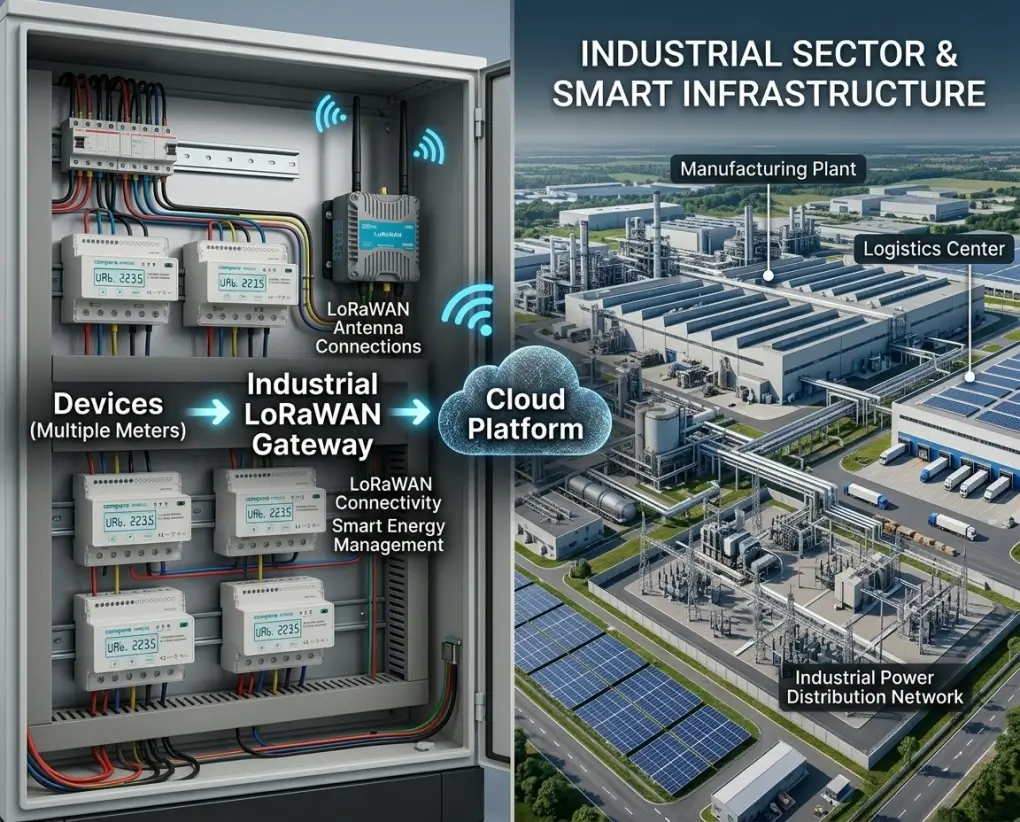
Massive Node Capacity: A standard industrial-grade gateway can manage hundreds or thousands of meters simultaneously, making it ideal for dense industrial building clusters like the one shown on the right.
3. What Data Can It Collect?
In addition to basic electricity consumption, industrial-grade LoRaWAN smart energy meters can typically monitor the following parameters:
Power Quality: Including harmonics, frequency offset, etc., which are crucial for the healthy operation of precision machining equipment.
Real-time Load: Helps factories identify which equipment is the “highest energy consumer.”
Abnormal Conditions: Detects issues such as voltage loss, phase loss, and reverse phase sequence, and can instantly issue alarms via wireless signals.
System Architecture: From Sensing to Cloud
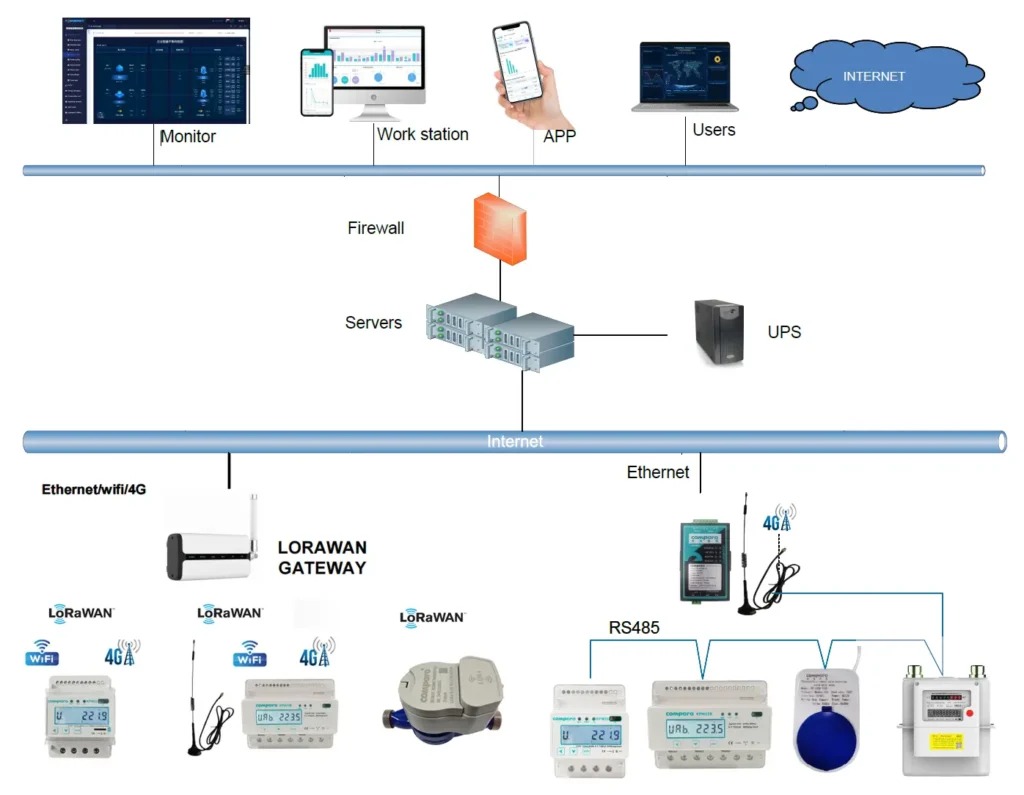
This solution adopts a typical “end-pipe-cloud” three-layer architecture to achieve fully automated energy data collection and analysis.
Sensing Layer (Equipment End):
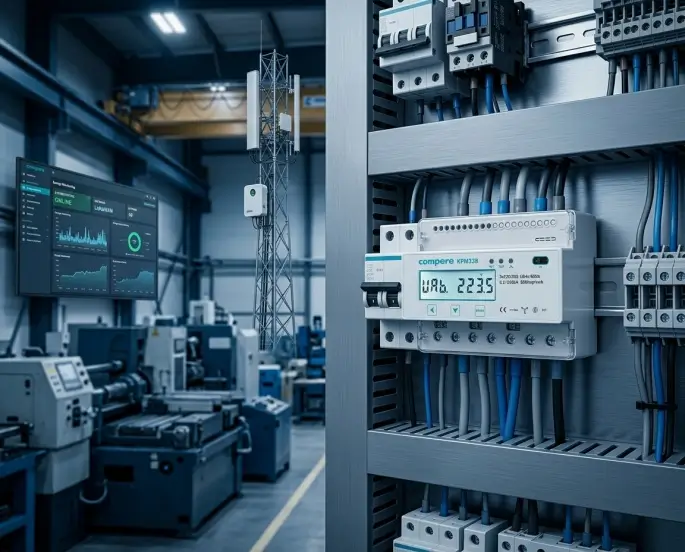
DIN Rail energy meters are installed in industrial power distribution cabinets.
Multiple meters monitor voltage, current, power factor, and total energy consumption in real time through built-in or external LoRaWAN modules.
Network Layer (Gateway End):
The LoRaWAN Gateway is responsible for receiving wireless signals uploaded by all energy meters within its coverage area.
The gateway encrypts and transmits the data to the backend server via 4G/5G or Ethernet.
Application Layer (Cloud Platform):
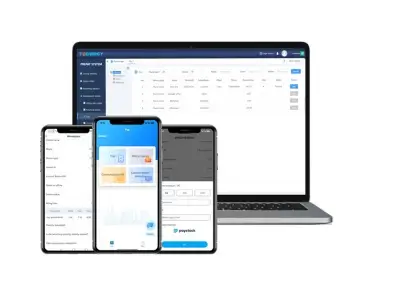
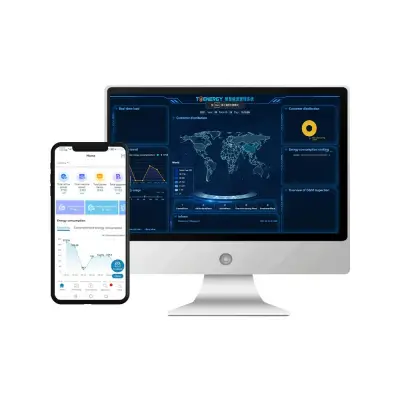
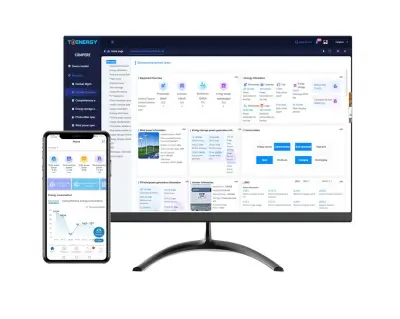
The Cloud Platform cleans, stores, and visualizes the raw data.
Achieving a complete data flow from device → Gateway → Cloud
Advantages for Industrial Applications
This solution is specifically designed for non-residential scenarios (such as manufacturing plants, commercial complexes, and logistics centers), offering significant practical value:
Simplified Deployment, Cost Reduction and Efficiency Improvement
When renovating old factories or deploying networks in large industrial parks, there is no need for large-scale cabling involving breaking down walls. Compared to traditional 4G solutions, the LoRaWAN self-built network mode eliminates the need to pay annual fees for numerous SIM cards, significantly reducing long-term operating costs.
High Capacity and High Reliability
A single gateway can connect to hundreds or even thousands of electricity meters. For sudden power fluctuations in industrial environments, the system can achieve millisecond-level anomaly detection and push alarms in real time via the cloud platform, preventing downtime risks caused by overload.
Refined Cost Accounting
Compared to solutions that require inserting a data SIM card into each electricity meter, the LoRaWAN self-built network mode eliminates the need to pay multiple monthly fees to operators, and the module’s power consumption is extremely low, significantly reducing maintenance costs. The system can meter electricity costs based on production lines, work groups, and even individual large pieces of equipment.
Real-time Alarms and Warnings
The system can automatically identify abnormal power fluctuations or overload risks, and push alarms in real time through the cloud platform to prevent industrial accidents.
Conclusion
By deploying a monitoring system centered on LoRaWAN smart energy meters, enterprises can establish transparent and traceable energy records. This is not merely a hardware upgrade, but a crucial step towards cost reduction and efficiency improvement through digitalization, and towards green industry.