Application Solutions of Smart Meters in Energy-Saving Retrofits of Old Factories (For System Integrators)
How Can Smart Meters Improve Efficiency of Old Factories by 20%?
In the current industrial environment, electricity costs have become a major part of operating costs for enterprises in industries such as textiles, cement, and metal processing. However, many factory owners still face the passive situation of “only realizing they’ve overspent when they receive their bills at the end of the month.” How can this passive situation be turned into an active one? The answer lies in the digital transformation of power monitoring.
Common Power “Stubborn Problems” in Industrial Sites
In our discussions with numerous system integrators, we found that the most pressing problems in factories are concentrated in the following areas:
Data Silos: Inconsistent protocols between different brands of equipment lead to high integration difficulty and costs.
Harsh Environment: High temperatures, high humidity, and strong electromagnetic interference in industrial sites place extremely high demands on hardware reliability.
Data Acquisition Discontinuity: Old equipment lacks communication capabilities, making real-time energy consumption monitoring impossible.
Power Quality Risks: Harmonic interference and excessive reactive power can shorten equipment lifespan and even lead to fines from the power company.
Limited Installation Space: Distribution cabinets in renovation projects often lack sufficient space to accommodate large equipment.
Layered and Hierarchical Monitoring Solution: From Distribution to Terminal
To address the complexity of industrial scenarios, we recommend a three-tiered power monitoring solution, using KPM series meters for comprehensive coverage.
1. Incoming Line Monitoring: The “Guardian” of Power Quality
In the factory’s main distribution room, we need to monitor grid quality in real time.
Core Solution: Deploy the KPM37 Wireless Energy Meter.
Functional Value: This meter not only provides high-precision metering with a 0.2s accuracy level but also captures harmonic data up to the 31st order and higher. By monitoring total harmonic distortion (THD) and voltage imbalance, integrators can help customers identify potential transformer overheating risks and avoid hefty fines due to substandard power quality.
2. Workshop-Level/Feeder Monitoring: Efficient Integration of Multiple Circuits
When monitoring dozens of production lines simultaneously, the traditional “one meter per circuit” approach is both expensive and space-consuming.
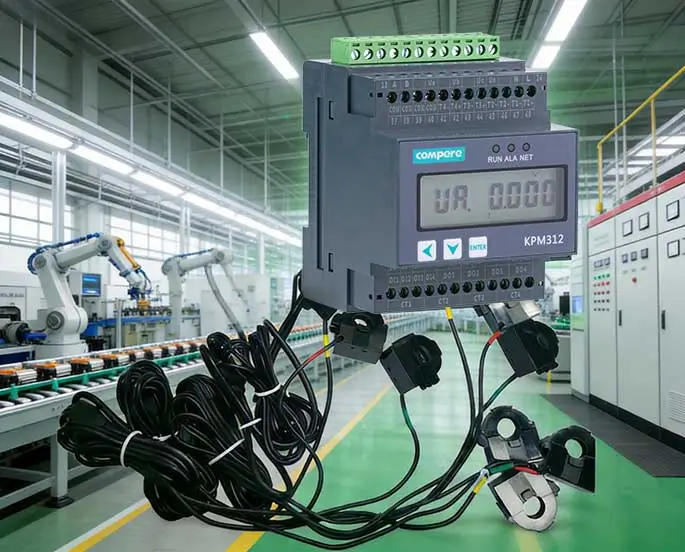
Core Solution: KPM312 Multi-Circuit Power Monitor.
Technical Advantages: A single device can support multiple three-phase or single-phase current connections.
Pain Points Solved: This design greatly simplifies wiring. In the solution page built with Elementor, we can emphasize its “modular” feature, which is highly attractive to efficiency-conscious integrators.
Core Value Analysis: How Do Smart Meters “Generate Revenue”?
Smart meters are not just a cost investment; they are a high-return investment (ROI):
Peak-Valley Electricity Optimization:
Utilizing the multi-rate (TOU) recording function provided by our prepaid meters, factories can rationally schedule production. For example, shifting high-energy-consuming processes to late-night peak-valley electricity pricing periods can directly reduce electricity costs by more than 15%.
Preventative Maintenance Solutions:
Traditional maintenance only addresses problems after they occur, while intelligent solutions monitor abnormal changes in motor starting current to predict bearing wear or insulation aging 2-4 weeks in advance. For system integrators, this is key to providing added-value services to customers.
Carbon Footprint Tracking:
To meet ESG reporting and green factory certification requirements, carbon emission conversion data provided by KPM meters is an indispensable underlying support.
Why Compere is the Preferred Partner for System Integrators?
Simple Integration: All products support the standard Modbus-RTU protocol, enabling seamless integration with your EMS or third-party IoT platforms.
Industrial-Grade Quality: Our meters undergo rigorous compatibility testing, ensuring stable readings even in environments with severe inverter interference.
Visual Aesthetics: Our hardware design follows a minimalist and professional industrial style, with clear meter screens free of unnecessary information, making them ideal for integration into high-end power distribution cabinets.