With the large-scale deployment of 5G networks, the electricity demand of the telecommunications industry continues to grow. Numerous communication base stations, data centers, edge computing nodes, and supporting air conditioning systems are placing increasing pressure on operators and system integrators in energy management.
Traditional manual meter reading methods are no longer sufficient to meet the demands of modern communication networks for “real-time monitoring, remote management, and energy conservation.” Therefore, smart energy meters are becoming an important component of digital energy management in the telecommunications industry.
Why Does The Telecommunications Industry Need Smart Meters?
Communication base stations are typically widely distributed, numerous, and many are located in remote areas. Traditional energy management methods suffer from the following problems:
- Inability to obtain real-time electricity consumption data for each base station
- Low efficiency and high cost of manual meter reading
- Inability to separately analyze the energy consumption of base station air conditioning and equipment
- Inability to promptly detect faults such as power outages, phase loss, and overloads
- Lack of a unified energy management platform
Especially in the 5G era, the power consumption of a base station is significantly higher than in 4G, and operators’ demands for refined energy data management are also increasing.
Main Application Scenarios of Smart Meters in the Telecommunications Industry
1. Energy Consumption Monitoring of Communication Base Stations
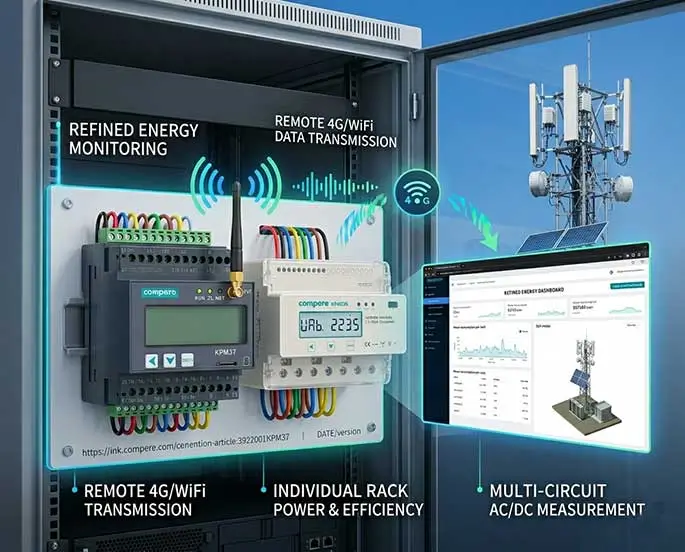
In 4G/5G communication base stations, smart meters can monitor in real time: voltage, current, power, power factor, energy consumption (kWh), and harmonic data. Data can be uploaded to a cloud platform via communication methods such as RS485, 4G, LoRaWAN, or NB-IoT for remote centralized management.
Suitable for: Carrier base stations, tower base stations, micro base stations, and outdoor integrated cabinets.
2. Power Distribution Monitoring in Data Centers and Communication Equipment Rooms
Communication equipment rooms typically include: UPS systems, precision air conditioning, server equipment, power distribution cabinets, and backup power generation systems. Smart meters help managers achieve: circuit-specific energy consumption statistics, PUE energy efficiency analysis, equipment operating status monitoring, anomaly alarms, and remote meter reading. For large data center projects, multi-circuit smart meters can monitor multiple circuits simultaneously in limited spaces, improving installation efficiency.
3. Remote Prepaid Management of Base Stations
Some communication base stations are operated or leased by third parties, leading to complex electricity billing issues.
Smart prepaid energy meters can achieve:
- Remote top-up
- Power cut-off for overdue payments
- Automatic billing
- Unified management of multiple sites
- Automatic generation of electricity consumption reports
This has significant application value for tower leasing, shared base stations, and distributed communication nodes.
4. Energy-Saving Retrofit Projects for Communication Equipment
In energy-saving retrofit projects in the communication industry, smart meters can provide accurate energy consumption data support:
- Air conditioning energy-saving optimization
- Environmental system upgrades
- Old base station renovation, energy hosting projects
- EMS energy management system access
Through real-time data analysis, they can help operators identify high-energy-consuming equipment, optimize operating strategies, and thus reduce overall operating costs.
Common Communication Methods for Smart Meters in the Communication Industry
Different communication projects have different network requirements; therefore, smart meters typically support multiple communication methods.
RS485 Modbus-RTU: RS485 communication is stable and low-cost, suitable for centralized deployment scenarios in communication equipment rooms, data centers, and power distribution cabinets, and facilitates access to EMS energy management systems.
4G Wireless Communication: 4G smart meters can connect to the network without a gateway, suitable for distributed communication base stations and remote site deployments, effectively reducing construction difficulty.
LoRaWAN Communication: LoRaWAN features ultra-long range and low power consumption, making it suitable for large communication parks and centralized management projects with multiple base stations, reducing communication cabling costs.
MQTT Cloud Platform Protocol: Smart meters supporting the MQTT protocol can more easily connect to IoT platforms and cloud systems, enabling remote data analysis and device management.
How Do Smart Meters Help the Telecommunications Industry Save Energy and Reduce Consumption?
As the telecommunications industry’s requirements for energy conservation and emission reduction continue to increase, more and more operators are promoting energy digitalization upgrades.
Smart energy meters can continuously collect real-time energy consumption data and analyze it in conjunction with energy management systems, thereby helping enterprises:
- Optimize air conditioning operating time
- Reduce standby energy consumption
- Detect abnormally high-energy-consuming equipment
- Reduce manual inspection costs
- Improve equipment operating efficiency
For operators with a large number of base stations, even a small reduction in energy consumption per base station can result in significant overall cost savings.
Conclusion
In the telecommunications industry, smart meters are helping operators, system integrators, and data center managers upgrade from “traditional manual management” to “digital and intelligent energy management.”
Whether it’s communication base stations, data centers, or energy hosting projects, smart meters with remote communication, real-time monitoring, and cloud platform access capabilities will become an essential component of future telecommunications energy systems.