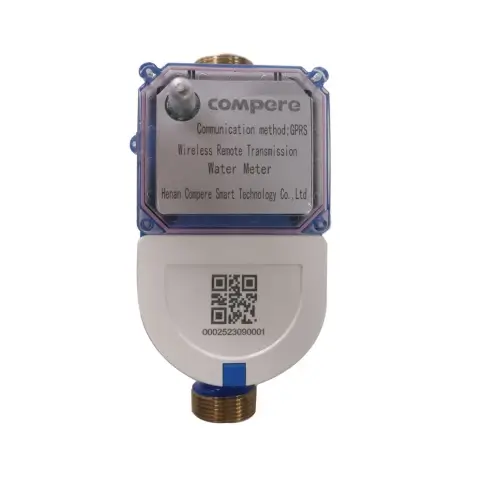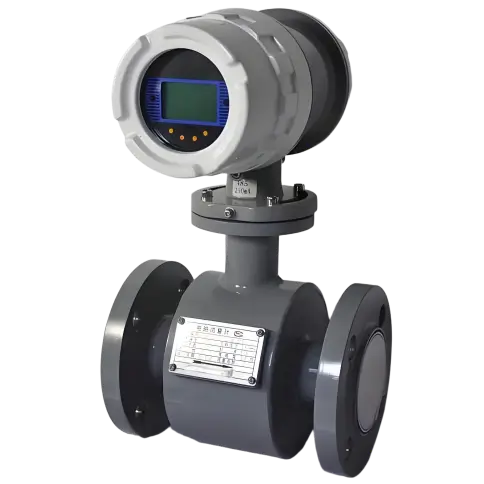
Under the dual waves of the “dual-carbon” strategy and digital transformation, in the past, electricity meters in industrial parks were merely “digital boxes” lying in distribution boxes, used only for month-end data readings. Today, however, smart meters have become an indispensable “digital brain” and low-carbon infrastructure for modern smart parks.
Faced with increasingly stringent energy consumption control requirements, if parks continue to rely on traditional meters or manual management, they will not only face low operational efficiency but may also lose competitiveness in attracting investment. This article will outline how smart energy meters can help industrial parks completely solve 5 core operational pain points, assisting them in achieving cost reduction, efficiency improvement, and low-carbon transformation.
1. Completely Eliminate “Manual Meter Reading”: Solving Efficiency Bottlenecks in Cross-Regional, Multi-Sectoral Properties
Industrial parks typically cover large areas, with factories and office buildings scattered across various sectors, sometimes encompassing R&D, production, warehousing, and other property types.
Park Pain Points: Arranging for property management staff to manually record electricity meter readings at each distribution box is not only manpower-intensive but also prone to errors and omissions due to long reading cycles across different areas. This results in extremely low efficiency when calculating electricity bills at the end of the month, severely slowing down the park’s financial operations.
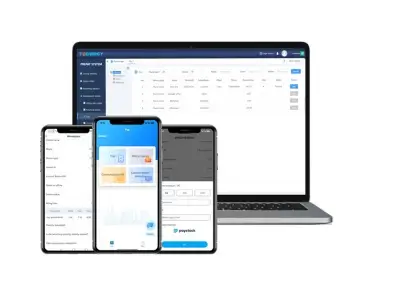
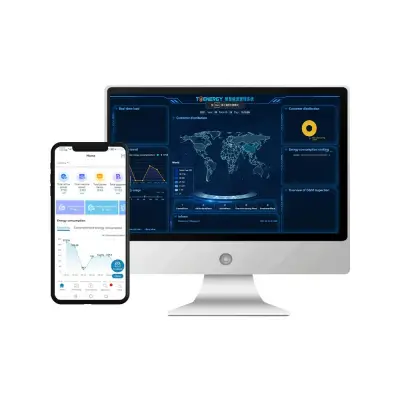
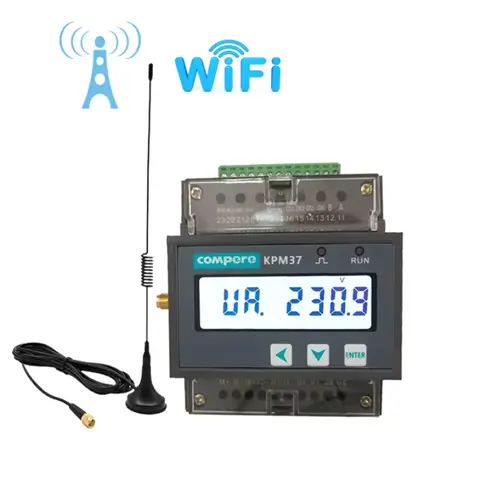
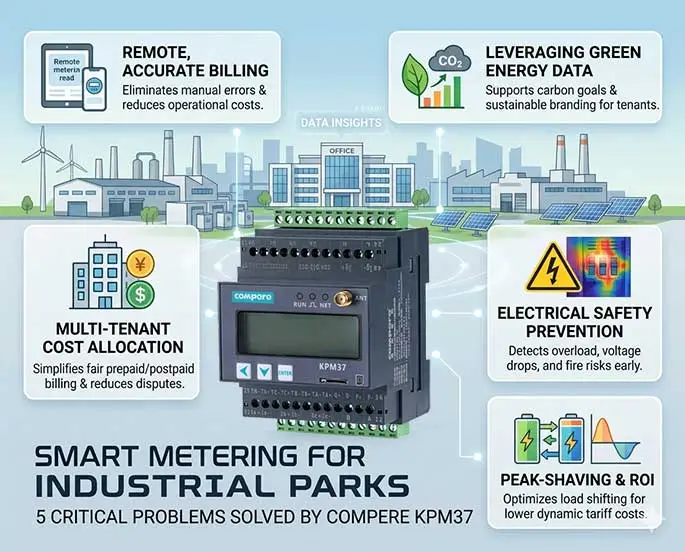
Smart Meter Solution: Smart meters support remote wireless Internet of Things (IoT) connectivity. Park managers can automatically obtain meter readings for all resident companies and public areas within seconds simply by sitting in front of the smart center’s large screen. This achieves 100% accuracy and frees up manpower from tedious, repetitive labor, allowing them to focus on providing more valuable services to park businesses.
2. Overcoming the “Energy Data Black Box”: Solving the Assessment Challenges of Implementing “Dual Carbon” Targets and Energy Consumption Control in Parks
On the policy front, parks are facing increasingly stringent assessments of total energy consumption and intensity control; on the investment front, high-end manufacturing and foreign-invested enterprises often require parks to provide green electricity certificates or carbon emission data when setting up operations.
Pain Points in Industrial Parks: Traditional electricity meters only provide the total monthly electricity consumption, making it impossible for industrial parks to grasp real-time energy consumption trends. Without underlying data support, parks cannot identify outdated production capacity enterprises with “high energy consumption and low output,” let alone conduct carbon footprint tracking and energy-saving renovations across the entire park.
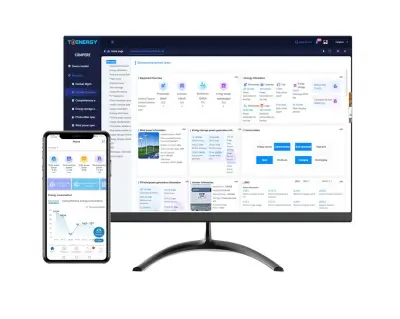
The Solution from Smart Meters: Smart meters provide energy consumption data dashboards by time period, region, and enterprise. They can display the park’s “electricity consumption curve” with minute-level granularity. Through this high-precision energy big data, parks can not only accurately identify “electricity-consuming” equipment (such as central air conditioning systems running idle at night), but also automatically generate carbon emission reports for the park. This not only allows parks to easily cope with government energy consumption assessments, but also creates a golden brand for the park as a “green and low-carbon park,” greatly enhancing its attractiveness to high-quality enterprises.
3. Say Goodbye to “Payment Collection and Disputes”: Solving the Problem of Multi-Tenant Electricity Bill Sharing and Optimizing Cash Flow
Industrial parks have diverse enterprise types and vastly different electricity needs. Some businesses operate at full capacity, while others operate with minimal assets, making shared electricity costs and payment reminders a frequent source of conflict between industrial parks and businesses.
Park Pain Points: The crude allocation of shared electricity costs based on area (such as streetlights, shuttle bus charging stations, and public green space irrigation) is extremely unfair to low-energy-consuming businesses, easily triggering backlash. Furthermore, issuing large electricity bills at the end of the month can lead to significant financial pressure on park property management if some businesses default.
Smart Meter Solution: Smart meters, with their individual metering and precise metering, ensure transparency in shared electricity costs, reducing complaints from businesses at the source. The system also supports a prepaid model. Businesses can top up their electricity bills online, similar to topping up phone credit, with the system automatically alerting and reminding them when their balance is low. This not only completely eliminates the risk of unpaid electricity bills in the park but also significantly optimizes the park’s cash flow.
4. Prevention is Better than Rescue: Addressing Electrical Fire Hazards Caused by High-Load Production in Industrial Parks
Many industrial parks have attracted manufacturing, processing, or R&D companies, with a large number of high-power automated equipment operating on the grid, posing a significant challenge to the park’s power safety.
Park Pain Points: Traditional circuit breakers often only trip in the event of a severe short circuit or fire, a “post-incident” solution. However, hidden problems such as daily voltage instability, sudden overloads, and three-phase imbalances within factory buildings are often undetectable to the naked eye, easily leading to large-scale power outages or even electrical fires, causing incalculable losses to the park and its businesses.
Smart Meter Solution: Smart meters not only measure electricity consumption but also function as power quality monitors. They can monitor microscopic electrical parameters such as current, voltage, and power factor in real time. Once an abnormal surge in load or a sudden drop in voltage is detected in a company or on a main power line, the system will immediately send anomaly warnings (SMS, email, or app alerts) to park maintenance personnel and company leaders, eliminating potential hazards before they occur and ensuring production safety in the park.
5. Smart Time-of-Use Tariffs: Solving the Passive Situation of Industrial Parks’ Inability to Cope with Electricity Price Fluctuations
With the advancement of electricity market trading, various regions have implemented strict peak-valley time-of-use tariffs (TOU Tariffs), with the price difference between peak and off-peak periods reaching several times.
Industrial Park Pain Point: Without understanding electricity consumption patterns, if industrial parks and businesses operate at full capacity during the most expensive “peak hours,” overall operating costs can spiral out of control, weakening the park’s overall cost advantage.
Smart Meter Solution: Smart meters are the first step for industrial parks towards “source-grid-load-storage” microgrid control. With real-time electricity consumption patterns provided by smart meters, industrial parks can accurately guide businesses to stagger production. More importantly, it can perfectly integrate with the park’s distributed photovoltaic and energy storage systems. Energy storage batteries can be charged during the cheap “valley” hours at night, and energy can be released during the expensive “peak” hours, achieving “peak shaving and valley filling.” This intelligent energy dispatching not only saves industrial parks and businesses significant amounts of money on electricity bills, but also directly increases the proportion of green and clean energy used in the parks.
Conclusion
In today’s world, where digitalization and decarbonization go hand in hand, smart meters are no longer just billing tools; they are the core digital foundation for industrial parks to build “smart parks” and “zero-carbon parks.” By installing smart meters in parks, managers not only solve immediate administrative problems, but also gain a long-term competitive advantage for the parks in the low-carbon era.