As cellular networks expand globally to handle high-speed 5G traffic, telecommunications operators and tower infrastructure companies (TowerCos) face a critical operational hurdle: rapidly escalating energy expenses. Telecom networks are fundamentally distributed systems, consisting of thousands of geographically isolated base stations that often run on unstable regional power grids or independent diesel generators. In this highly competitive market, managing power costs while maintaining a strict 100% network uptime target is no longer just an ideal—it is an absolute operational requirement.
Implementing a robust telecom tower energy monitoring framework allows network managers to shift from a reactive maintenance model to proactive, data-driven utility management. By combining high-precision smart energy meters with advanced IoT hardware and centralized analytics software, infrastructure providers gain complete visibility into their field assets, stop energy leaks, and significantly lower their ongoing operational expenditure (Opex).
1. What Is Telecom Tower Energy Monitoring?
Telecom tower energy monitoring is the centralized process of measuring, collecting, analyzing, and optimizing electrical power consumption across distributed wireless network sites. Rather than relying entirely on monthly aggregated utility bills that lack granular detail, this specialized approach measures energy metrics at the individual equipment level—tracking specific power draws from base transceiver stations (BTS), climate control units, power rectifiers, and backup battery systems.
Modern network management demands the deployment of a dedicated IoT energy monitoring system. Standard commercial meters only track total kilowatt-hour (kWh) accumulation over time. In contrast, an integrated solution utilizes a specialized smart energy meter for telecom tower sites to capture real-time electrical parameters (such as voltage fluctuations, current draw, power factor, and active/reactive power) and transmits this dataset to a central platform. This architecture gives network operations centers (NOCs) immediate, actionable insights into site efficiency, power quality, and specific asset health.
2. Why Telecom Operators Need Energy Monitoring Solutions
Managing hundreds or thousands of unmanned base stations creates distinct operational challenges. Telecommunications operators, mobile network providers, and engineering contractors generally struggle with inefficiencies across three main operational areas:
Compliance Challenges
- Energy Data Transparency: Without immutable, time-stamped data logs, it is practically impossible to verify billing discrepancies with local power utility companies or sub-tenant network operators.
- Accurate Electricity Measurement: TowerCos that rent antenna space to multiple mobile network operators (MNOs) require certified, high-accuracy billing data to ensure transparent, indisputable cost allocation among tenants.
- Regulatory Requirements: Environmental regulations are tightening worldwide, mandating that heavy commercial and communications infrastructure track, report, and systematically lower carbon emissions.
- International Certification Requirements: Procurement departments require metering hardware that complies strictly with international quality and safety benchmarks, such as CE and IEC standards, to guarantee long-term field safety and legal compliance.
Cost Challenges
- High Electricity Bills: Electrical power represents one of the largest ongoing expenses in telecom infrastructure management, driven higher by the intensive power requirements of newer 5G transceivers and constant active cooling.
- Energy Waste: Faulty air conditioning systems, degrading rectifiers, and unauthorized power tapping can go undetected for months without granular, load-specific energy visibility.
- Manual Meter Reading Costs: Sending technicians to remote, rural, or mountainous sites simply to log monthly meter counts generates high labor and transportation expenses.
- Multiple Site Management Costs: Consolidating different billing periods and regional utility rates manually across a vast nationwide portfolio is highly labor-intensive and vulnerable to human calculation errors.
Efficiency Challenges
- Thousands of Distributed Tower Sites: Managing geographically fragmented infrastructure makes physical site audits and frequent manual inspections economically unfeasible.
- Difficult Remote Management: A lack of centralized visibility prevents engineering teams from benchmarking site performance across different regions or environmental zones.
- Lack of Real-Time Energy Data: Standard utility bills offer retrospective information weeks after the energy is consumed, making it impossible to implement immediate operational adjustments.
- Slow Fault Detection: Power quality issues, phase imbalances, or battery backup failures are often only discovered after a site goes completely offline, resulting in service outages and strict Service Level Agreement (SLA) penalties.
3. How Telecom Tower Energy Monitoring Solutions Work
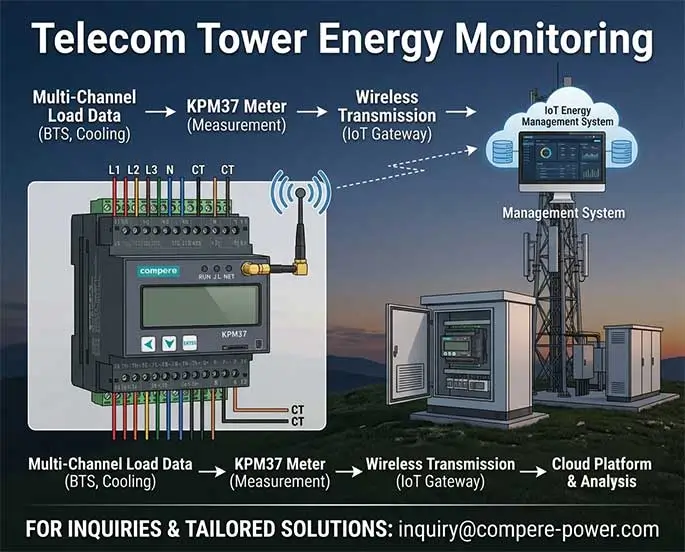
An efficient telecom base station energy management setup relies on a continuous loop of automated data collection, secure transmission, and cloud analysis. This architecture bridges physical site equipment with central management software.
- Data Collection (Hardware Layer): At the base station, a multi-circuit smart meter or a series of targeted smart electricity meters for telecom sites are integrated directly into the AC/DC distribution cabinets. These meters continuously track incoming grid power, diesel generator output, hybrid solar arrays, and specific sub-loads like climate control units and individual carrier transceivers.
- Data Transmission (Network Layer): The collected electrical data is bundled using standard industrial protocols and processed through an integrated communication module. Depending on the site’s available infrastructure, this data is streamed back to the central servers via wireless networks (such as 4G LTE, WiFi, or LoRaWAN) or through secure local network connections.
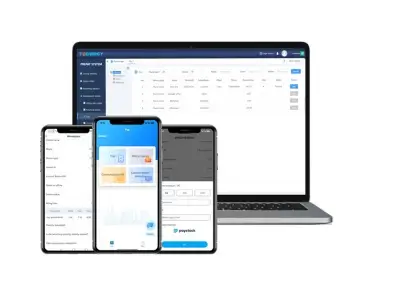
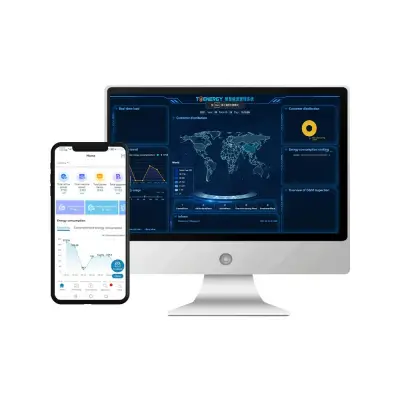
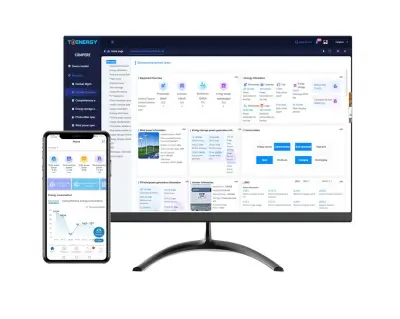
- Cloud Analysis & Remote Management (Application Layer): The incoming data feeds into a centralized telecom tower energy management system (EMS). This cloud platform processes the raw numbers into visual analytical dashboards, maintains historical consumption records, automates billing sheets, and sends immediate alerts to field teams the moment an operational anomaly is detected.
4. Key Features of Smart Energy Monitoring Systems for Telecom Towers
To deliver reliable value in harsh industrial environments, a professional remote energy monitoring solution must feature robust engineering and comprehensive data processing capabilities.
Real-Time Energy Monitoring
The monitoring platform provides continuous visibility into essential electrical parameters. Technical teams can monitor active voltage, current, power factor, frequency, and total active/reactive energy consumption. This ensures instant awareness of local power quality and live site loads.
Remote Data Collection
By leveraging secure remote power monitoring for telecom infrastructure, operations teams can completely eliminate routine on-site visits for data gathering. The system supports automated data uploads on a custom schedule, live on-demand queries, and concurrent multi-site tracking for thousands of sites through a single screen.
Accurate Measurement
Industrial smart meters feature precision-engineered measurement components (such as Class 0.5S for active energy). This professional calibration provides stable, tamper-resistant data that can be trusted for financial tracking, internal auditing, and utility bill verification.
Multiple Communication Options
Communications sites are deployed in highly diverse environments. A versatile power monitoring solution supports multiple hardware communication interfaces to adapt to any local site infrastructure:
- RS485 / Modbus RTU: For stable, long-distance wired connection to on-site controller units.
- 4G: For reliable cellular data transmission directly to the cloud without needing to access local site IT networks.
- LoRaWAN: For cost-effective, low-power wireless tracking across dense clusters of local equipment.
- WiFi : For sites with localized networks or existing wireless infrastructure.
Energy Analysis and Alarm Function
The system operates as an automated digital monitoring assistant. It includes customizable threshold settings that instantly flag abnormal power draw (such as a sudden electrical spike or a failing air conditioner compressor). The software fires off immediate alerts via email or platform notifications while saving historical data to identify long-term efficiency trends.
5. Technical Specifications of Telecom Tower Energy Monitoring Meter
To support utility engineers and procurement specialists during technical evaluations, the table below outlines the standard, industrial-grade technical specifications for a dedicated multi channel energy meter optimized for telecom infrastructure:
| Parameter | Specification |
|---|---|
| Voltage Range | AC: 3×57.7/100V, 3×220/380V, 3×230/400V (Optional DC configuration: -48V to -60V) |
| Current Range | Transformer operated (1(6)A) or via external split-core current transformers (5A to 600A) |
| Accuracy Class | Active Energy: Class 0.5S; Reactive Energy: Class 2.0 |
| Measurement Channels | Multi-circuit design (Supports up to 4 three-phase AC circuits or 12 single-phase AC circuits simultaneously) |
| Communication Protocol | Modbus-RTU, MQTT, open-standard industrial protocols |
| Data Upload Method | 4G(Global bands), LoRaWAN, WiFi, Wired Network Interface |
| Installation Type | Standard 35mm DIN Rail mounting (Space-saving for compact telecom cabinets) |
| Display | Multi-functional LCD screen with integrated backlight |
| Protection Level | IP51 Front Panel / IP20 Terminal Connections within an enclosed distribution panel |
| Operating Temperature | -40°C to +70°C (95% relative humidity, non-condensing) |
| Certification | CE compliant, manufactured in accordance with IEC 62052-11 / 62053-22 standard requirements |
6. Application Scenarios of Telecom Tower Energy Monitoring
Every field deployment environment presents its own distinct power challenges. A versatile industrial energy monitoring solution adapts easily to different structural needs:
Telecom Base Stations
Standard urban base stations regularly house equipment from multiple separate network carriers. Multi-circuit smart meters isolate the exact power consumption of Carrier A versus Carrier B, enabling transparent co-location leasing billing while monitoring the efficiency of shared site cooling systems.
5G Communication Towers
5G active antenna units consume significantly more power than older network generations and require aggressive, consistent climate control. Real-time data tracking helps network managers analyze the precise correlation between live data traffic volume and overall power consumption, setting the stage for smart, automated power-saving configurations during off-peak hours.
Remote Telecom Sites
Off-grid or bad-grid tower sites depend heavily on hybrid power setups that combine solar panels, large battery banks, and diesel generators. Remote monitoring tracks fuel consumption against the exact kilowatt-hours produced by the generator, alerting operators instantly to fuel theft, low fuel reserves, or battery degradation before an unexpected power failure occurs.
Telecom Energy Management Projects
For large-scale infrastructure optimization initiatives, an integrated power monitoring network provides the foundational data layer. By aggregating clear performance data across an entire national portfolio, executives can easily identify underperforming sites, prioritize renewable energy upgrades, and confidently evaluate capital investment returns.
7. Benefits of Implementing Telecom Tower Energy Monitoring
Integrating an automated power management framework provides measurable financial and operational advantages for infrastructure portfolios:
- Reduce Electricity Costs: Detect power leaks, eliminate ghost loads, and identify malfunctioning hardware causing power spikes to lower overall electricity expenses by 15% to 25%.
- Improve Operational Efficiency: Automate data collection across thousands of sites, simplify shared-tenant utility billing, and completely remove the need for periodic manual meter readings.
- Reduce Maintenance Workload: Live telemetry detects phase drops or asset anomalies early. This allows maintenance supervisors to schedule repairs before minor component issues turn into severe hardware breakdowns, optimizing field team schedules.
- Enable Centralized Management: Take complete control over an entire regional or national infrastructure footprint through a single dashboard, ensuring uniform operating standards across all assets.
- Support Sustainability Goals: Dependable energy data helps operators minimize generator runtime, optimize renewable hybrid systems, and accurately track progress toward corporate carbon-reduction targets.
8. How to Choose the Right Telecom Tower Energy Monitoring Solution
Selecting the right hardware and software setup requires evaluating technical capabilities alongside long-term vendor reliability:
Certification Requirements
Ensure all energy tracking hardware carries recognized international markings, such as the CE mark and compliance with relevant IEC engineering standards. Certified equipment guarantees long-term measurement stability, structural electrical safety, and compliance during regulatory audits.
Communication Compatibility
Telecom sites regularly combine legacy systems with brand-new hardware. Your power monitoring units must integrate cleanly into this existing setup, utilizing open communication protocols like Modbus RTU or MQTT to link easily with external remote terminal units or central software platforms.
Measurement Accuracy
For internal cost mapping or tenant billing, prioritize industrial meters with an active accuracy class of 0.5S or 1.0. High-precision hardware prevents data drifting caused by extreme ambient temperatures or electromagnetic interference inside dense electrical cabinets.
Supplier Capability
Partner with an established manufacturer that has documented R&D expertise in electrical measurement and industrial IoT technologies. Choose suppliers with proven OEM/ODM capabilities who can customize hardware form factors, firmware features, and terminal configurations to match your exact field requirements.
After-Sales Service
Industrial technology deployments require dependable lifecycle support. Evaluate the manufacturer’s warranty terms, the accessibility of their engineering support desk, and their ability to guide your team remotely through system commissioning and field troubleshooting.
9. Why Choose Our Telecom Tower Energy Monitoring Solution
As an established global designer and manufacturer of professional smart power meters and industrial energy management hardware, we deliver integrated, field-ready solutions built specifically for telecommunications environments. Our product range includes space-saving DIN-rail multi-circuit meters, robust IoT communication gateways, and cloud-based analytical software.
With deep, expert-level OEM/ODM engineering capabilities, we can adjust hardware dimensions, firmware configurations, and connection layouts to match your unique site requirements. Every device we build undergoes rigorous quality screening and complies with global electrical standards, ensuring continuous, precise operation in extreme environments from -40°C to +70°C. We provide thorough technical documentation, reliable manufacturing lead times, and direct engineering support to ensure your network rollout proceeds smoothly.
10. Frequently Asked Questions (FAQ)
Q1: How does energy monitoring reduce telecom tower operating costs?
A:By tracking power draw at the individual load level, the system identifies operational inefficiencies, uncovers malfunctioning cooling fans, and detects power theft. This allows field managers to fix issues early, verify utility billing accuracy, and avoid regular, manual site inspections.
Q2: What type of smart meter is best suited for telecom tower environments?
A:Compact, multi-circuit DIN-rail smart meters are ideal. Space inside standard telecom equipment enclosures is tightly restricted; a DIN-rail design clips easily into existing distribution blocks. Multi-circuit capability allows a single meter to track multiple independent AC or DC loads simultaneously, such as individual tenant hardware and local cooling systems.
Q3: What communication options are available for data backhaul?
A:Our tracking hardware supports standard open industrial protocols like Modbus-RTU and MQTT. For data upload, units can be configured with integrated 4G LTE cellular modems, LoRaWAN wireless modules, or local WiFi connections depending on the specific connectivity available at the base station.
Q6: How does the monitoring system handle areas with unstable cellular coverage? Our industrial IoT devices are engineered with integrated non-volatile flash memory. If local network connectivity drops, the hardware continues logging and saving all data locally. The moment network connection is restored, the buffered data uploads automatically to the cloud server, preventing data loss.
Get a Tailored Engineering Solution
Optimizing power distribution and lowering site Opex requires reliable, specialized hardware built for the realities of telecommunications infrastructure. Whether you are managing an urban 5G rollout or a network of off-grid base stations, our technical engineering team is here to design a power monitoring configuration tailored to your specific deployment needs.
Contact us directly at [email protected] to request product specification sheets, discuss custom OEM/ODM hardware modifications, or obtain a comprehensive technical quotation for your project. Our engineers are ready to provide one-on-one technical guidance and build a customized field solution for your network operations.