In today’s highly prevalent Industrial Internet of Things (IIoT) technology, standardized power or environmental metering hardware is increasingly unable to meet the stringent requirements of specific high-precision industries. Enterprises often face challenges such as data incompatibility, excessive device power consumption, and harsh environments in specific industrial scenarios when integrating IoT platforms.
How can you perfectly embed metering hardware into your IIoT ecosystem and achieve a smooth transition from demand definition to large-scale mass production? This article will provide an in-depth analysis of the core links and success factors of customized OEM smart energy metering solutions.
Hidden Pitfalls of Hardware Customization: Are You Facing These IIoT Integration Pain Points?
When launching IoT platform integration projects, many R&D and supply chain teams often encounter the following bottlenecks:
Protocol Discontinuities and Data Silos: Standard metering modules only support traditional protocols such as Modbus, while your IIoT platform requires MQTT or proprietary encrypted cloud-native protocols, resulting in low gateway layer conversion efficiency.
Space and Power Constraints: Space is extremely limited in telecom base stations or compact industrial power distribution cabinets, making it impossible for off-the-shelf equipment to meet size and power consumption requirements.
Accuracy Degradation in Harsh Environments: Data centers require extremely high metering accuracy down to the 0.2s level, but ordinary hardware often experiences data drift under harmonic interference, high-density magnetic fields, or extreme temperatures.
Mass Production and Supply Chain Disconnection: Samples may test perfectly in the lab, but when entering mass production, the lack of Design for Manufacturability (DFM) leads to low yield rates and severe delivery delays.
Industry Customization: Core Requirements Analysis for Three Major Scenarios
The underlying logic and customization focus of metering hardware differ significantly for different high-value IIoT integration scenarios.
1. Data Centers
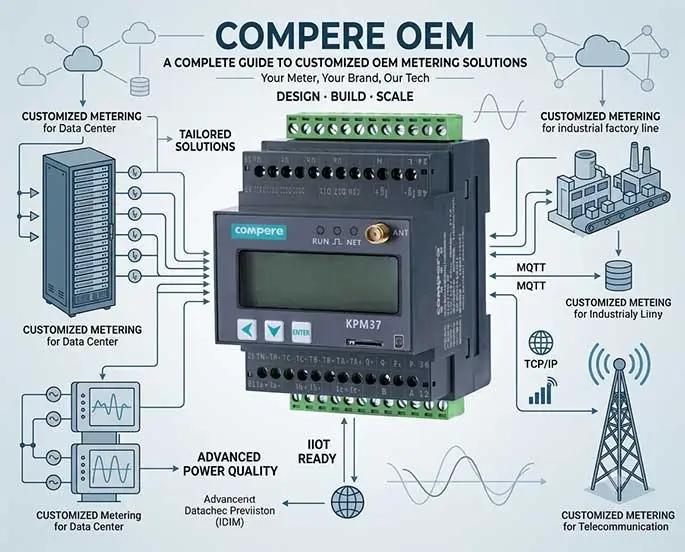
The core metric for data centers is PUE (Power Usage Effectiveness). The core of metering here is not just calculating electricity costs, but also achieving microsecond-level monitoring of IT load and the power environment.
Key Customization Features: Ultra-high precision metering (0.2S level), multi-circuit miniature circuit breaker integration, harmonic analysis capability, dual-redundant power supply.
IoT Integration: Must perfectly interface with DCIM (Data Center Infrastructure Management) platforms, supporting SNMPv3 or BACnet IP.
2. Telecom Base Stations and 5G Edge Sites
Telecom sites are widely distributed, mostly in outdoor environments without air conditioning, resulting in extremely high maintenance costs.
Key Customization Features: Wide operating temperature range (-40°C to +85°C), extremely low standby power consumption, surge protection design.
IoT Integration: Supports NB-IoT, LTE-M, or 5G wired/wireless dual-channel backup, capable of local data caching during network outages.
3. Industrial Automation and Heavy Industry Manufacturing (Industrial IIoT)
Harsh workshop environments with high electromagnetic interference (EMI) and diverse equipment protocols.
Key Customization Points: Strong anti-interference capability, DIN rail or modular embedded design.
IoT Integration: Deep integration of OPC UA, Profinet, and EtherNet/IP to achieve integrated hardware and software edge computing.
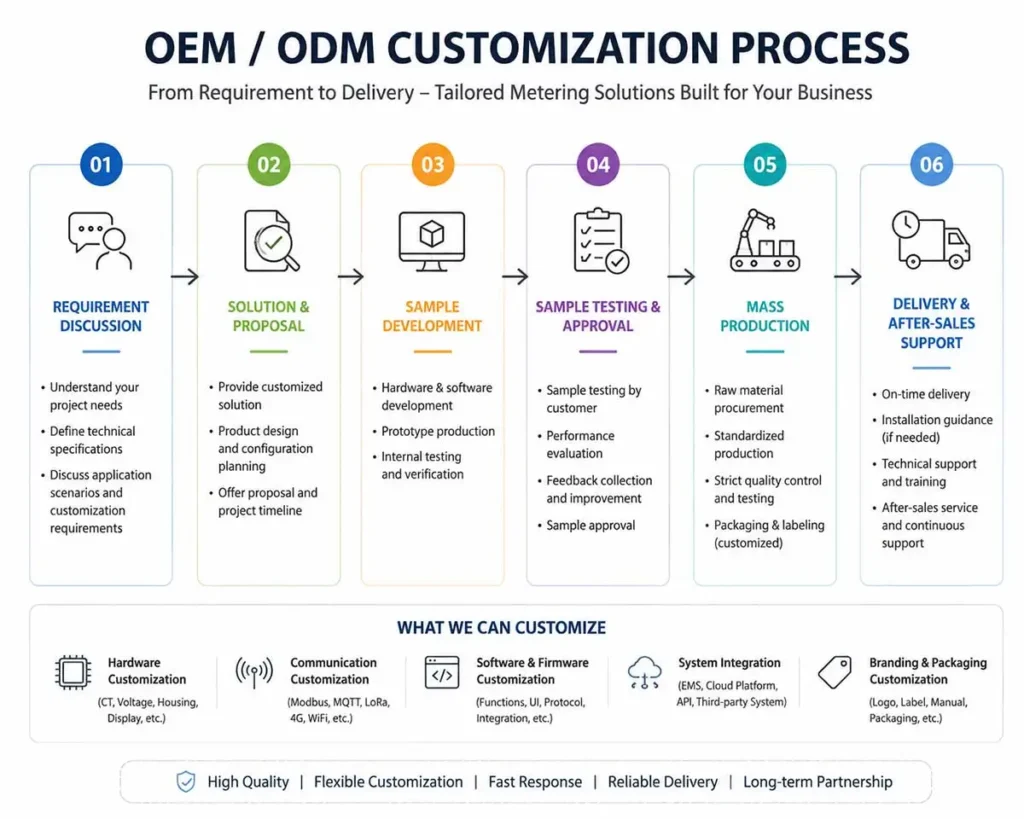
From Specification to Mass Production: Standard OEM Customization Six-Step Process
A high-success-rate customized OEM metering project must adhere to rigorous Engineering Lifecycle Management (PLM):
Specification Formulation: Collaborating with the chief architect and your IIoT team to define electrical specifications, mechanical dimensions, communication protocols, and security requirements.
Prototyping: Completing PCB design and firmware development, and delivering the first-generation working prototype within 3-4 weeks.
Deep Integration and Verification of the IIoT Platform: Connecting the prototype to your IoT testing environment. During this stage, we optimize communication mechanisms, data reporting frequency, and encryption algorithms (TLS 1.3) to ensure unblocked data throughput.
Regulatory and Industry Certifications: Assisting or acting as an agent for CE, FCC, UL, MID, or industry-specific State Grid certifications. Small-batch pilot production (Beta Run / PPAP): Implement a small-scale pilot production of 100-500 units, pass Design for Manufacturability (DFM) review, and solidify production test fixtures and calibration software.
Mass Production and Supply Chain Delivery: Leveraging a fully automated SMT production line and MES system for end-to-end traceability, achieve stable delivery in the tens of thousands or hundreds of thousands of units.
Frequently Asked Questions (FAQ)
Q1: What is the minimum order quantity (MOQ) for customized OEM metering hardware?
A: The MOQ in the supply chain typically depends on the depth of customization. For pure firmware/protocol layer customization, the MOQ is very low, even 150 units or more.
Q2: How do you ensure the security of the hardware and our existing private IoT platform?
A: Security is the bottom line for IIoT integration. We can embed a secure element in the hardware, supporting hardware-level key storage; the firmware natively supports two-way TLS authentication and AES-128/256 encryption.
Q3: What is the average lead time for customized projects?
A: It typically takes 4-6 weeks from finalizing specifications to the first functional prototype. Testing and transitioning to small-batch trial production takes another 4 weeks. Final mass production usually begins with the first batch delivered within 6-8 weeks after production scheduling is finalized.
Q4: What are the OEM customization levels?
Level 1: Brand design only (Logo/Label)
Level 2: Hardware configuration
Level 3: Communication protocol customization (Modbus/LoRa/4G)
Level 4: Complete ODM development