In a hotel setting, the choice of IoT communication protocol for a smart meter directly determines the stability of data transmission, the cost of retrofitting, and the ease of maintenance.
Hotel environments are complex, with both high-density partitions in guest rooms (severely blocking wireless signals) and small, metal-shielded spaces like electrical boxes/rooms. Therefore, hotels typically use a hybrid network combining wired and wireless protocols when deploying smart meters.
Below is a comparison of the mainstream communication protocols used in hotel smart energy meter applications and their advantages and disadvantages:
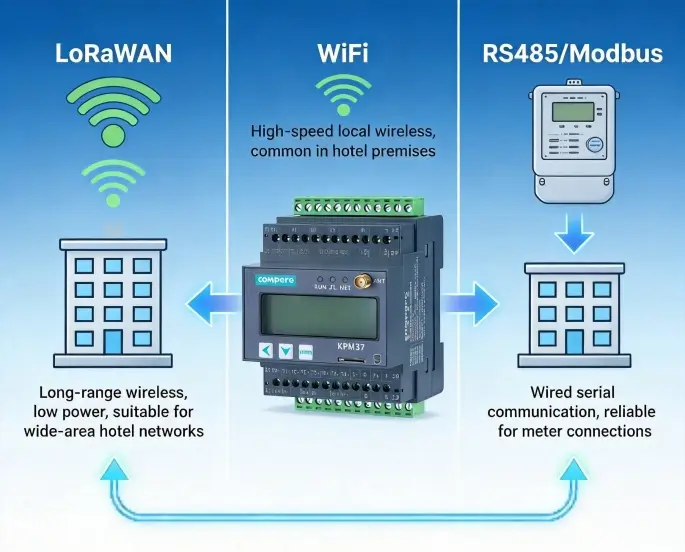
1. LoRa / LoRaWAN (Long-range, strong penetration wireless network)
LoRa is a Low Power Wide Area Network (LPWAN) technology, commonly used in hotels for data transmission between meters on different floors, in large spaces, or in centralized electrical rooms.
Advantages:
Extremely strong penetration: Operating in the sub-GHz (e.g., 470-510MHz) unlicensed frequency band, with a long wavelength, it has extremely strong diffraction and penetration capabilities. Even if the electricity meter is securely locked in a metal distribution box in the basement, the signal can still be easily established.
Wide Coverage: One or two LoRa gateways can cover an entire high-rise hotel or resort area, saving the cost of a large number of repeater devices.
Disadvantages:
Extremely Low Bandwidth: The transmission rate is very slow, only suitable for periodically uploading small structured data such as power consumption and voltage, and cannot achieve high-frequency, high-throughput real-time control.
Gateway Dependence: A separate LoRa concentrator (gateway) needs to be deployed, and the initial architecture requires some professional debugging.
2. WiFi (High-Bandwidth, High-Utilization Wireless Network)
Utilizing the hotel’s existing WiFi network, the electricity meter’s built-in WiFi module directly connects to the AP (Access Point) to access the network.
Advantages:
No Additional Gateway Required: Hotels typically already have full WiFi coverage, and the electricity meter can directly connect to the existing network, saving the hardware cost of laying a dedicated network.
High bandwidth and high speed: Extremely low data transmission latency, ideal for scenarios requiring real-time monitoring and frequent control commands (such as protection against malicious high-power appliances).
Disadvantages:
Network stability is affected by the host: If a large number of guests connect to Wi-Fi causing network congestion, or if the front desk changes the Wi-Fi password, the meters may collectively disconnect.
Higher power consumption and heat generation: Compared to Zigbee and LoRa, Wi-Fi modules consume more power and are prone to heat buildup in enclosed meter boxes.
Distribution box shielding: 2.4GHz/5GHz signals have extremely difficulty penetrating metal distribution boxes, usually requiring an external antenna.
3. RS485 / Modbus(Classic wired bus)
Although it is a “wired” protocol, RS-485 bus remains the undisputed king in hotel smart meter applications (e.g., mainstream DIN rail meters from ABB, Chint, etc.).
Advantages:
Rock-solid stability: Wired transmission is completely immune to any radio interference, wall obstructions, and metal shielding, with an online rate approaching 100%.
Industrial-grade lifespan: The technology is extremely mature, with meters having a lifespan of over 10 years and communication failures being extremely rare.
Standardized protocol: Utilizes the universal Modbus-RTU protocol, making it easily integrated into various central control or PLC systems in hotels.
Disadvantages:
High construction and cabling costs: Requires daisy-chaining of shielded twisted-pair cables. For renovations of older hotels, breaking through walls for cabling would lead to hotel closure, incurring high costs and making it virtually impractical. It is best suited for new hotels, implemented concurrently with the initial construction phase.
Summary: The “Mainstream Hybrid Solution” for Smart Hotels
In practical implementation, smart hotel service providers rarely adopt a “one-size-fits-all” approach. Instead, they use a hybrid architecture combining wired and wireless technologies:
Centralized power distribution areas (floor power distribution rooms, server rooms): An RS-485 wired bus connects a row of electricity meters in series, with data transmitted centrally through a wired-to-network gateway.
Distributed control areas (individual guest rooms, restaurant stalls): LoRa (requires no wiring for existing hotels), enabling lightweight and non-destructive rapid deployment.