In modern industrial facilities, energy is one of the highest operational expenses. Accurate data collection is the foundation of any successful energy-saving initiative. However, when facility managers and electrical engineers source hardware for an industrial power monitoring solution, they frequently confront a pivotal technical question: What is the suitable accuracy class for industrial electricity meters in our specific application?
Choosing the wrong accuracy level can lead to significant setbacks. Selecting a class that is too low results in unreliable data, making energy optimization nearly impossible. Conversely, over-specifying accuracy unnecessarily inflates project hardware costs. Navigating this balance requires a deep understanding of how meter measurement accuracy aligns with your specific operational goals.
1. Common Challenges When Choosing Accuracy Class for Industrial Electricity Meters
Selecting the right parameters for an industrial energy meter selection process involves solving several real-world operational challenges.
Difficulty Selecting the Right Accuracy Level
Industrial users often find themselves uncertain about which accuracy class is truly suitable for their operations. Is a higher accuracy class always necessary, or does it represent an over-investment? Without a clear framework, engineering teams often guess, leading to suboptimal deployment.
Balancing Measurement Accuracy and Project Cost
Every engineering project operates under budget constraints. Companies must constantly balance strict measurement requirements against equipment investment. While high-precision meters offer pinpoint data, deploying dozens or hundreds of them across a large industrial park can rapidly drain financial resources without delivering a proportional return on investment.
Different Industrial Applications Have Different Requirements
A one-size-fits-all approach does not work in industrial environments. Factories, commercial complexes, institutional buildings, and digital energy monitoring projects all demand different levels of precision. A manufacturing production line heavy with inductive loads needs different monitoring characteristics than a standard commercial HVAC system.
Inaccurate Energy Data Affects Energy Management
When low-quality or incorrectly specified meters are installed, the resulting data risks being highly inaccurate. Inaccurate energy data directly compromises energy management. It leads to flawed energy analysis, complicates cost allocation across departments, and ultimately causes energy optimization strategies to fail because they are built on a shaky data foundation.
2. What Does Accuracy Class Mean for Industrial Electricity Meters?
In simple terms, the accuracy class of an electricity meter defines its maximum permissible percentage error under standard operating conditions. For example, a Class 1.0 meter means the allowable margin of error for active energy measurement is 1%.
In an industrial setting, power meter measurement accuracy matters because it dictates the trustworthiness of your data. Industrial environments are filled with electrical noise, variable loads, and non-linear equipment like variable speed drives. A meter with a well-defined accuracy class ensures that despite these challenging electrical conditions, the recorded consumption closely matches reality, allowing for dependable baseline calculations.
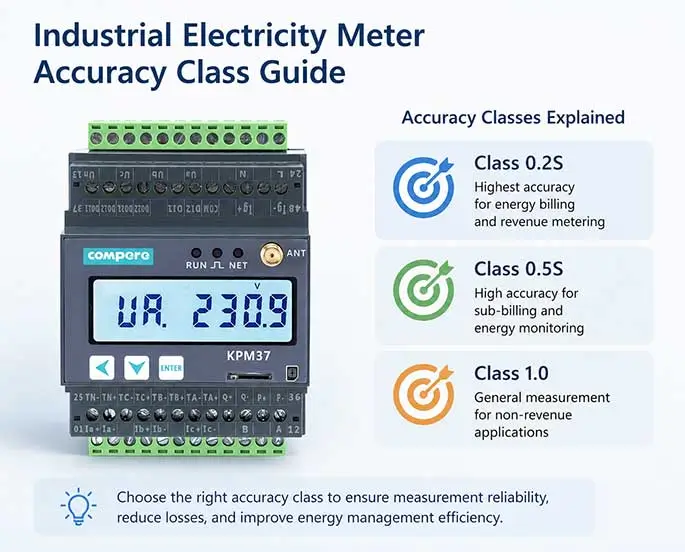
Understanding the Key Accuracy Classes: 0.2, 0.5, 0.2S, 0.5S, and 1.0
- Class 1.0 (and Class 2.0): These are the standard workhorses of sub-metering. A Class 1.0 meter has a maximum error margin of ±1.0% at full load. They are highly cost-effective and perfectly suited for internal cost allocation, non-critical branch circuit monitoring, and commercial building sub-panels.
- Class 0.5: This class tightens the allowable error to ±0.5%. Meters of this tier are commonly used for main factory incoming lines, major energy distribution panels, and large-scale industrial facility monitoring where higher precision is required for bulk energy calculations.
- Class 0.2: Representing precision engineering, Class 0.2 meters offer a tiny ±0.2% error margin. These are typically reserved for power plant main outputs, major substation nodes, and massive industrial complexes where even a fraction of a percent represents tens of thousands of dollars in monthly consumption.
What Does the “S” Suffix Mean? (0.5S vs. 0.5 and 0.2S vs. 0.2)
You will frequently see meters specified as Class 0.5S or Class 0.2S. The “S” stands for “Special” (associated with current transformer-operated meters under IEC standards).
The critical difference lies in light-load performance:
- A standard Class 0.5 meter is calibrated to guarantee ±0.5% accuracy down to about 5% or 10% of its rated current. Below that, its accuracy may drift significantly.
- A Class 0.5S or Class 0.2S meter is designed to maintain its strict ±0.5% or ±0.2% accuracy even under extremely light loads—down to as low as 1% of the rated current.
In industrial environments where machinery cycles on and off, or standby loads run overnight, current levels drop dramatically. Standard meters will miss or miscalculate this low-load consumption, whereas an “S” class meter guarantees pinpoint precision across the entire load spectrum.
3. How to Select the Suitable Accuracy Class for Industrial Electricity Meters
Determining the suitable accuracy class for industrial electricity meters does not require memorizing complex, dense regulatory standards. Instead, it requires evaluating three practical operational pillars:
Based on Application Purpose
- Basic Energy Monitoring: For generalized tracking of a building’s overall consumption where financial billing is not involved, a standard accuracy level (Class 1.0 or Class 2.0) is often perfectly adequate.
- Internal Energy Management: For tracking departmental usage or allocating costs internally, a dependable Class 1.0 meter provides the necessary precision without overstretching the budget.
- Energy Analysis & Carbon Footprint Audits: Projects aiming for strict regulatory compliance, carbon tracking, or deep efficiency optimization require high-tier data accuracy (Class 0.5S or Class 0.5) to capture subtle variations in power consumption.
Based on Measurement Requirements
Define your core data objectives early. If your project expectations rely on identifying minor 1% to 2% leaks or inefficiencies in automated machinery, your metering equipment must be accurate enough to detect those changes. Your monitoring objectives dictate your hardware limits.
Based on Equipment Importance
A balanced facility deployment uses a tiered strategy. For critical, high-consumption machinery—such as heavy duty compressors, large smelting furnaces, or main incoming distribution lines—investing in high-reliability, high-accuracy meters (like Class 0.5S) is vital. For minor auxiliary zones or common areas, cost-effective Class 1.0 options represent a much smarter allocation of capital.
4. Industrial Electricity Meter Accuracy Class Applications in Different Industries
Where are these principles applied? Let’s look at how distinct energy monitoring meter solution deployments operate across various sectors.
Manufacturing Factory Energy Monitoring
On a heavy manufacturing floor, a three phase industrial energy meter is typically deployed to monitor specific production lines or heavy machinery. Because factory energy analysis is used to calculate the exact manufacturing cost per unit produced, Class 1.0 or Class 0.5S meters are highly favored here to keep cost tracking precise.
Commercial and Industrial Buildings
Large industrial parks and office buildings utilize meters for energy management and internal cost analysis. For tenant sub-metering or departmental cost allocation, deploying Class 1.0 smart meters provides the ideal sweet spot, giving management indisputable data for fair overhead distribution.
Energy Management Projects
For specialized energy-saving initiatives and digital energy monitoring contracts, accuracy is tied directly to project validation. If an energy service company guarantees a 5% reduction in electricity consumption, they must use highly accurate meters (Class 0.5S) to legally prove those micro-savings occurred.
Sub-Metering Applications
Sub-metering involves breaking down a facility’s total consumption into localized zones. By using a tailored mix of accuracy classes—high accuracy at the main breaker and standard accuracy at individual sub-panels—operators achieve total visibility without inflating the total cost of ownership.
5. Factors to Consider When Choosing Industrial Electricity Meters
Beyond the accuracy class number itself, a successful procurement strategy evaluates several supporting operational variables:
- Measurement Accuracy Requirement: Align the meter’s certified class directly with the financial or operational goals of the specific installation point.
- Meter Application Environment: Industrial environments can be harsh. Ensure the hardware can handle wide temperature fluctuations, dust, and vibrations without its internal electronics drifting out of their calibrated accuracy range.
- Communication and Monitoring Requirements: A meter is only as good as the data it shares. Look for units that integrate robust smart electricity meter accuracy with reliable, industry-standard communication protocols for seamless remote data collection.
- Future Expansion Requirements: Choose hardware platforms that allow your system to scale. Your monitoring requirements might grow from basic kW/kWh tracking today to comprehensive power quality analysis tomorrow.
6. Smart Industrial Electricity Meters for Accurate Energy Monitoring
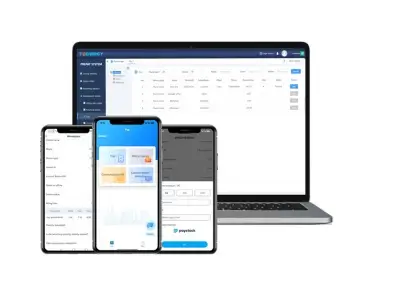
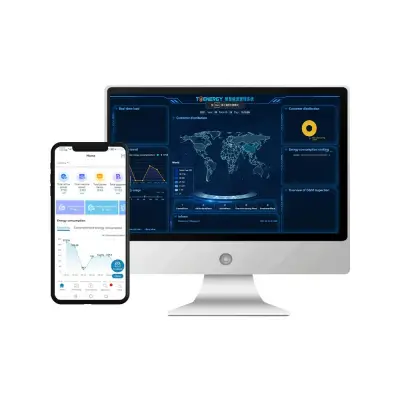
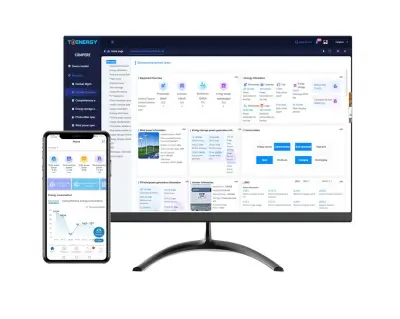
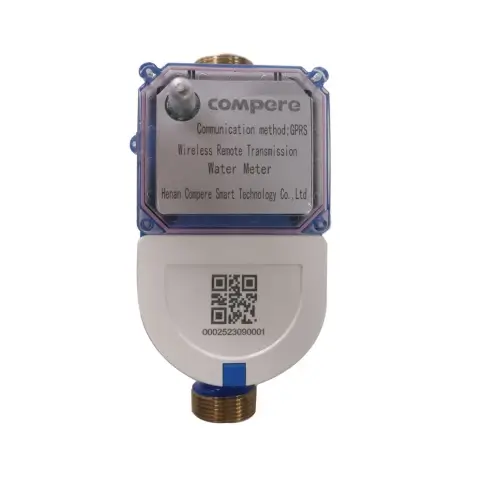
Modern industrial facilities no longer rely on standalone meters that require manual clip-board readings. Today’s industrial landscape demands a unified approach: Smart Energy Meter + IoT Communication + Energy Monitoring Platform.
Implementing a smart industrial electricity meter system unlocks real-time energy monitoring and automated remote data collection. Instead of receiving a historical utility bill at the end of the month, facility operators can view live demand spikes, track load profiles, and conduct immediate energy analysis. This level of digitalization allows teams to pinpoint operational waste the moment it happens, shifting facilities from reactive maintenance to proactive energy management.
7. Benefits of Choosing the Right Accuracy Class for Industrial Energy Monitoring
To summarize the business value of a strategic selection process, the table below highlights how matching the correct meter to the correct application optimizes your operations:
| Selection Factor | Business Value |
|---|---|
| Suitable Accuracy Level | Provides highly reliable energy data for actionable root-cause analysis. |
| Correct Meter Selection | Prevents budget overruns by avoiding unnecessary premium equipment costs. |
| Accurate Monitoring | Protects the bottom line by improving the precision of energy management decisions. |
| Smart Data Collection | Elimates human transcription errors and supports digital energy management scaling. |
8. Why Choose Our Industrial Electricity Meter Solution?
As an experienced smart electricity meter manufacturer, we understand that industrial energy management requires more than just buying a piece of hardware off a shelf. We leverage years of deep industrial application experience to deliver tailored, robust metering solutions designed for real-world facility environments.
We provide a comprehensive range of options—from high-precision Class 0.2S/0.5S meters for critical infrastructure to cost-effective Class 1.0 sub-metering units for widespread facility deployment. Backed by dedicated technical support and seamless remote communication capabilities, our solutions empower your engineering and management teams to build a data-driven infrastructure that reduces overhead and boosts operational efficiency.
9. Frequently Asked Questions (FAQ)
Q1: What accuracy class is suitable for industrial electricity meters?
For main incoming power lines, critical machinery, and high-value internal cost-allocation, Class 0.5S or Class 1.0 meters are highly recommended. For generalized sub-metering, auxiliary areas, or basic statistical monitoring where financial billing is not tied to the data, a Class 1.0 or Class 2.0 meter is typically sufficient and more cost-effective.
Q2: What is the difference between Class 0.5 and Class 0.5S?
Class 0.5S meters feature “Special” calibration that maintains a strict ±0.5% accuracy even at extremely low current loads (down to 1% of the rated current). Standard Class 0.5 meters are only calibrated to guarantee this accuracy level down to 5% or 10% load, making S-class meters superior for variable industrial workloads.
Q3: Should all industrial meters use the highest accuracy class?
No. Deploying the highest accuracy class everywhere leads to over-engineered systems and unnecessary capital expenditure. A smart procurement strategy uses a tiered approach: high-accuracy meters (Class 0.2S/0.5S) for primary distribution and high-consumption assets, and standard-accuracy meters (Class 1.0) for lower-priority localized sub-panels.
Q4: How can companies choose the right industrial electricity meter?
Companies should evaluate the ultimate purpose of the data (billing vs. basic tracking), the electrical characteristics of the monitored equipment, the severity of the physical installation environment, and the required communication protocol for centralized data collection.
Connect With Our Engineers
Are you looking to optimize your facility’s energy tracking or seeking the most cost-effective hardware configurations for an upcoming project? We invite you to contact our technical team for a free professional consultation. Our senior application engineers will provide a customized, site-specific monitoring solution and one-on-one technical guidance to ensure your meters perfectly match your accuracy and budget requirements.