At airports, hangars, or aircraft repair shops, you’ll often see a special type of power supply—the Aviation Ground Power Supply (GPU). This power supply generates electricity at 400Hz, while the electricity in your home wall sockets is 50Hz (or 60Hz).
Many people ask, “It’s just a slightly higher frequency, can’t I just use a regular multimeter or industrial instrument to measure it?”
The answer is: Absolutely not. It’s like using a sports car’s odometer to measure the speed of a supersonic aircraft; not only will the reading be inaccurate, but the instrument itself might also “explode.”
Core Difference: The Frequency Changes, And So Do The Physical Characteristics
1. “Heated” Instruments: Core Losses
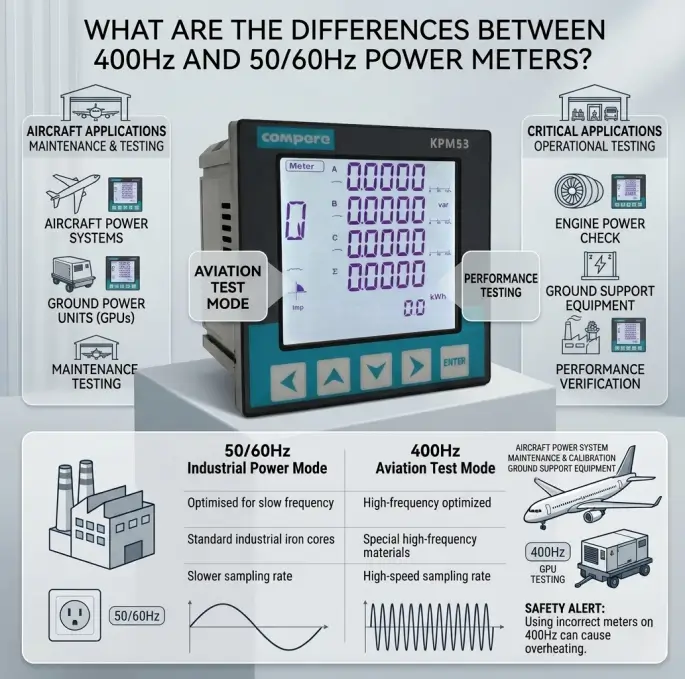
Ordinary power meters contain a “magnetic core” (used to sense current). These cores are specifically designed for the “slow pace” of 50Hz. When a “fast pace” current of 400Hz flows through, the atoms inside the core experience intense friction and generate enormous heat.
Consequences: If you connect a regular instrument to a 400Hz power supply, the instrument may become extremely hot within minutes, potentially even burning out internal components.
2. Increased “Resistance”: Inductive Reactance
In electrical engineering, the higher the frequency, the greater the “resistance” (inductive reactance) encountered by the current. 400Hz is eight times the frequency of regular electricity, meaning the resistance experienced by the instrument’s internal circuitry increases significantly.
Consequences: Just like a person with poor vision, the voltage and current measured by the instrument will be severely deviated. A voltage that should be 115V might only show tens of volts on a regular meter. Such false alarms are fatal in precision aviation testing.
Why Must Aviation Equipment Use 400Hz?
Since it’s so troublesome, why don’t aircraft simply use 50Hz electricity? The answer is for “slimming down.”
According to physics formulas, the higher the frequency, the smaller and lighter the generator and transformer can be made. For aircraft, every gram of weight is crucial. 400Hz devices are significantly lighter than their 50Hz counterparts of the same power.
Three Major Pitfalls in Aviation Ground Power Supply Testing
If you choose the wrong instrument when testing a GPU or aircraft power supply system, you may face the following risks: Misjudging Power Supply Performance: The instrument displays unstable voltage, leading you to believe the power supply is faulty, when in fact the instrument is simply out of sync. Damaging Expensive Avionics: Avionics equipment is extremely expensive. If inaccurate instrument readings cause maintenance personnel to mistakenly increase the output voltage, it could instantly damage the aircraft’s core control system. Safety Hazards: Inferior or incompatible instruments are prone to short circuits in high-frequency environments, potentially even causing fires at the test site.
Choosing the Right Instrument: From a Single Choice to Multiple Choice
In actual support work, testers frequently encounter different power environments: sometimes testing ordinary industrial power in a factory, and other times testing 400Hz aviation power on the tarmac. In the past, engineers often had to carry several instruments back and forth, which was cumbersome and prone to errors.
The KPM53 multi-functional power meter solves this pain point. It’s not only professional but also incredibly intelligent: Three-mode switching: The KPM53 breaks the limitation of traditional instruments operating on a single frequency. With simple settings, it can seamlessly switch between 50Hz, 60Hz, and 400Hz modes.
One meter for everything: Whether for routine factory power monitoring or rigorous aviation power testing, one KPM53 is sufficient.
Precise algorithm optimization: When switched to 400Hz mode, the meter activates a specialized high-frequency processing algorithm to ensure that every measurement at extremely high frequencies is accurate and reliable.
Summary: Precision Is Not Just About Data, But Also About Safety
Aerospace ground power testing is a task with extremely low tolerance for error. Inaccurate readings not only misjudge power supply performance, but more seriously, if maintenance personnel adjust the output voltage based on incorrect values, it could instantly damage the aircraft’s expensive avionics system.
Choosing an instrument like the KPM53, which is compatible with multiple frequencies and designed for high-precision environments, is not only about improving work efficiency, but also about adding a robust “safety lock” to valuable aviation assets.
For more information about 400Hz electricity meters, please refer to the article: