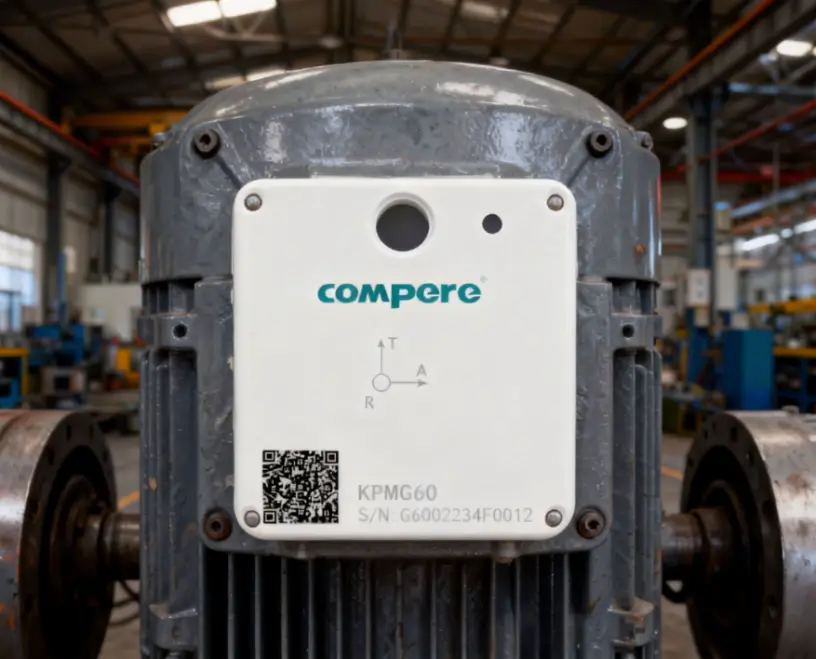
In modern industrial operation and maintenance and equipment health management, we often hear the keyword “predictive maintenance.” Achieving predictive maintenance requires comprehensive sensing of equipment status. Temperature vibration sensors are playing an increasingly important role in this process. So, what is it? Why is it so crucial? This article will provide a comprehensive analysis of this powerful industrial “stethoscope” and “thermometer.”
1. What is a temperature vibration sensor?
A temperature vibration sensor is an integrated monitoring device that integrates temperature and vibration sensing elements within the same housing or module.
Simply put, it’s like a sensory expert with both “touch” and “temperature” capabilities, simultaneously and at the same point collecting vibration information (such as acceleration, velocity, and displacement) and surface temperature information from equipment.
Its development has solved the problem of needing to install separate temperature and vibration sensors in traditional monitoring solutions, simplifying data acquisition, optimizing costs, and improving system reliability.
2. Why is Integration Necessary? The Intrinsic Relationship Between Temperature and Vibration
Integrating temperature and vibration monitoring is not simply a functional addition, but rather based on a profound physical relationship between the two:
A Synergistic Indicator of Faults: Many equipment faults simultaneously trigger both increased temperature and intensified vibration.
For example, bearing failure: Poor lubrication leads to increased friction (increased temperature), which in turn causes wear and impact (intensified vibration). A single parameter may not be accurate, but simultaneous alarms from both parameters greatly improve the confidence level of fault diagnosis.
Value of Data Correlation Analysis: Synchronously acquired data facilitates deeper root cause analysis.
For example: Is vibration causing heat (e.g., misalignment), or is heat causing changes in vibration (e.g., friction caused by thermal expansion)? The synchronous data provided by the integrated sensor provides a time reference for analysis.
Economic Benefits and Installation Convenience: Saves installation space, wiring, and data acquisition channels, significantly reducing the complexity and total cost of ownership of the entire condition monitoring system.
3. Core Working Principle of Temperature Vibration Sensor
A temperature vibration sensor typically contains two main functional modules:
(1). Vibration Monitoring Module
Core Technology: Mostly employ the piezoelectric effect. A sensitive element made of piezoelectric ceramic material generates a charge signal (i.e., acceleration signal) proportional to the applied pressure when subjected to vibration.
Output Signal: The raw output is vibration acceleration. Through a built-in or external integrator, it can be further converted into vibration velocity (RMS value) and displacement to meet the evaluation requirements of different standards.
(2). Temperature Monitoring Module
Core Technology: Primarily uses Pt100 platinum resistance thermometers or thermocouples.
Pt100: Utilizing the characteristic that the resistance value of high-purity platinum wire changes regularly with temperature, it has the advantages of high accuracy and good stability, making it the most common choice for temperature vibration sensors.
Output Signal: The change in resistance value or a standard voltage/current signal converted by the circuit.
Ultimately, the signals from these two modules are integrated through internal circuitry and output through a unified interface (such as an M12 connector) to connect to the data acquisition system.
4. Core Application Scenarios
Temperature vibration sensors are mainly used for equipment health monitoring and status early warning. These sensors are installed on rotating or critical equipment such as motors, pumps, fans, gearboxes, and engines. By simultaneously monitoring temperature and vibration, they can promptly detect potential faults, enable predictive maintenance, improve equipment reliability, and reduce maintenance costs. They are the cornerstone of the Industrial Internet of Things (IIoT) and predictive maintenance, and are widely used in industry:
Rotating machinery monitoring: Online monitoring of the health status of bearings and shaft systems in motors, pumps, fans, compressors, and gearboxes.
Wind power industry: Continuous monitoring of wind turbine main shafts, gearboxes, and generators to ensure equipment safety.
Smart manufacturing production lines: Periodic inspection of key industrial robot joints and conveyor drive units.
Rail transportation: Monitoring the operating status of train traction motors and bearings.
Data centers: Monitoring the operational health of server room cooling fans.
Conclusion
In summary, temperature vibration sensors are highly integrated intelligent sensing devices that provide powerful, efficient, and economical data support for predictive maintenance strategies in modern industry by simultaneously capturing the two most critical equipment status parameters: temperature and vibration. Understanding what temperature vibration sensors are and their value means you have a key to unlocking the door to intelligent equipment operation and maintenance.