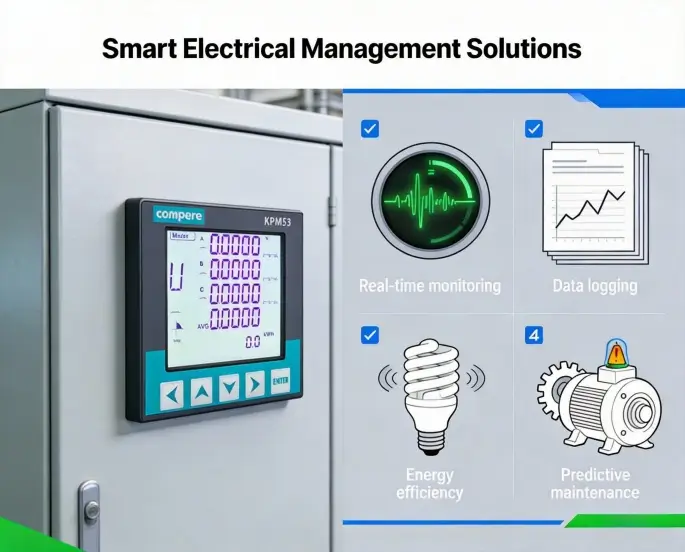
In the electrical systems of industrial production, commercial buildings, and even modern homes, the importance of panel meters, as a basic measurement and display device, is often underestimated. They are not only the “eyes” monitoring electrical parameters, but also a key entry point for achieving energy management, equipment protection, and system intelligence. This article will analyze the core functions, main types, and key selection points of panel meters to help you choose the right “monitor” for your power system.
What Is A Panel Meter? What Is Its Core Function?
A panel meter, as the name suggests, is an instrument installed on an equipment panel or control cabinet to measure and display various electrical parameters in real time, such as voltage, current, power, frequency, and power factor. Its core functions are:
Real-time monitoring: Provides instant visual data on the system’s operating status, serving as the primary basis for maintenance personnel to determine whether equipment is operating normally.
Energy management: By accurately measuring energy consumption, it helps users analyze electricity usage patterns, providing a data foundation for energy conservation and consumption reduction.
Safety Warning: Monitors abnormal fluctuations in current and voltage, providing early warnings in case of overload, short circuit, or parameter exceeding limits, protecting downstream equipment.
Process Control: Provides feedback signals for automated control systems, a crucial component for achieving precise control and system integration.
Mainstream Panel Meter Types and Technical Characteristics
Based on display technology and functions, panel meters are mainly divided into the following categories:
1. Digital Display Panel Meters
Features: Uses LED or LCD digital tube displays, providing intuitive and accurate readings.
Advantages: High accuracy, fast response, good visibility, often with backlighting, suitable for industrial environments with complex lighting. High-end models have programming, ratio setting, and communication interface functions.
Applications: Most power monitoring, distribution cabinets, and mechanical equipment requiring high-precision readings.
2. Pointer Panel Meters
Features: Traditional magnetoelectric or electromechanical meter heads.
Advantages: Displays without power supply (some types), intuitively reflects trend changes and fluctuation ranges, strong anti-interference capability.
Suitable for:Applications requiring high trend observation, inconvenient power supply, or as redundancy backup. However, accuracy and functional expandability are generally inferior to digital display meters.
3. Intelligent Communication Panel Meter
Features: Integrates RS-485, Modbus, and other communication interfaces on top of a digital display meter.
Advantages: Enables remote data transmission to PLCs, SCADA systems, or cloud platforms, achieving centralized monitoring, data recording, and analysis. It is a fundamental unit for building the Internet of Things and smart grids.
Suitable for: Automated factories, smart buildings, data centers, etc., requiring system integration, remote monitoring, and data analysis.
How to Choose a Panel Meter Based on Application Scenarios?
1. Industrial Automation and Motor Control:
Requirements: High reliability, anti-interference, ability to monitor three-phase balance, and alarm output.
Recommendation: Choose a three-phase digital display current/voltage meter with transformation ratio setting function to adapt to different current transformers. Products with analog output or communication functions are preferred for easy integration into PLC systems.
2. Commercial Buildings and Energy Management
Requirements: Accurate metering of electricity (kWh), support for multi-rate statistics, and easy integration into a building management system (BMS).
Recommendation: Smart meters or multi-functional power meters, equipped with standard communication interfaces (such as Modbus), capable of real-time uploading of full parameter data such as voltage, current, power, energy, and power factor.
3. Laboratory and Testing Equipment
Requirements: High precision, high resolution, multiple ranges, and good stability.
Recommendation: Choose benchtop or panel-mounted digital meters with high accuracy (e.g., 0.5 or 0.2 class). Some require true RMS measurement to handle nonlinear loads.
4. Renewable Energy Systems (PV/Wind Power)
Requirements: DC measurement capability (DC voltage/current), strong environmental adaptability, and ability to monitor power generation efficiency.
Recommendation: Dedicated DC panel meters or AC/DC meters. Note that their voltage and current measurement ranges must cover the system’s maximum values.
Key Parameter Checklist
Measurement Parameters: Clarify whether the measurement needs to be of current, voltage, power, or energy. Input Signal: Direct input or through a current transformer/shunt? AC or DC? What is the signal range?
Accuracy Class: Typically 0.5, 0.2, etc., with smaller numbers indicating higher accuracy.
Power Supply: The operating voltage range required for the instrument’s operation.
Installation Dimensions: Standard panel opening dimensions (e.g., 96mm×96mm, 72mm×72mm, etc.).
Additional Functions: Alarm output, analog output, communication interface required? Keypad programming required?
Environmental Certifications: Protection rating (e.g., IP54 dustproof and waterproof), operating temperature range, and relevant safety certifications (e.g., CE, UL).
Conclusion
In the wave of digitalization and intelligentization, panel meters have evolved from simple indicating devices into key nodes for data acquisition. Choosing a suitable panel meter means endowing your power system with more acute sensing capabilities and stronger management potential. Whether improving operational efficiency, ensuring power safety, or tapping into energy-saving potential, a reliable panel meter is an indispensable and powerful assistant.
There is also a special type of panel meter used in military or aviation fields for 400Hz electricity meters. Those interested can refer to the corresponding articles for more information.