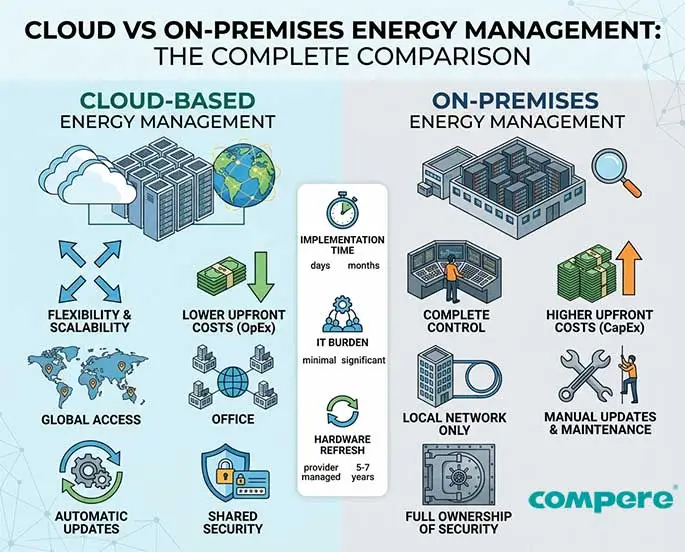
With the dual advancements of enterprise digital transformation and green, low-carbon development, Energy Management Systems (EMS) have become core infrastructure in modern industrial and commercial buildings and data centers. However, when deploying an energy management platform, enterprises often face a classic choice: go “cloud-based,” stick “on-premises,” or choose a compromise “edge/hybrid” architecture?
This article will delve into the advantages and disadvantages of different architectures from three core dimensions: data security, latency (real-time performance), and cost. It will also provide a comprehensive scenario-based selection guide, combining underlying industrial protocols and smart meter applications.
Core Architecture Forms and Definitions
Before in-depth comparisons, we need to clarify the three mainstream energy management architecture forms:
On-Premises Architecture: All data acquisition, processing, storage, and control commands are completed on physical servers or local control cabinets within the enterprise.
Cloud-based architecture: Only data acquisition and transmission modules (gateways) are retained locally; all computing and big data analysis run on cloud servers.
Hybrid/Edge architecture: Combines the advantages of both. Lightweight, high-real-time control is completed at the local edge, while long-term big data analysis, multi-region optimization, and report generation are handled by the cloud.
In-Depth Competition Across Three Core Dimensions
1. Data Security & Compliance
Data is the core asset of energy management, and different industries have vastly different sensitivities to it.
Local architecture (winner): Physical data isolation, giving the enterprise absolute control. Easily meets the compliance requirements of national critical information infrastructure (such as power grids, military, and heavy industry).
Cloud architecture: Data transmission must pass through the public internet, posing a risk of interception; regulations in some sensitive industries strictly restrict energy data from being “released.” However, it can share the cloud vendor’s top-tier advanced encryption and multi-copy disaster recovery backup.
2. Latency & Real-time Requirement
Some scenarios in energy systems (such as instantaneous peak shaving in microgrids and fault circuit interrupter linkage) have extremely high requirements for response time.
Local Architecture (Winner): Latency is typically in the 1-10 millisecond (ms) range. Suitable for microgrids requiring millisecond-level closed-loop control and energy storage system charge/discharge switching.
Cloud Architecture: Affected by network bandwidth and jitter, latency is typically between 100 milliseconds and several seconds. Suitable for non-real-time scenarios such as daily energy consumption report analysis and 24-hour photovoltaic power generation forecasting.
3. Cost Structure (TCO)
Cost assessment should not only consider initial investment but also the total cost of ownership (TCO) over the entire lifecycle.
| Cost Dimension | On-premises Architecture | Cloud-based Architecture |
|---|---|---|
| Initial Investment (CapEx) |
Very High
Requires purchasing servers, UPS, software licenses, and building physical server rooms. |
Very Low
Requires only gateway hardware and pay-as-you-go subscription fees. |
| Operational Cost (OpEx) |
High & Hidden
Professional IT O&M teams, electricity, hardware depreciation, and maintenance/upgrades. |
Moderate & Transparent
Annual or traffic-based subscription models with automatic cloud upgrades. |
| Scalability Cost |
High
Requires scaling and upgrading physical servers and network hardware equipment. |
Very Low
Elastic scaling of computing power and storage with just a few clicks. |
A Mirror of Underlying Technologies: The Modbus vs. MQTT Rivalry Through Smart Meters
In energy management systems, the choice of architecture (cloud or local) not only determines the location of the server but also directly impacts the data transmission protocols used by underlying field devices (such as smart meters).
1. The Role of Smart Meters in Energy Management
Smart meters are the “eyes” of the entire system. In modern factories, meters not only measure total electricity consumption (kWh) but also require high-frequency acquisition of three-phase voltage/current, power factor, active/reactive power (for energy efficiency analysis and load forecasting), and harmonic distortion rate (for power quality and safety early warning in precision manufacturing). Different architectures have completely different requirements for the data acquisition frequency and transmission protocols.
2. Comparison of Core Transmission Protocols: Modbus vs. MQTT
In field deployments, the most commonly encountered protocols are the established industrial standard Modbus (Modbus RTU/TCP) and the lightweight protocol MQTT, born in the internet era. They represent the genes of “local control” and “cloud interconnection,” respectively.
| Feature Dimension | Modbus (RTU/TCP) The Bedrock of On-premises | MQTT The Tool for Cloud/Hybrid |
|---|---|---|
| Communication Mode |
Master/Slave
The master station (Gateway/PLC) must periodically poll each meter for it to respond. |
Publish/Subscribe
Meters or gateways actively push/upload data, which is then distributed by a Message Broker. |
| Network Requirements |
LAN / Dedicated Bus. Extremely low bandwidth required, but transmission distance is limited (RTU typically uses RS485 twisted pair). |
Internet / WAN. Inherently supports long-distance and cross-network remote transmission (supports 4G/5G/Wi-Fi). |
| Data Payload |
Pure binary/hexadecimal stream. The packet is extremely small with zero redundancy. However, the data has no semantics (requires a register mapping table to parse). |
Text-based (usually JSON format) with self-contained data semantics. Although the packet size is slightly larger than Modbus, it is extremely cloud-friendly. |
| Disconnection Reconnection |
Poor
If the network is interrupted, data is directly lost and cannot be retransmitted. |
Excellent
Built-in QoS (Quality of Service) mechanisms, supporting session resumption and data caching for resume-on-reconnect. |
| Network Security |
No Native Encryption. Belongs to a trusted network with default physical isolation. Highly vulnerable to attacks if directly exposed to external networks. |
High Security. Natively supports TLS/SSL encrypted transmission and client certificate authentication, making it ideal for public network transfer. |
Implementation Solutions for Smart Meter Access and Protocol Selection
Based on the above comparison, we typically adopt the following three solutions when deploying smart meters, depending on the architecture:
Solution 1: Pure Local Architecture (Modbus throughout)
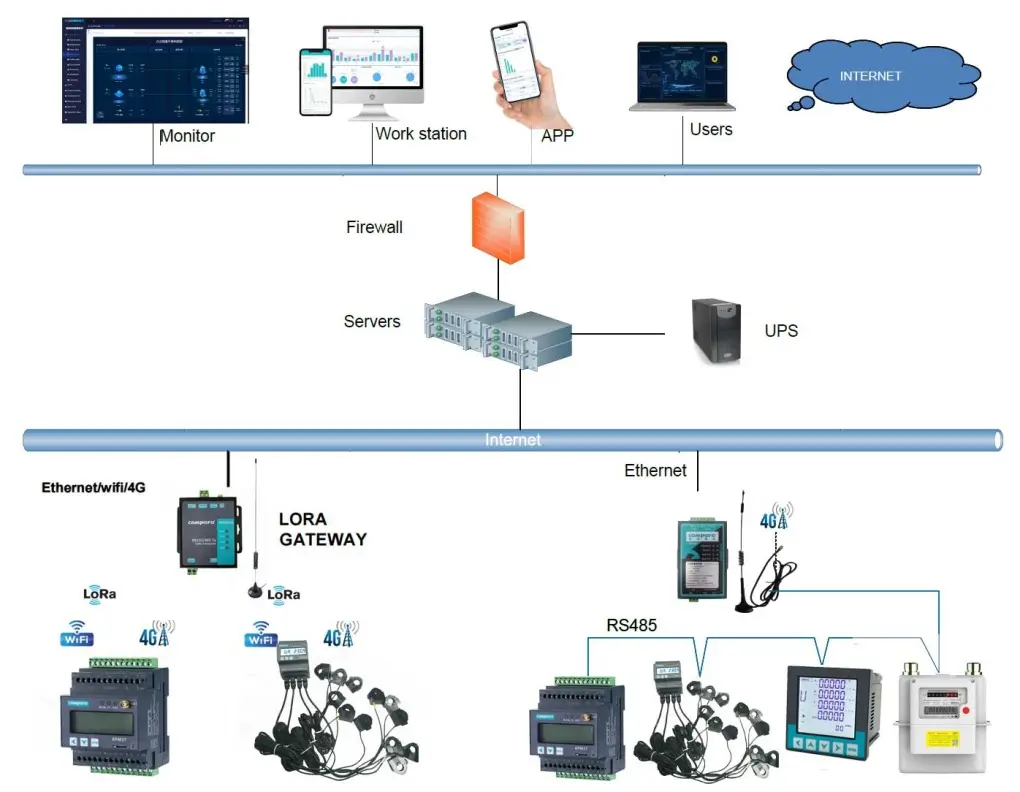
Topology: Dozens of smart meters on-site are connected daisy-chained via an RS485 bus, using the Modbus RTU protocol to access a local industrial gateway. The gateway sends data to the local EMS server via Modbus TCP.
Features: Extremely fast polling speed (down to seconds or even milliseconds), data never leaves the factory.
Solution 2: Pure Cloud Architecture (Modbus to MQTT Edge Gateway)
Topology: Deploy an edge IoT gateway. The gateway polls traditional meter data locally via Modbus, internally parses and packages the data into JSON format, and then sends it across the public network to the cloud server via the MQTT protocol.
Features: Solves the pain point of traditional meters “not being able to directly access the cloud”. Even with occasional public network outages, the edge gateway can utilize MQTT’s breakpoint resume function to resend historical energy consumption data to the cloud during the outage, ensuring the continuity of financial billing and carbon emission data.
Solution 3: Modern Hybrid Architecture (Native MQTT Direct Meter Connection)
Topology: Employs new energy smart meters with built-in 4G/5G modules or Ethernet ports, natively supporting the MQTT protocol. The meters directly publish data to the cloud IoT platform, while the local system can also obtain the high-frequency data required for control via the LAN.
Features: Eliminates intermediate gateways, significantly simplifying the system structure, making it ideal for spatially dispersed energy management scenarios such as distributed photovoltaic power stations and charging pile clusters.
Scenario-Based Selection Guide: Which Should You Choose?
To help you make the most appropriate decision, we have summarized common enterprise needs into the following decision model:
📈 Scenario A: Choose “Pure Local Architecture”
Typical Characteristics: National core energy enterprises, hazardous chemical plants, military units, large heavy industrial plants.
Core Requirements: Zero tolerance for data outflow; 100% system uptime during network outages; millisecond-level anti-islanding or circuit breaker linkage control required.
Technology Combination: Smart meter + RS485/Modbus RTU + Local server.
☁️ Scenario B: Pure Cloud Architecture
Typical Characteristics: Multinational chain retail, light industrial assembly plants, small and medium-sized commercial office buildings.
Core Requirements: Limited budget, lack of professional IT maintenance personnel, need for unified and collaborative management of energy consumption across hundreds of locations nationwide and horizontal benchmarking.
Technology Combination: Smart meter + Modbus to MQTT gateway + Cloud platform.
🌐 Scenario C: Hybrid/Edge Architecture (Trend Indicator)
Typical Characteristics: Modern large-scale manufacturing parks, data centers, microgrid projects integrating photovoltaic, energy storage, and charging systems.
Core Requirements: The system needs both rapid response from local edge devices for energy storage inverters and initial data cleaning, as well as powerful cloud-based AI computing for algorithm training, load forecasting, and digital dashboard display.
Technology Combination: Edge controller + MQTT gateway supporting edge computing + cloud-based energy management platform.
Conclusions and Recommendations
Choosing an energy management architecture is not a simple black-and-white question. “Leave control locally, leave intelligence to the cloud” is becoming an industry-recognized golden rule.
When deploying an energy management system, enterprises are advised to first classify data assets and analyze control latency:
For controls involving safe production, core processes, and millisecond-level联动 (interaction/coordination), resolutely implement localized or edge-based deployment.
For businesses involving carbon asset management, cross-regional energy efficiency optimization, and future load forecasting, actively embrace the cloud.