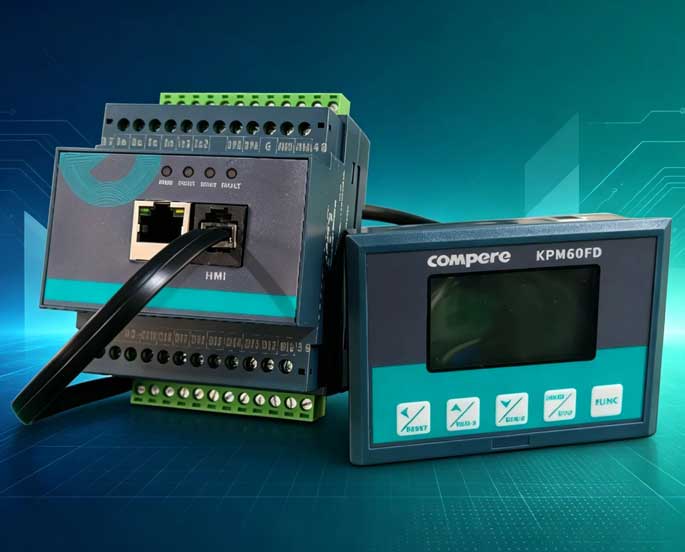
In industrial automated production, electric motors are the core power source, and their stable operation directly affects the entire plant’s capacity and efficiency. However, many maintenance engineers face these challenges: distribution cabinets are cramped, wiring is like a “spider web”; once a motor fails, troubleshooting is time-consuming, resulting in significant production line downtime and losses.
Can traditional integrated motor protectors truly meet the needs of modern industry? Today, we’ll discuss the revolutionary experience brought by split-type low-voltage motor protectors.
1. The Three Major Challenges of Traditional Integrated Protectors
Many factories still use traditional integrated protectors. While highly integrated, they have revealed several shortcomings in practical applications:
Installation Difficulty: The main unit and display are integrated, requiring installation inside a cabinet. In the narrow depths of the cabinet, it’s difficult to see the screen and operate the buttons.
Maintenance Difficulty: Once the display panel is damaged, replacement often requires complete disassembly or even a power outage and production stoppage.
Compatibility Difficulty: Different power motors require different current transformers, leading to high inventory pressure.
2. Split-Type Design: Giving Convenience Back to Operation and Maintenance
The core concept of the split-type design is “separation of man and machine, convenient installation.”
Our split-type low-voltage motor protector separates the main module from the display module:
The main module handles the “heavy lifting”: focusing on current acquisition and protection execution, it uses a 35mm DIN rail for mounting, is compact, and saves space.
The panel handles “easy interaction”: connected via a dedicated RJ11 interface, the display panel can be extended and installed on the cabinet door. No need to open the door, the operating status can be viewed at a glance.
3. More Than Just Split-Type, It’s Intelligent
In addition to the optimized physical structure, this product is also highly competitive in terms of functionality:
Full Parameter Measurement: Real-time monitoring of three-phase current, voltage, leakage current, active power, and energy.
Precise Protection Mechanism: Equipped with over 20 protection functions including overvoltage, undervoltage, phase loss, three-phase imbalance, locked rotor, and leakage current, with an action accuracy of up to 0.5 class.
Fault Traceability: Equipped with a black box function, it records the causes and waveforms of the last 20 faults, helping you quickly pinpoint the root cause of problems, rather than “fixing after it breaks down.”
For industrial enterprises that prioritize high reliability, choosing a split-type motor protector is not only an equipment upgrade, but also an upgrade to the operation and maintenance model.